

THIS PAGE WILL BE UPDATED WITH THE LATEST NEWS
UPDATE: 8:00 PM CEST
Demonstrators Gather Outside United Nations General Assembly

Demonstrators have lined the streets of New York City outside the United Nations headquarters, flying Iranian resistance flags Monday as world leaders converge for the 81st UN General Assembly this week.
The rallies, organized in part by the National Council of Resistance of Iran (NCRI), are timed to coincide with high-profile addresses from both President Donald Trump and Iranian President Masoud Pezeshkian. Protesters are demanding an end to political executions and repression in Iran, pushing for democratic freedom and regime change, and showing support for opposition leader Maryam Rajavi.
The demonstrations underscore the intense diplomatic and geopolitical tension framing this year’s assembly, as the U.S. and Iran remain locked in a months-long war.
The Iranian delegation faces strict movement restrictions imposed by the U.S. State Department while in Manhattan, limiting them strictly to their accommodations and UN headquarters.
Thousands Gather in NYC Outside UN to Protest Iran’s Continued Political Executions-Call for Democratic and Secular Republic

As world leaders gather in New York at the UN, they will be greeted by thousands of Iranian-Americans from across the U.S. who are expected to protest the ongoing political executions in Iran.
Maryam Rajavi, the president-elect of the National Council of Resistance of Iran (NCRI), has organized the rally, set for when President Trump is scheduled to address the Assembly. The rally will turn into a protest on Wednesday when Iranian President Masoud Pezeshkian is set to speak. They are there to demand an end to executions in Iran and to oppose Iranian President Masoud Pezeshkian, addressing the UN, noting he does not represent Iranians.
They are also advocating for a democratic and secular republic.
A smaller protest was held on Monday outside Pezeshkian’s New York hotel.
Organizers say Tehran has ramped up hangings while the regime is weak and society is restless, and cite hundreds of executions this Iranian year.
UPDATE: 7:30 AM CEST
Amnesty Report Exposes the State Machinery Behind Iran’s 2022 Crackdown
Four years after Iran’s 2022 nationwide uprising, the regime is still trying to evade accountability for its brutal crimes against humanity. Security forces killed hundreds of protesters, injured thousands, and arrested tens of thousands to suppress demonstrations that spread across the country following the death in custody of Mahsa Zhina Amini.
A new investigation by Amnesty International now provides one of the most detailed reconstructions yet of how that crackdown was organized. Published on September 16, 2026, the more than 1,000-page Architects of Atrocities report examines not only what security forces did on the streets, but also the institutions, officials, orders, and command structures behind the repression.
Amnesty concludes that Iranian authorities committed crimes against humanity while suppressing the uprising and identifies 87 officials who it says should face criminal investigation. Its findings are based on years of research, including interviews with 270 people, analysis of more than 2,000 videos, leaked official documents, prosecution orders, court verdicts, and forensic records.
The Bulldozers Can’t Bury the Truth in Iran

When a dictatorship starts demolishing its prisons and bulldozing its mass graves, the world should ask a simple question. What is it frightened of? The Iranian regime has begun demolishing Gohardasht Prison in Karaj, one of the most infamous sites of political repression in the Islamic Republic.
Iranian state media reported this month that the prison walls would be demolished, and the site prepared for development. But Gohardasht is far more than redundant real estate. It is a crime scene.
During the summer of 1988, political prisoners were hauled before so-called Death Commissions. Hearings often lasted only minutes. Thousands were subsequently executed in prisons across Iran. The People’s Mojahedin Organization of Iran (PMOI/MEK) estimate that around 30,000 political prisoners were murdered nationwide, the great majority members or supporters of the PMOI and National Council of Resistance of Iran (NCRI).
Amnesty International has documented the killing of several thousand prisoners and regards the executions and continuing enforced disappearances as crimes against humanity.
Why Iran’s Regime Fears the Reopening of Schools and Universities
As Iran’s new academic year begins, officials of Iran’s regime are once again warning about the political dangers they see inside schools and universities. The language is striking: Rather than describing educational institutions simply as places of learning, regime officials portray them as strategic spaces that could be “conquered” by an alleged enemy.
Speaking at Friday prayers in Bojnurd, regime cleric Reza Nouri warned education officials to remain vigilant, saying that the “enemy” was seeking to “conquer” the education system, universities, and other educational centers. He called on teachers, administrators, and officials to work together to “sanitize” the educational environment and urged them to enlist students and university students in that effort.
The warning raises a basic question: Why does the reopening of schools and universities generate such anxiety for Iran’s regime?
The answer lies in the political significance that educational institutions have acquired over decades of confrontation between Iranian society and the ruling system.
From “Javid Shah” to the Ballot Box: What Does Reza Pahlavi Mean by a Monarchy Decided by Vote?
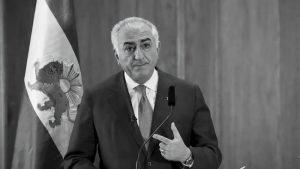
Reza Pahlavi’s latest remarks about the slogan “Javid Shah” have triggered renewed debate among Iranians, particularly across the diaspora, over what kind of political future his movement envisions for Iran.
Speaking at a gathering identified as Cyrus 2, Pahlavi said:
“Javid Shah is a slogan of support. Let’s make it so that the day the ballot box is established in Tehran, it becomes a vote rather than a slogan.”
The statement is significant because it links an explicitly monarchist slogan—“Long Live the Shah”—with the future establishment of a ballot box in Iran.
The issue is not whether monarchists have the right to advocate their preferred political system. In a genuinely free Iran, they should have that right, just as republicans and other democratic political currents should have the right to organize, campaign, and compete.
The fundamental question is different: Would the ballot box be genuinely free to reject the monarchy, or is the electoral process being presented as the mechanism for converting an existing monarchist movement into political legitimacy?
That distinction matters.
Iran: Student Najmeh Amini Sentenced to Death After 8 Months in Limbo, Fair Trial Denied
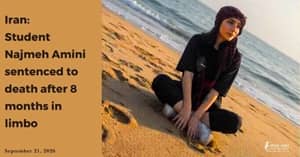
The issuance of a death sentence against Najmeh Amini, a 23-year-old accounting student detained in the women’s ward of Vakilabad Prison in Mashhad, has ignited a new wave of grave concern over the Iranian judiciary’s accelerated deployment of hasty, repressive verdicts against protesters and civil activists.
Documented information and an audio message transmitted by this political prisoner indicate that the investigation, trial, and issuance of her death sentence were marked by gross violations of fundamental human rights, denial of access to a fair trial, and reliance on vague security accusations.
- Violent Arrest and Prolonged Arbitrary Detention
Najmeh Amini was arrested on Saturday, 31 January 2026 (11 Bahman 1404), near Ferdowsi Bazaar in Mashhad, suffering severe physical beatings by state security forces.
According to human rights reports:
- Following her arrest, she was held in isolation in the security ward of Vakilabad Prison in Mashhad for nearly three months.
- She remained in a state of severe administrative and judicial limbo for 8 months, deprived of basic rights guaranteed to detainees.
- Heavy Security Charges
Throughout her detention and interrogation, security and judicial authorities leveled a series of security and criminal charges against the 23-year-old student—charges that raise widespread human rights concerns.
Iran’s Parliament Speaker Criticizes “Endless War” as Debate Grows Over Talks and the Strait of Hormuz
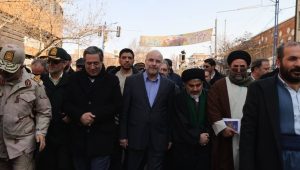
Iran’s parliament speaker has defended a combination of war and diplomacy, while Kayhan argues that ending the war depends on preserving the “will to resist.”
Mohammad Bagher Ghalibaf, Iran’s parliament speaker and the head of Tehran’s negotiating team in talks with U.S. officials, has criticized forces inside the country that favor continuing the war without offering a way to end it, a position that, amid debate over reopening the Strait of Hormuz, has highlighted differences within the Islamic Republic’s political and media establishment over how to bring the conflict to an end.
In a speech to parliament, Ghalibaf said: “There is a view in the country that talks about war but has no prospect or mechanism for bringing it to a strong conclusion.” He added that rejecting engagement and diplomacy could push the country toward “attrition and endless war.”
At the same time, he rejected an approach that would pair negotiations with retreat in the face of the United States, saying: “The choice between war or negotiations is not a real one; rather, we must both fight and negotiate.”
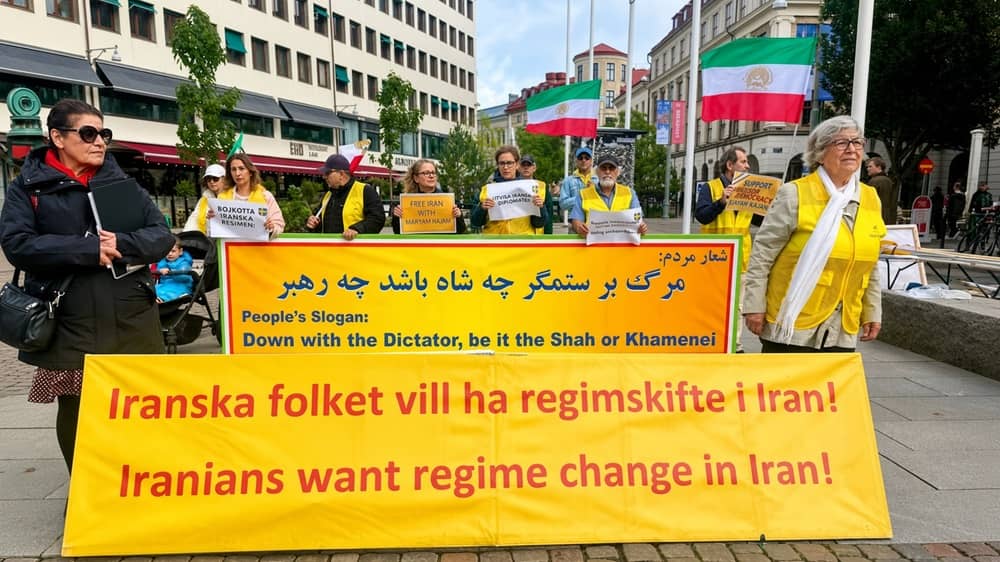
Gothenburg Rally Marks Fourth Anniversary of Iran’s 2022 Uprising, Calls for a Democratic Republic
Gothenburg, September 19, 2026 — Supporters of the People’s Mojahedin Organization of Iran (PMOI/MEK) held a rally in Gothenburg to mark the fourth anniversary of Iran’s nationwide uprising of September 2022.
Demonstrators voiced their support for the Iranian people’s struggle for freedom and their rejection of all forms of dictatorship. They denounced both the former monarchical dictatorship and the current clerical dictatorship ruling Iran, emphasizing that the Iranian people seek neither a return to the past nor the continuation of the present regime, but a democratic future.

The participants expressed their support for the organized Iranian Resistance and its democratic alternative, based on Mrs. Rajavi’s Ten-Point Plan, which calls for the establishment of a democratic republic in Iran based on freedom, human rights, and the separation of religion and state. They also called on the international community to recognize the Iranian people’s organized resistance and to hold the clerical regime accountable for its crimes and human rights violations in Iran, stressing that impunity for those responsible for the repression and killing of protesters must end.
Iranian Resistance Supporters in Malmö, Sweden Denounce Executions and Back the NCRI Alternative
Malmö, Sweden – September 19, 2026: Supporters of the Iranian Resistance (PMOI and NCRI) held a rally and photo exhibition to protest the Iranian regime’s continued use of the death penalty and draw international attention to the plight of political prisoners and protesters facing execution.

Participants strongly denounced the actions of Iran’s ruling clerical regime, calling the executions a clear violation of fundamental human rights. Demonstrators honored the victims by displaying their photographs and called on the Swedish government to close the Iranian regime’s embassy in Sweden, as a center for espionage and terrorism targeting freedom-seeking Iranians, particularly supporters of the Iranian Resistance. They reaffirmed their determination to continue the struggle against the regime until its overthrow and the establishment of a democratic republic founded on peace, freedom, and justice.
PMOI Supporters in Heidelberg Condemn Executions and Call for Accountability of the Mullahs’ Regime
Heidelberg, Germany – September 19, 2026 – Supporters of the People’s Mojahedin Organization of Iran (PMOI/MEK) held a book table and photo exhibition in Heidelberg to protest the Iranian regime’s continued use of the death penalty and draw international attention to the plight of political prisoners and protesters facing execution.

Participants called for immediate and decisive international action to save the lives of political prisoners and protesters arrested during recent protests who are facing execution. They urged the international community to act swiftly to prevent further executions and to exert effective pressure on the Iranian regime to halt the use of the death penalty as an instrument of repression.
PMOI Supporters in Hamburg Call to End Executions and the Death Penalty in Iran
Hamburg, Germany – September 19, 2026: Supporters of the People’s Mojahedin Organization of Iran (PMOI/MEK) held a book table and photo exhibition in Hamburg to denounce executions carried out by Iran’s ruling regime and call for an end to the death penalty.

The participants urged the international community to take concrete action to halt executions in Iran and condemned the execution of PMOI political prisoners, as well as the continued detention and prosecution of protesters arrested during the January 2026 uprising. The event also expressed solidarity with the “No to Executions” campaign, which calls for an end to the use of the death penalty in Iran.