

THIS PAGE WILL BE UPDATED WITH THE LATEST NEWS
UPDATE: 6:30 PM CEST
Waltz Says Iran Wanted Sanctions Relief Up Front in Rejected Deal; Tehran Pushes Back

Mike Waltz, U.S. ambassador to the United Nations, said Sunday that President Donald Trump rejected Iran’s latest proposal because Tehran wanted sanctions relief and access to “billions in frozen assets” before negotiating an end to its nuclear program.
“They were asking for everything up front, with a promise that they would then talk,” Waltz said on CNN’s “State of the Union” when asked what Trump objected to.
In a separate interview on NBC’s “Meet the Press,” Waltz called the proposal “a pretty cynical attempt to put something on the table that they knew was unacceptable.” He said the U.S. would ultimately need to reach “some type of agreement” with Iran, but Trump would keep all options on the table.
Iranian Foreign Minister Abbas Araghchi, in an interview later on the same NBC program, pushed back on Waltz’s account and told host Kristen Welker that Iran was prepared to open the strait if the U.S. met its conditions, including releasing frozen assets and allowing Iranian oil sales.
“I am surprised that the ambassador is talking about a seven-day plan, as he has not read it,” Araghchi said. “Maybe he has not been given a copy.”
UPDATE: 5:00 PM CEST
Drug Shipment from Iran to Russia Intercepted in Azerbaijan
As a result of comprehensive operational-search measures and customs controls carried out by officers of the State Customs Committee’s Astara Customs Department, the transit of a particularly large quantity of narcotics through Azerbaijan has been prevented.
“Operative Information Center-OMM”, citing the committee, reports that a truck carrying a consignment of “peaches” from Iran to Russia was stopped on the import inspection line at the Astara customs post and placed under customs control.
The vehicle was inspected using a stationary X-ray scanner and a customs service dog. The inspection revealed packages concealed inside the cargo.
During the inspection, 104 packages shaped like “peaches” containing 51 kilograms and 906 grams of marijuana by net weight were found hidden from customs control.
Remarks by the Honourable Anita Anand, Minister of Foreign Affairs, to the United Nations General Assembly – September 26, 2026

Canada’s position on Iran is unequivocal: Iran is the principal threat to peace and security in its region, and it must never acquire a nuclear weapon.
Iran’s threats to navigation rights in the Strait of Hormuz are a direct affront to international law – and we join our Gulf and European partners in strongly condemning Iran’s attacks in the region.
And Canada is deploying every available tool, including targeted sanctions that I announced this week, to confront the Iranian regime’s abhorrent behavior.
Here at the United Nations, Canada will again lead the resolution in the General Assembly on human rights in Iran.
Because we stand firmly with the Iranian people against repression, and for human rights, dignity, and aspirations for a better life.
UPDATE: 10:00 AM CEST
Resistance Units in Zahedan Commemorate Bloody Friday and September 27 Uprising
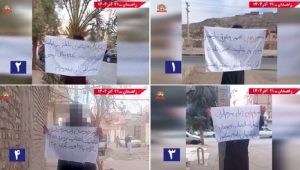
On September 25, 2026, PMOI/MEK Resistance Units in Zahedan, southeast Iran, marked two key anniversaries: the September 30, 2022, “Bloody Friday” crackdown in Zahedan and the September 27, 1981, confrontation between PMOI fighters and the clerical regime in Tehran.
As part of their weekly anti-regime activities, Resistance Units displayed placards in public places despite the presence of security forces and measures aimed at suppressing opposition activities. Their messages combined remembrance of those killed in Zahedan with tributes to PMOI members killed in September 1981.
One placard declared, “Despite the highest number of martyrs, the oppressed warriors and brave Baluch people roar: From Zahedan to Tehran, my life for Iran!” Another read, “Salute to the martyrs and the oppressed people of Sistan and Baluchestan.”
Zahedan’s Bloody Friday took place on September 30, 2022, during the nationwide uprising that had begun earlier that month. After Friday prayers, security forces opened fire on protesters and civilians in Zahedan. More than 100 people, including children, with hundreds more wounded.
Iranian Youth Conference in New York Discusses Freedom, Human Rights, and Iran’s Democratic Future
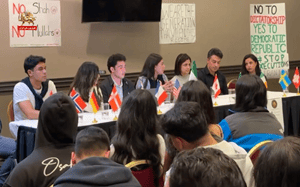
Against the backdrop of the United Nations General Assembly and two days of demonstrations by Iranian supporters of the Resistance in New York, a coalition of young Iranians held a conference titled “What Does a Free Iran Mean for Our Generation?”
The gathering brought together young Iranians from the United States, Canada, and several European countries to discuss Iran’s human rights crisis, the continuing wave of executions, the prospects for a free and democratic Iran, and the role of younger generations in shaping the country’s future.
Rather than focusing exclusively on opposition to the current regime, participants sought to address a broader question: what should replace repression, and what principles should define Iran’s future?
The discussion began from a clear set of principles: no to executions, no to torture, and yes to a free Iran.
Participants argued that the conversation about Iran should extend beyond the issues that dominate international discussions, such as nuclear policy, sanctions, regional security, diplomacy, and relations between governments.
Iran Regime Puts 51,000 Security Forces on Alert Amid Fear of Renewed Unrest

Iran’s regime has placed its military and security apparatus on heightened alert and canceled personnel leave through September 27, according to information released by the National Council of Resistance of Iran (NCRI). The measures include the deployment of 51,000 security and suppressive forces in Greater Tehran, expanded patrols and surveillance, new detention facilities, and increased financial incentives for security personnel.
The reported measures offer a detailed picture of the regime’s preparations for possible unrest at a time when economic and social grievances remain widespread across Iran.
According to the NCRI statement, the Army, Islamic Revolutionary Guard Corps (IRGC), Basij, and State Security Force (SSF) have been placed on 100-percent alert. Personnel leave has been canceled until midnight on September 27, with the measure subject to extension depending on “social conditions and political developments.”
The most significant element of the reported security preparations is the deployment of 51,000 forces to control Greater Tehran.
According to the NCRI, the force consists of approximately 21,000 SSF personnel and 30,000 members of the IRGC and Basij.
Rising Number of Out-of-School Children in Iran and Its Various Causes

With the start of the new school year, images of crowded classrooms and enrollment ceremonies were published across the country. However, a significant number of children still remain outside the education system.
The 2026-2027 school year began on September 23 with the reopening of more than 124,000 schools across the country. According to the Ministry of Education, more than 16.5 million students attended classes. About 83% of these students are enrolled in public schools.
Education officials also usually speak of efforts to identify out-of-school children alongside announcing enrollment figures. However, experts’ main question is whether simply announcing the enrollment rate is sufficient. It must be determined what happened to each child absent from school and why they were deprived of their right to education.
According to the latest announcement by the Ministry of Education, 140,562 out-of-school children were identified during the previous school year. About 41,000 had also left the country. Meanwhile, nearly 18,000 had severe disabilities that prevented them from attending school. Despite these exclusions, a significant number of children still require follow-up.
Rare Disease Patients in Iran Reach 3 million

The addition of 18 new diseases to the official list has brought the number of recognized rare diseases in Iran to 531.
At the second meeting of the specialized commission of Iran’s Rare Diseases Foundation in 2026, 18 of the 22 cases registered in the Sabna system were approved, bringing the number of recognized rare diseases to 531. One case was removed from the list because it did not conform to the scientific definition. The figures once again highlight gaps in diagnosis, access to medicines, insurance, and financial support.
Mohammad Raiszadeh, head of the Iranian regime’s Medical Council, has estimated the number of people with rare diseases in Iran at nearly 3 million. This estimate shows that the issue extends beyond a handful of scattered cases and has become a national challenge. An expanded scientific list has meaning for patients only when it leads to early diagnosis, timely referrals, and accessible treatment and the funding needed for care.
Iran’s Seven-Day Proposal for US Talks Draws Hardline Backlash in Tehran

Tehran’s proposal to halt hostilities, reopen the Strait of Hormuz and resume nuclear talks has received conditional support from some senior military figures, while lawmakers and hardline media have challenged Foreign Minister Abbas Araghchi’s contacts with the US side.
While Iranian Foreign Minister Abbas Araghchi has presented a seven-day plan in New York to halt hostilities, reopen the Strait of Hormuz and resume talks with the United States, and several senior military figures have said negotiations alongside military power are acceptable, hardline lawmakers have questioned the legitimacy of his contacts with the US side and called for his impeachment, while media outlets such as Kayhan describe negotiations under the current circumstances as a “deception operation.”
On the sidelines of the United Nations General Assembly, Araghchi said Tehran had presented Washington, through mediators, with a proposal under which the Strait of Hormuz would reopen at the end of the seventh day and negotiations would resume if Iran’s conditions were met. “We have presented the United States, through mediators, with a plan under which, if certain conditions are met, the Strait of Hormuz will reopen at the end of the seventh day and negotiations will resume,” he said.