

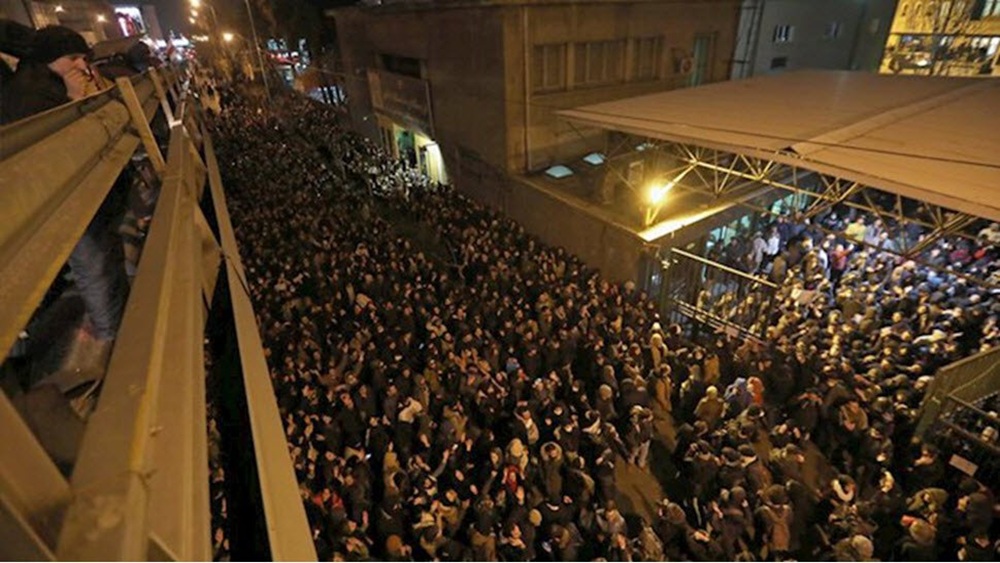
On the 20th consecutive day of Iran’s nationwide uprising, the clerical regime has intensified its efforts to isolate the country from the world, implementing a digital blockade of unprecedented scale. According to global internet monitor NetBlocks, the total internet blackout in Iran has now exceeded 180 hours, surpassing the duration of the notorious shutdown during the November 2019 massacre. Despite this information vacuum and the implementation of undeclared martial law in major cities, reports leaking out on Thursday, January 15, and Friday, January 16, confirm that the regime has failed to silence the streets.
Tehran Under Siege: A Capital Garrisoned
The capital has been transformed into a military garrison. Reports from Tehran indicate that the regime, fearful of the escalating momentum of the protests, has deployed heavy security contingents across the metropolis. ‘NOPO’ special forces have blockaded Jomhouri Square and its surrounding arteries. In neighborhoods including Pirouzi, Gorgan, Naziabad, Yousefabad, Sattar Khan, and the First and Third Squares of Tehranpars, security forces have established a suffocating presence. Twenty-four-hour motorcycle patrols, equipped with Kalashnikovs and shotguns, are now a fixture in these districts.
Yet, the heavy boot of the security apparatus has not deterred the population. On Wednesday and Thursday nights, defiant youths in the Pirouzi and Tehranpars districts engaged in hit-and-run clashes with suppressive forces, chanting anti-regime slogans. In a significant escalation in Qolhak, rebellious youths set fire to an ammunition depot belonging to the Islamic Revolutionary Guard Corps (IRGC) and the paramilitary Basij.
Escalation in the Provinces: Tanks in the Streets
While Tehran remains under a security lockdown, the situation in the provinces indicates the regime is losing its grip on local governance. In Khorramabad, western Iran, authorities have resorted to deploying tanks at key points throughout the city, a desperate measure reportedly driven by the fear that government buildings were on the verge of falling into the hands of protesters.
In Rafsanjan, the unrest has targeted the economic symbols of the theocracy. On Thursday night, youths engaged in clashes with special units, setting ablaze the local offices of the Imam Khomeini Relief Committee, the post office, and a state-owned bank. Similar scenes of defiance played out in Kermanshah, Islamabad-e Gharb, and Ilam, where hit-and-run battles continued late into the night. Reports suggest that state forces have effectively lost control over parts of the mountainous regions in these areas.
January 2026—Dezful, southwest Iran
Newly obtained video shows security forces using firearms against civilians during the nationwide uprising.#IranProtests pic.twitter.com/MaifeN2Iqh— People's Mojahedin Organization of Iran (PMOI/MEK) (@Mojahedineng) January 16, 2026
Evidence of the regime’s brutality continues to emerge despite the digital blockade. New video footage from Dezful, Khuzestan province, captured at the city’s Imam Square (formerly Saat Square), shows security forces firing live ammunition directly at unarmed protesters—a tactical choice that underscores the lethal intent behind the crackdown.
Zahedan: The Friday of Resistance
In the restive southeast, the city of Zahedan witnessed a massive show of force by the state on Friday, January 16. Following the weekly Friday prayers at the Makki Mosque, the regime saturated the city with military personnel. Checkpoints were established at all entry and exit routes, where citizens were subjected to body searches and invasive inspections of their mobile phones.
January 16—Zahedan, southeast Iran
Heavy presence of security forces in fear of anti-regime protests.#IranProtests pic.twitter.com/z5Z9ctLN60— People's Mojahedin Organization of Iran (PMOI/MEK) (@Mojahedineng) January 16, 2026
Despite this intimidation, thousands of Baluch citizens poured into the streets. Chanting “Death to Khamenei” and “Death to the dictator,” the protesters turned their weekly religious gathering into a political rally. Maryam Rajavi, the President-elect of the National Council of Resistance of Iran (NCRI), praised the resilience of the Baluch people, stating that they had “once again ignited the flames of Iran’s uprising” amidst a “heavy security presence.”
The Human Cost: Names Behind the Numbers
The crackdown has exacted a heavy toll. The People’s Mojahedin Organization of Iran (PMOI/MEK) has begun identifying the victims of the regime’s fire. Among the confirmed dead are:
- Zahra (Raha) Bohlouli-Pour, an 18-year-old student at the University of Tehran, shot dead on Fatemi Street on January 8.
- Diar Pour-Chehriq, 32, a self-employed tradesman, killed in Tehran.
- Yasin Mirzaei Qaleh Zanjiri, a student killed in Kermanshah.
- Reza Ghanbari (17), Rasoul Kadivarian (17), and Reza Kadivarian (20), workers killed during clashes in Kermanshah on January 3.
🚨 BREAKING | Iran Protests — Resistance Units Identified
The @Mojahedineng has identified members of its brave Resistance Units who were killed by regime fire during the nationwide uprising:• Zahra (Raha) Bohlouli-Pour, 18, University of Tehran student — shot dead on Jan 8,… pic.twitter.com/I0OcVTjRdG
— SIMAY AZADI TV (@en_simayazadi) January 15, 2026
In Abdanan, Ilam province, the funeral of teenager Alireza Seidi transformed into a massive anti-regime demonstration. Thousands of mourners chanted, “I will kill the one who killed my brother” and “This is the year of blood; Seyed Ali [Khamenei] will be overthrown.”
Global Isolation Deepens
As the regime turns its weapons on its own citizens, its diplomatic isolation is accelerating. On Thursday, Portugal announced the closure of its embassy in Tehran, citing “tension” and violent repression, while urging its nationals to leave the country. The Portuguese Foreign Minister indicated readiness to join tightened EU sanctions against Tehran.
🚨 Iran News Update
BIPARTISAN LETTER FROM U.S. CONGRESS — REJECTING ALL DICTATORSHIPIn a letter sent by 59 Members of the U.S. Congress from both parties — including 3 committee chairs and 16 subcommittee chairs — lawmakers wrote to Marco Rubio:
“The Iranian people have made… pic.twitter.com/t02UALR8WO
— SIMAY AZADI TV (@en_simayazadi) January 16, 2026
Simultaneously, international political support for the Iranian people’s desire for regime change is crystallizing. In the United States, a bipartisan group of 59 Members of Congress sent a letter to State Secretary Marco Rubio, explicitly rejecting both the current theocratic dictatorship and the former monarchy. The lawmakers emphasized that the Iranian people seek a “secular, democratic, non-nuclear republic.”
Elsewhere, Marko Mihkelson, Chairman of the Foreign Affairs Committee of the Estonian Parliament, described the current crackdown as “the bloodiest suppression of protests in modern history,” demanding concrete action from the free world. Australia’s Foreign Minister, Senator Penny Wong, also issued a condemnation, advising all Australians to leave Iran immediately.
As the uprising enters its third week, the regime is acting out of desperation rather than strength. The slogans echoing from Abdanan to Zahedan indicate that the Iranian people have moved past the point of fear, viewing the current struggle not merely as a protest, but as a final push to overthrow the theocracy.