
Three-minute read
A fatal accident involving oil-industry workers erupted into an anti-regime demonstration in Abdanan on November 17, with protesters demanding officials’ resignations and chanting against the ruling establishment. The unrest coincided with fresh disclosures of deteriorating roads, severe monetary instability, failures in pensioners’ healthcare and intelligence penetration of the regime’s security institutions.
Abdanan Protest Turns Against the Regime
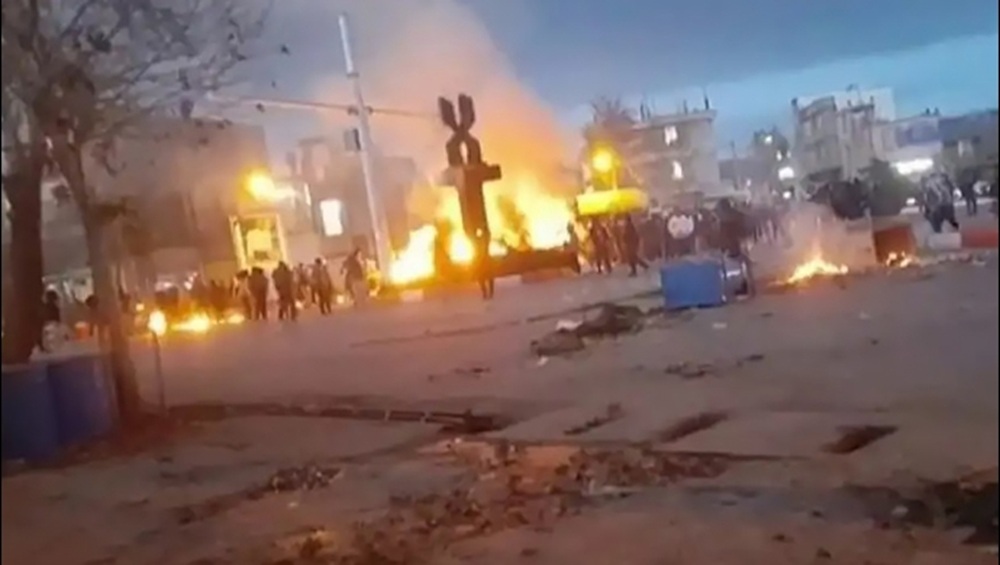
Hundreds of residents demonstrated in Abdanan following the deaths of 13 workers from the Dehloran oil and gas project in a November 14 bus crash.
Even the IRGC-run Fars news agency acknowledged that the gathering expanded from approximately 200–300 participants to around 1,000, with slogans taking a political turn.
Videos showed protesters chanting “Death to the dictator,” “Resign, resign,” and “Poverty, corruption, high prices—we will fight until overthrow.” Some protesters also tore down security-related banners, while reports described shopkeepers closing their businesses in solidarity.
The city’s security council warned against gatherings it deemed disruptive. The protest revived the political defiance seen in Abdanan during January’s nationwide uprising.
#IranProtests erupt in Abdanan after a bus crash claims 13 workers’ lives.
What began as mourning and demands for accountability has turned into a political protest, with demonstrators taking to the streets and chanting against the authorities.The November 14 tragedy involved…
— NCRI-FAC (@iran_policy) November 17, 2026
Officials Admit Road Neglect Behind Mounting Death Toll
A senior Road Maintenance Organization official acknowledged on November 17 that 25% of Iran’s roads are deteriorating, with rehabilitation requiring an estimated 500 trillion tomans.
Hassan Jahanian admitted that the latest comprehensive road-quality assessment dated to 2024, despite worsening infrastructure conditions.
In the Dehloran accident, police identified unsafe driving, irregularities in the transport contract and inadequate road-safety infrastructure as contributing factors. Provincial authorities scrambled to claim they have initiated legal proceedings concerning the transport company and road administration.
The disaster follows official figures showing more than 10,000 road deaths and 224,000 injuries during the first six months of the Iranian year. Despite repeated warnings about dangerous roads and vehicles, the authorities have failed to address the structural causes of the country’s persistent road-fatality crisis, adding yet another grievance to the growing list of hardships fueling public anger against the regime.
"A society can endure for years without accepting the conditions imposed on it—but when accumulated anger finally breaks through, the result may be sudden, nationwide and far harder to contain," @MansoreGolestan writes.https://t.co/BYM0Pzydhe
— NCRI-FAC (@iran_policy) November 15, 2026
IRGC Commander Acknowledges Security Penetration
In a November 16 interview with Defa Press, senior IRGC commander Mohammad-Jafar Asadi acknowledged intelligence penetration of the Revolutionary Guards, Intelligence Ministry, state broadcasting and other institutions.
“Infiltration has occurred at high levels,” he declared.
Asadi described vulnerabilities involving surveillance cameras, mobile phones, electronic prescriptions, fuel transactions and airline reservations. He claimed that foreign intelligence services could exploit these systems to track Iranian officials.
His remarks expose continuing concern within the security establishment over intelligence failures following the deaths of senior officials during the war.
Fuel shortages spark unrest, retirees and workers protest across multiple cities, and parliament advances penalties against cooperation with Persian-language media. The intelligence-minister dispute persists as lawmakers warn of worsening #inflation. Twelve oil workers die in a…
— NCRI-FAC (@iran_policy) November 16, 2026
Parliament’s Internal Conflicts Intensify
Factional disputes continued after lawmakers disclosed competing efforts to undermine the government through parliamentary procedures.
MP Majid Nasirpour complained that the administration faced 32 impeachment initiatives, more than 350 investigations and over 5,000 parliamentary questions. He challenged colleagues who had claimed that removing a previous economy minister would resolve the economic crisis.
Another lawmaker, Ahmadi, demanded judicial action against former and serving officials accused of promoting concessions to foreign adversaries.
The dispute extends to state broadcasting, which Nasirpour accused of spreading despair, amid competing efforts to use the broadcaster to influence the establishment’s internal struggle.
These exchanges reveal how rival factions increasingly employ parliamentary proceedings, prosecution threats and state-controlled media against one another.
"#Women make up approx. 64% of university applicants, yet barely one in seven participates in Iran’s labor market. The contradiction is not merely social discrimination. It is the destruction of human capital on a national scale," writes @SaforaSM https://t.co/fg7WBiayQ3
— NCRI-FAC (@iran_policy) November 14, 2026
Central Bank Admits Severe Monetary Expansion
Central Bank Governor Abdolnaser Hemmati told parliament on November 17 that monetary-base growth had reached approximately 80% before declining to around 65%.
Separate monetary figures published November 16 placed year-on-year monetary-base growth at 89.9% in September.
Official annual inflation reached 76.8% in October, while the government spokesperson acknowledged that wage increases could lose their purchasing-power gains within six months.
The figures highlight the erosion of incomes as inflation continues outpacing wages, pensions and limited government assistance.
Iran, Nov. 13: Fuel-card restrictions expand toward nationwide implementation. Cement workers report up to seven months of unpaid wages, bakeries face flour cuts, #women remain denied motorcycle licences, and Tehran officials acknowledge losing up to 45% of trees in a major…
— NCRI-FAC (@iran_policy) November 13, 2026
Pensioners Protest as Healthcare Payments Remain Unsettled
Iran Air retirees demonstrated in Tehran and regional branches on November 17 over interrupted medical insurance, unpaid treatment expenses and suspended welfare benefits.
Separately, labor council representative Mohsen Bagheri disclosed that the Social Security Investment Company, Shasta, was financing documentary production while supplementary medical-insurance payments to retirees had reportedly remained unsettled for ten months.
Bagheri also criticized delayed payments owed to physicians and pharmacies, warning that these debts were disrupting medical services.
Gasoline Restrictions and Winter Energy Shortages
On November 17, the National Iranian Oil Products Distribution Company confirmed implementation of its third gasoline allocation in 11 provinces, priced at 10,000 tomans per liter. Officials claimed gasoline consumption had declined 3%.
The announcement conflicts with continuing citizen reports of lengthy filling-station queues and serious difficulties obtaining fuel.
Why Iran’s ruling establishment has turned nightly street mobilization into a permanent instrument of political survival. By @HakamianMahmoud https://t.co/u8owHP6TZv
— NCRI-FAC (@iran_policy) November 17, 2026
The Abdanan uprising illustrates a danger that the regime cannot eliminate through administrative measures or displays of military strength: an ordinary tragedy can rapidly become a confrontation over political authority when public anger has already accumulated.
The establishment’s internal disputes and admitted intelligence vulnerabilities further complicate its ability to respond coherently. While officials remain preoccupied with preserving control, deteriorating infrastructure, inflation and the breakdown of essential benefits continue to undermine the population’s willingness to endure the consequences of their rule.
The regime faces an increasingly difficult combination of political fragmentation above and social volatility below. Abdanan demonstrates how little may be needed for that volatility to surface.