

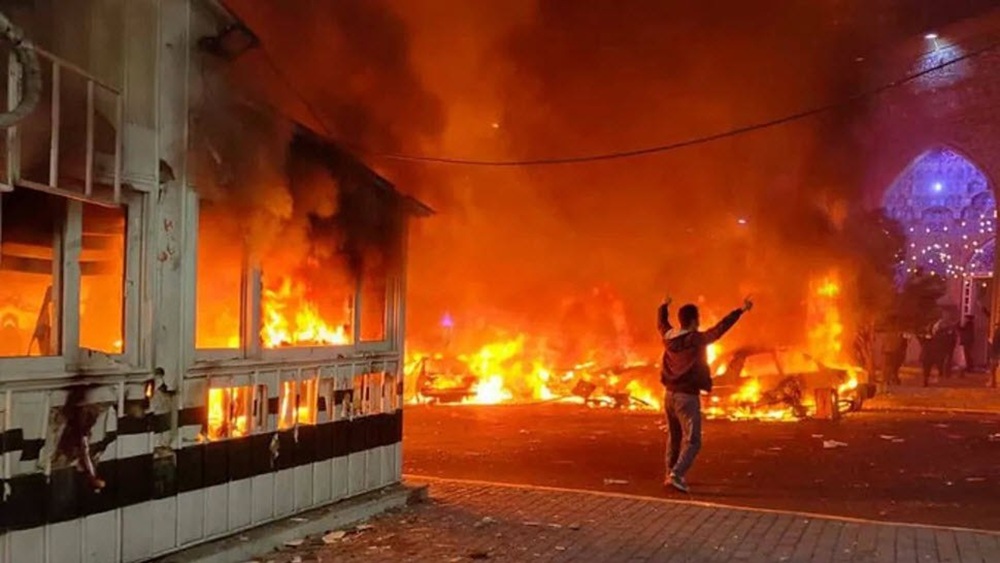
Despite a draconian internet blackout and intensified security measures, the nationwide uprising in Iran has entered a new, more volatile phase as of late January 2026. While the regime attempts to project control, internal admissions by high-ranking officials reveal a different reality: one where the state’s propaganda infrastructure is being dismantled by protesters, university students are engaging in nationwide strikes, and the economy is imploding under the weight of corruption and mismanagement.
“Apparatus of Lies” Under Fire
In a rare and telling admission of vulnerability, Peyman Jebelli, the head of the regime’s state television and radio (IRIB), acknowledged on January 31 that the network’s facilities have come under sustained attack. Speaking with evident concern, Jebelli confirmed that “rioters”—the regime’s pejorative term for protesters—have targeted IRIB centers in multiple provinces.
According to the IRIB chief, the most severe damage occurred in Kish and Mashhad, though attacks were also reported in Qazvin, Isfahan, Gorgan, and Alborz. The operations specifically targeted the regime’s ability to broadcast its narrative. Jebelli admitted that live broadcasting equipment and mobile transmission units were set on fire and “completely destroyed.” He specifically highlighted the destruction of a mobile unit in Gorgan, which had been used just a week prior to cover a state-sponsored propaganda program titled “Iran Jan Golestan.”
These attacks signify a strategic shift in the uprising. By targeting the IRIB, protesters are dismantling the “Voice of Repression,” the primary tool used by the mullahs to censor news of the dissent and broadcast forced confessions.
As the nationwide uprising in Iran pushes through late January, the clerical regime has intensified its dual strategy of brutal suppression on the streets and a suffocating information #blackoutinIran designed to conceal the scale of its crimes.https://t.co/3GICmfMfEH
— NCRI-FAC (@iran_policy) January 30, 2026
Field Reports: Resistance in the Streets
Due to the severe internet restrictions imposed by the regime to hide the scale of the unrest, reports from earlier in the month are only now reaching the outside world. These reports, dating from January 8 to January 10, depict a fearless confrontation between the youth and the regime’s suppression forces.
In the city of Saveh, on January 8, the conflict intensified significantly. Defiant youth targeted a Special Unit water cannon—a symbol of crowd control and intimidation—disabling it completely. Later that same day, at the city’s Mokhaberat Square, nine vehicles belonging to the Islamic Revolutionary Guard Corps (IRGC) were set ablaze. Reports from the scene indicate that the intensity of the youth’s counter-offensive forced the security forces to flee the area.
Similar acts of defiance were recorded across the country. In Talesh, on January 8, protesters used fire to block Saadi Street, effectively halting the advance of security units. In Zanjan, a police vehicle was torched during a confrontation.
The economic symbols of the regime were also targeted. In Fuladshahr, on January 9 and 10, protesters set fire to branches of the “Maskan” and “Shahr” banks. These institutions are viewed by the public not as service providers, but as financial arms of the IRGC and the elite, funding the very apparatus that suppresses them.
Medical Universities Join the Boycott
As the streets burn, the campuses have gone silent in an act of civil disobedience. On January 31, reports confirmed a widening boycott of end-of-term examinations by medical students across Iran. This movement is a direct response to the militarized atmosphere in universities and the detention of students.

In Tehran, students at the Nursing and Midwifery School of Shahid Beheshti University staged a sit-in outside exam halls on Thursday, refusing to participate. In Tabriz, pharmacy students boycotted exams on Saturday, demanding the release of their classmate, fourth-year medical student Mahdi Kuhsari. In a statement, the students declared that participating in exams under the current conditions is “neither possible nor ethical.”
Similar strikes were reported at Jundishapur University of Medical Sciences in Ahvaz and the University of Medical Sciences in Zahedan. The students cited “lack of psychological peace” and “severe security pressures” as the reasons for their refusal to legitimize the academic process while their peers remain behind bars.
Economic “Shock Therapy” and Regime Infighting
The social explosion is being fueled by an economic collapse that officials are now blaming on one another. The government of regime President Masoud Pezeshkian has implemented what critics call “shock therapy” policies: eliminating the preferred currency exchange rate, raising the price of wheat and gasoline, and allowing the currency to freefall to 125,000 tomans against the dollar.
Hamid Rasaei, a member of the regime’s parliament, launched a scathing attack on the administration, stating that these four decisions were made without any social safety net. “The government has effectively detonated a bomb on the foundation of people’s livelihoods,” Rasaei said, admitting that these policies have “ignited the fire of anger and despair across the country.”
Former MP Jalal Rashidi Kouchi offered a stark warning to the ruling elite, noting that the leadership is deaf to the demands of the population. “They act in a way that turns the protester of yesterday… into the rioter of today,” he cautioned, acknowledging that the window for political solutions has long since closed.
🚨 Iran Uprising | PMOI Martyr Identified
Naim Abdollahi, 34 — a University of Tehran professor, PhD in law and political science, and a @Mojahedineng Resistance Unit commander — was shot dead by regime forces in Naziabad, Tehran, on January 8, 2026.A brave Resistance Unit… pic.twitter.com/iYHyLGrQp8
— SIMAY AZADI TV (@en_simayazadi) January 29, 2026
International Isolation Deepens
Compounding the domestic crisis, the regime faces unprecedented international isolation. Following the European Union’s recent designation of the IRGC as a terrorist organization, the regime’s officials have reacted with panic and threats. Ali Larijani, Secretary of the Supreme National Security Council, threatened retaliation, stating that the regime would consider the armies of EU nations as terrorists. This defensive posturing highlights the regime’s fear as it finds itself besieged by a defiant population at home and a unified stance against its terror apparatus abroad.