

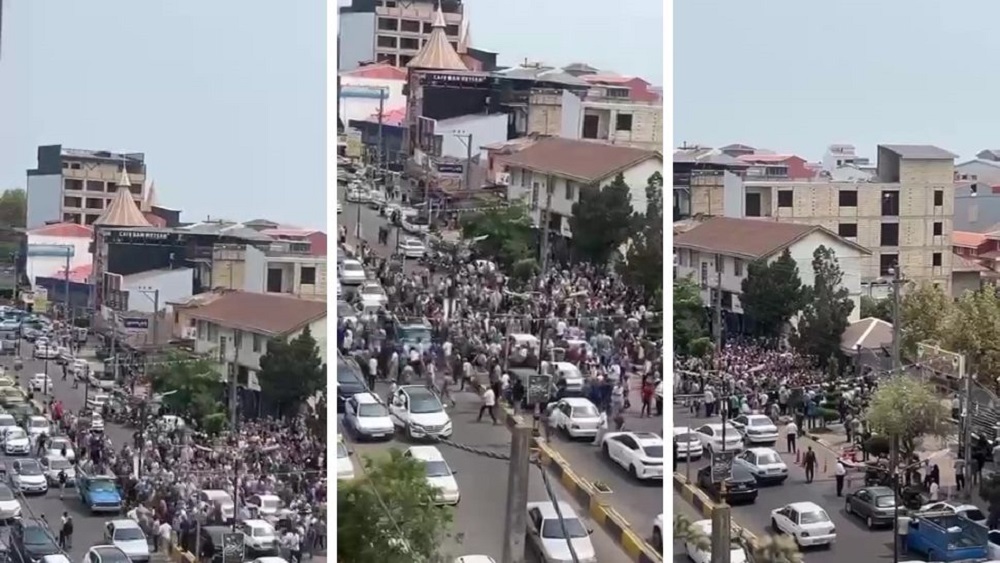
A new and intense wave of protests swept across Iran on July 28 and 29, 2025, revealing the profound and systemic failures of the clerical regime. From citizens in the north demanding water to workers across the country striking against economic ruin, these are not isolated incidents of discontent. They are the unified cry of a nation pushed to its limit by a government that offers only corruption, incompetence, and violent suppression.
Protests Over Water and Power Expose Systemic Collapse
The crisis reached a boiling point on July 29, 2025, in the city of Khomam, Gilan province, where residents took to the streets to protest chronic and debilitating water and electricity cuts. Their chants captured the essence of their struggle: “Water, electricity, life; our undeniable right.” The protest laid bare the regime’s complete disregard for the basic needs of its people. One citizen starkly articulated this sentiment, stating, “We have no water, no electricity, no cooling, no life! This isn’t just mismanagement, it’s our direct humiliation.”
More footage of rallies in Khomam in protest to water and electricity outages.
Protesters chant, "Water and electricity are cut off, this happens every day."#IranProtestspic.twitter.com/tpbbSLe8Qx— People's Mojahedin Organization of Iran (PMOI/MEK) (@Mojahedineng) July 29, 2025
Predictably, the regime’s response was not dialogue, but force. According to local reports, security forces launched a repressive crackdown, attempting to intimidate and violently disperse the demonstrators. This came just days after regime president Masoud Pezeshkian, on July 21, publicly admitted that the regime’s approach to managing the country’s dwindling water resources had been “incorrect.” The events in Khomam prove that while the regime can acknowledge its failures, its only practical solution remains the suppression of its own citizens.
Nationwide Strikes Expose Rampant Corruption
The protests in Khomam are a symptom of a much wider national crisis rooted in the regime’s economic plunder. On July 28, a coordinated series of strikes across multiple sectors highlighted the depth of this despair. In Bostanabad, East Azerbaijan province, truck drivers protested the systemic corruption and cronyism that defines the economy, specifically targeting the monopolies and discriminatory distribution of freight by regime-affiliated steel companies.
July 28—Rasht, northern Iran
People chant "Down with Khamenei, damned be Khomeini," as they protest constant water and electricity outages.#IranProtestspic.twitter.com/KxqCokXFX9— People's Mojahedin Organization of Iran (PMOI/MEK) (@Mojahedineng) July 29, 2025
This protest was part of a larger, nationwide mobilization against economic hardship on the same day:
- In Tehran, bakers held a rally, declaring it was impossible to continue working under the crushing weight of soaring flour prices and other essential materials.
- In Southern Iran, oil and gas industry workers, both permanent and contractual, protested low wages and precarious, temporary contracts.
- At the Fajr Jam gas refinery and in Ilam, workers held demonstrations against discriminatory work conditions and mass layoffs at the Arghavan Gostar Petrochemical Company, respectively.
A Symbol of Lethal Negligence: The Sanandaj Tragedy
Beyond economic despair, the regime’s lethal negligence has also become a powerful catalyst for protest. On July 28, the funeral for environmental activist Chiako Yousefinejad in Sanandaj transformed into a large anti-regime demonstration. Yousefinejad, along with two other activists, Hamid Moradi and Khabat Amini, tragically lost their lives after suffering severe burns while trying to extinguish a massive fire on Abidar mountain.
The public’s anger is aimed directly at the government, whose complete indifference and inaction are seen as the cause of these preventable deaths. In a cynical maneuver, the provincial governor declared two days of “public mourning,” a deceitful attempt to co-opt the public’s outrage and pre-empt further escalation of protests. This hollow gesture only served to underscore the regime’s culpability in the eyes of the people.
A Regime Facing a Unified Uprising
The thirst in Khomam, the economic desperation in Bostanabad and Tehran, and the grief-fueled anger in Sanandaj are not separate crises. They are interconnected manifestations of a single, systemic failure. The government of Masoud Pezeshkian, like its predecessors, offers only repression for grievances, cynical gestures for tragedies, and continued corruption for economic demands.
These protests demonstrate the unwavering resolve of the Iranian people. The regime’s foundations are cracking under the pressure of a populace that refuses to be silenced and is determined to reclaim its fundamental rights to life, dignity, and a functioning country. The message from the streets of Iran is clear: the era of enduring mismanagement and oppression is over.