

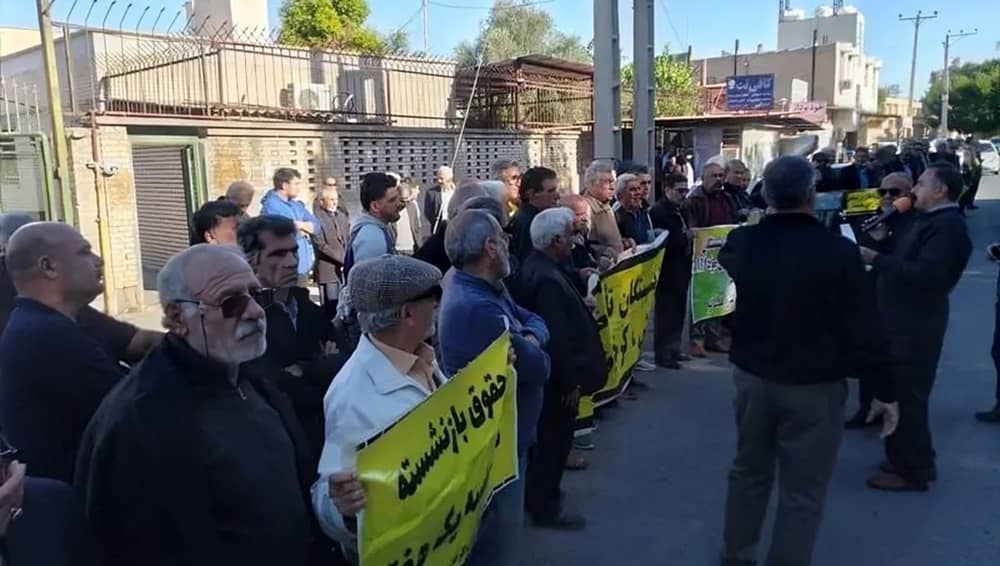
A sweeping wave of protests and industrial strikes erupted across Iran on Sunday, December 21, 2025, challenging the clerical regime’s narrative of stability. From the freezing industrial zones of Hamadan to the streets of Khuzestan and Tehran, diverse sectors of Iranian society—including steelworkers, retirees, medical staff, and municipal cleaners—coordinated a unified display of dissent against systemic mismanagement and economic collapse.
Industry in the Deep Freeze
In the western province of Hamadan, the collapse of state-managed infrastructure sparked an immediate crisis at the Rad Steel Complex. On Sunday morning, workers walked off the job after the state gas company severed the factory’s supply. The cutoff occurred as temperatures plummeted to -6 degrees Celsius, leaving the facility paralyzed and its workforce in precarious conditions. Workers reported that the factory holds a debt of approximately 95 billion tomans to the gas department—a financial hole that has led to repeated shutdowns, directly threatening the job security of the labor force.
December 21—Hamedan, western Iran
Workers at the Foolad Rad steel plant went on strike after the Gas Company cut the factory’s gas amid -6°C cold—threatening their jobs, livelihoods, and workplace safety.#IranProtests pic.twitter.com/lP01FP1Egg— People's Mojahedin Organization of Iran (PMOI/MEK) (@Mojahedineng) December 21, 2025
Simultaneously in the south, at the Varda Zartak production group in Kavar, Fars Province, a strike entered its second day. This facility, the second-largest industrial unit in the county, saw its workforce cease all operations after months of written requests regarding wage increases and contract security went unanswered by management.
“Leave Lebanon Alone”: A Political Indictment
While industry halted, the streets of major cities were occupied by retirees of the Social Security Organization. Rallies took place in Tehran, Kermanshah, Rasht, and notably in Shush, Khuzestan Province.
The gathering in Shush was distinguished by slogans that targeted the regime’s core ideological and foreign policy priorities. Rejecting the government’s interference in their personal lives and its funding of overseas proxies, retirees chanted, “Leave the headscarf alone, think of us,” and “Leave Lebanon alone, think of us.”
December 21—Shush, southwest Iran
Social Security Organization retirees marched and rallied outside the SSO office, protesting poverty, soaring prices, and inadequate pensions, and demanding free, proper healthcare and hospitals.#IranProtests pic.twitter.com/1AMcpFU8c8— People's Mojahedin Organization of Iran (PMOI/MEK) (@Mojahedineng) December 21, 2025
Further chants such as “Where is the inflation control? You lie to the people,” and “Only in the street will we get our rights,” signaled a total loss of faith in the administration of regime president Masoud Pezeshkian to resolve the economic crisis through negotiation. Parallel to these events, steel industry retirees in Isfahan gathered outside the pension fund building, demanding the implementation of wage equalization laws.
Public Services on the Brink
The unrest extended to essential public service workers, highlighting the depth of the poverty line. In Dezful, municipal cleaners (Pakbanan) rallied to protest extreme exploitation. Despite high inflation in 2025, these workers reported that their wages are still calculated based on last year’s rates. Furthermore, they are subjected to monthly temporary contracts that offer no job security, and they are denied pay for holiday work.
December 21—Kavar County (Fars Province), southern Iran
For a second day, workers at Verda Zartak—the county’s second-largest employer—are on strike after months of unanswered written demands, saying authorities left them no choice but broad protest.#IranProtests pic.twitter.com/vlXzrRwA4p— People's Mojahedin Organization of Iran (PMOI/MEK) (@Mojahedineng) December 21, 2025
Meanwhile, in Behbahan, the healthcare sector voiced its grievances. Nurses and medical staff gathered in front of the Governor’s office to protest delayed wage payments and deteriorating livelihood conditions, further straining a healthcare system already under pressure.
The events of December 21 paint a picture of a regime facing a multi-front crisis of legitimacy. Whether it is the inability to provide natural gas to factories in winter, the refusal to pay fair wages to municipal cleaners, or the diversion of national wealth to foreign conflicts, the message from the Iranian street is uniform: the Iranian people have concluded that their rights can only be secured through presence in the streets.