

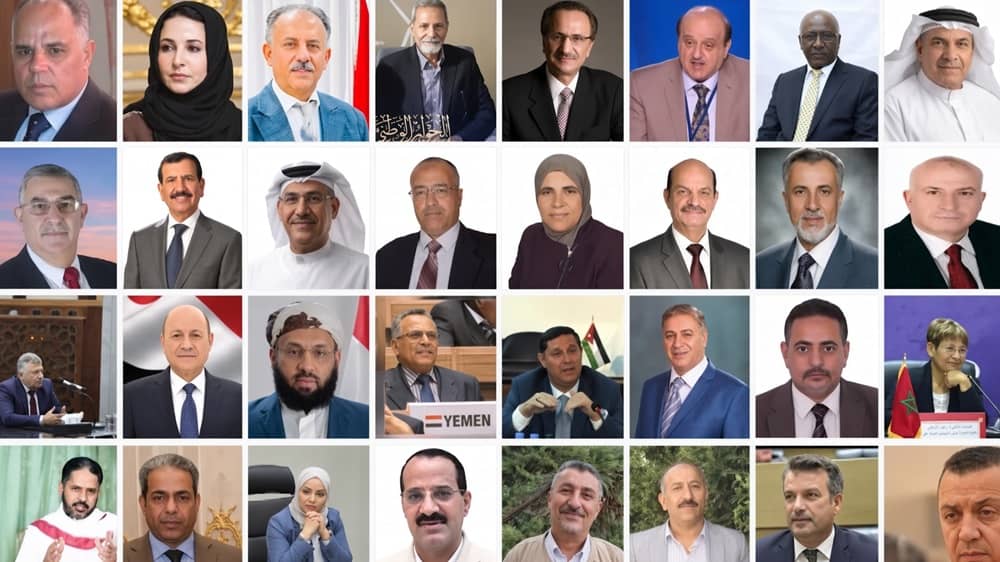
A group of 286 current and former Arab lawmakers, ministers and political figures from 11 countries has condemned Iran’s regional policies and called for greater support for the Iranian people’s organized resistance, arguing that neither military confrontation nor accommodation with Tehran offers a durable solution to the country’s political crisis.
The declaration, signed by figures from Bahrain, Tunisia, Jordan, Sudan, Syria, Iraq, Palestine, Lebanon, Egypt, Morocco and Yemen, accused the Iranian regime of interfering in Arab states, backing armed groups and using regional instability as an instrument of political survival.
“We condemn the aggressive policies of the Iranian regime, its interference in the affairs of Arab countries, its support for militias, its export of terrorism, its threats to the security and sovereignty of the countries of the region, and its persistent efforts to destabilize them,” the statement said.
The signatories portrayed Tehran’s domestic repression and foreign policy as two components of the same strategy. They said that, over the past 47 years, “repression at home, the export of terrorism, interference in the countries of the region, and the pursuit of nuclear weapons have constituted fixed pillars in this regime’s strategy for survival.” They also cited missile and drone attacks and support for allied forces as evidence that Iran’s leaders had, in their view, subordinated regional stability to the preservation of the political system.
🚨 280 Arab Figures From 11 Countries Back Organized Resistance as the Solution for Iran
A statement signed by 280 Arab figures, including former ministers and current and former parliamentarians from Jordan, Bahrain, Tunisia, Sudan, Syria, Iraq, Palestine, Lebanon, Egypt,… pic.twitter.com/wn4osyoPZ9
— SIMAY AZADI TV (@en_simayazadi) August 28, 2026
Emphasis on Iran’s organized opposition
A central theme of the declaration is the argument that political pressure inside Iran — rather than war from outside — should be decisive in any change of government.
The document points to increased executions, arrests and pressure on opponents, including “members and supporters of the People’s Mojahedin Organization of Iran (PMOI/MEK)”. But it interprets those measures not as evidence of clerical establishment control, but as vulnerability.
“This repression does not reflect the regime’s strength,” the statement said. “Rather, it reveals its fear of the organized resistance and of a society standing on the verge of explosion.”
The statement issued by the Arab-Islamic Committee for Rejecting the Iranian Regime’s Interference in the Region stated that regional security initiatives would remain incomplete without what it called “the Iranian people and their organized resistance.” It contended that policies designed merely to contain Iranian power abroad would fail unless they also addressed the political system that produces it.
At a #Ramadan conference hosted by NCRI, political figures and representatives from the parliaments of various Islamic and Arab nations expressed support for #IranRevolution and condemned Iranian regime's terrorism. pic.twitter.com/OsWMv8gPuD
— NCRI-FAC (@iran_policy) April 5, 2024
The declaration explicitly rejects what it presents as a binary choice between accommodating Tehran and going to war.
“Neither the policy of appeasement nor war constitutes a solution to the crisis of Iran and the region,” the signatories said. “The real solution lies in supporting the Iranian people’s right to freedom and democracy, and supporting the organized Iranian Resistance, in a way that guarantees peace, stability, good-neighborly relations and cooperation among the peoples of the region.”
The committee went further in its own press statement, arguing that the decisive source of pressure on the regime lies inside Iran. It called for recognition of the Iranian people’s right to defend themselves and of the organized Resistance’s right to dismantle the Islamic Revolutionary Guard Corps, which the committee described as the principal instrument of domestic repression and regional warfare. Its stated end goal was the replacement of Iran’s system of clerical rule with “a democratic, nonnuclear republic” living peacefully with its neighbors.
With a shared acknowledgment of the persistent suffering caused by the terrorist regime ruling #Iran upon their nations, the speakers of the 2nd day of #FreeIran2023 World Summit voiced a collective aspiration for #IranRevoIution, one that would emancipate the Muslim and Arab… pic.twitter.com/JJ1Pn5CaLq
— NCRI-FAC (@iran_policy) July 11, 2023
Former ministers and sitting lawmakers among signatories
The attached list identifies dozens of supporters from across the Arab political establishment. They include Ibrahim Abrash, a former Palestinian culture minister; Ahmad Qarata, the current second deputy speaker of Bahrain’s Council of Representatives; Ayham al-Samarrai, a former Iraqi electricity minister; Hatem al-Sir Ali, a former Sudanese transport minister; and Hassan Boukhammas, a Bahraini lawmaker who chairs the chamber’s foreign affairs, defense and national security committee.
Other names include Kamil Chamoun, a current Lebanese member of Parliament; Moin al-Merhebi, a former Lebanese tourism minister; Siham Badi, a former Tunisian minister for women’s affairs; Mohammad Qubati, a former Yemeni tourism minister; and Mousa al-Ma’ani, a former Jordanian minister of state who is identified in the press release as chairman of the Arab-Islamic Committee for Rejecting the Iranian Regime’s Interference in the Region.
The declaration represents an unusually broad public endorsement by Arab political figures of an Iranian opposition-centered approach to regional security. Its central contention is that the durability of Iran’s regional posture cannot be separated from political conditions inside the country — and that the most consequential counterweight to Tehran is not another foreign military intervention, but an organized domestic movement capable of challenging the system from within.