

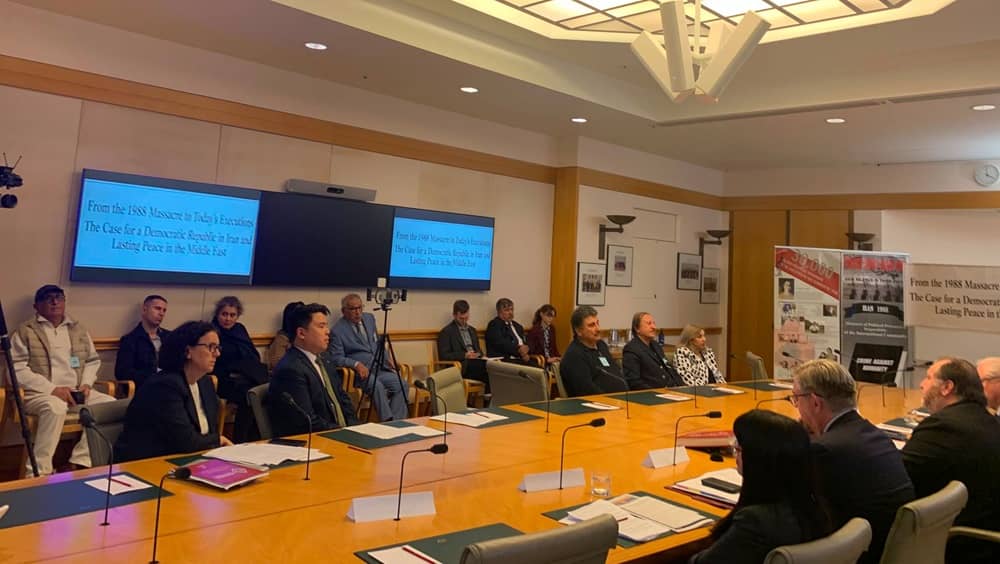
A conference held at the Australian Parliament in Canberra on August 19, 2026, marked the 38th anniversary of Iran’s 1988 massacre of political prisoners and called for international action against continuing executions and repression. Australian parliamentarians, human-rights advocates, members of the Iranian-Australian community and representatives of the National Council of Resistance of Iran (NCRI) heard appeals for accountability, an end to appeasement, and recognition of the Iranian people’s right to determine their own political future.
Speakers presented the NCRI and the People’s Mojahedin Organization of Iran (PMOI/MEK) as an organized resistance capable of leading change, highlighting Resistance Units operating inside Iran and the movement’s Ten-Point Plan as a framework for a democratic, pluralist republic. The event also rejected both the clerical regime and a return to monarchy, including any externally imposed role for the Pahlavi family or the Shah’s son. Participants urged Australia to proscribe the Islamic Revolutionary Guard Corps (IRGC), refer grave crimes to international mechanisms and stand with Iranian activists seeking freedom, equality, justice and human dignity.
In her keynote speech, Mrs. Maryam Rajavi, President-elect of the NCRI, addressed the conference by video and placed the 1988 massacre at the center of the current struggle. She said Khomeini’s execution decree targeted PMOI prisoners who remained “steadfast in their positions” despite torture and abuse, and stated that 30,000 people were hanged, 90 percent of them PMOI members.
Mrs. Rajavi emphasized that the regime still regards the PMOI as its principal threat and that Resistance Units, part of the organized PMOI network in Iranian cities, had carried out 200 anti-repression operations across Iran’s provinces in the previous month. “In recent months, nine members of the PMOI have been executed,” Mrs. Rajavi said. “Dozens of other young individuals who participated in the uprising have also been hanged. In the regime’s courts, they bravely declared that they had risen up to overthrow the regime, and just before their execution, they collectively sang songs of freedom inside prison.”
“The regime welcomes war conditions that have lasted for about 15 months, using the situation as cover to confront its main enemy: the Iranian people and Resistance,” she declared. “Amid the war, the ruling regime also attempts to conceal its fundamental weakness. Its empty show of force is a major deception. A clear sign of the regime’s deadly impasse are deep divides at the top of the ruling establishment.”
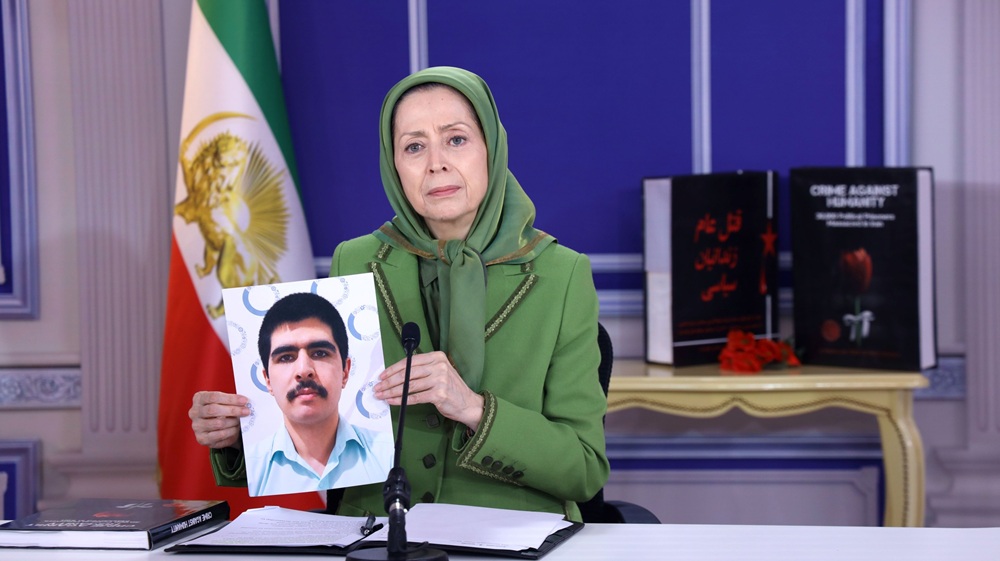
Mrs. Rajavi presented the organized resistance as the Iranian people’s means of bringing about regime change rather than relying on war or foreign intervention. The NCRI President-elect rejected the idea that Iran should return to monarchy, saying the country would “neither tolerate the current dictatorship nor return to the past.”
She described the NCRI as advocating a democratic republic based on separation of religion and state and free elections, and called for universal jurisdiction, referral of the 1988 massacre to the UN Security Council and an end to executions in any international agreement. Concluding her remarks, Mrs. Rajavi called for:
• Prosecuting Iran’s ruling criminals by governments under the principle of universal jurisdiction.
• Referring the case of the 1988 massacre of political prisoners, as a crime against humanity, along with the regime’s other major crimes against the Iranian people, to the UN Security Council.
• Including an end to executions in Iran as a key demand of the entire Iranian people in any international agreement.
Throughout the past 38 years, the regime has maintained the pattern of the 1988 massacre. Every time, it brutally suppresses the people's resistance and uprisings. Despite all this, the resistance to change the regime continues.
A country whose people pay such a heavy price for… pic.twitter.com/OczIbp93a4— Maryam Rajavi (@Maryam_Rajavi) August 19, 2026
Rob Mitchell, an Australian parliamentarian, framed the gathering as an expression of solidarity with “the brave people of Iran” and with Iranian-Australian communities. He condemned the Iranian regime’s domestic repression, missile and nuclear programs, support for armed proxies and “brutal acts of violence and intimidation.” Referring to the 1988 massacre, he said that approximately 30,000 political prisoners had been killed and argued that the anniversary demanded reflection rather than silence. Mitchell endorsed Maryam Rajavi’s Ten-Point Plan, describing it as a basis for free and fair elections, and stressed that “war is not the answer, nor is appeasement.” He cited Australia’s diplomatic, legal and security measures, including the closure of its embassy, expulsion of the ambassador, designation of the IRGC as a terrorist organization and targeted sanctions on more than 230 individuals. In his closing remarks, he promised that Australian political figures would continue to support the Iranian people’s aspiration for freedom and democracy.
Senator Paul Scarr of Queensland said he had signed Rajavi’s Ten-Point Plan and supported it as “a roadmap for the people of Iran to secure freedom and democracy and peace.” Recalling his participation in 2022 solidarity events in Brisbane after the killing of Jina Mahsa Amini, Senator Scarr described the Iranian-Australian community’s stories of loss and continuing resistance as a source of personal commitment. He praised community efforts to expose human-rights abuses and expressed sympathy for families whose loved ones were named in the memorial book on the 1988 massacre. The Australian senator also addressed the security of diaspora activists, declaring that any attack on their freedom of expression, including foreign interference or transnational repression, would be “an attack on me as an Australian parliamentarian.” He concluded by looking forward to a future gathering at Parliament House to celebrate Iran’s achievement of freedom and democracy.
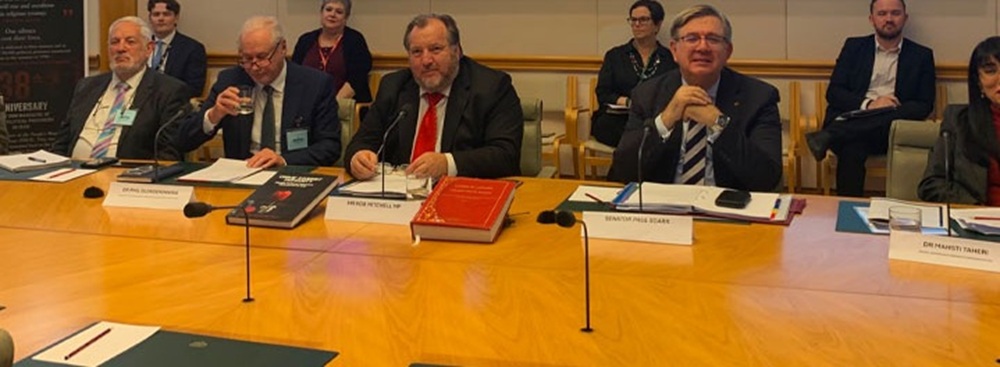
Phil Glendenning, former president of the Refugee Council of Australia and emeritus director of the Edmund Rice Centre, connected the testimony to Australia’s civic responsibility. He cited former Irish President Mary Robinson’s description of Mrs. Rajavi as “the bravest and the most courageous woman in the world,” while praising her commitment to the Iranian people. Glendenning said more than 90 percent of those killed in 1988 were PMOI members or supporters and warned that political prisoners and young activists remained at risk. His central political argument was that Iranians do not want to exchange one dictatorship for another: “We had the Shah’s dictatorship, we’ve had the clerical dictatorship, and we don’t want to return to another Shah’s dictatorship.”
He rejected an externally imposed solution centered on the Shah’s son or the Pahlavi family, arguing instead for democracy, human dignity, equality, justice, the rule of law and self-determination. Speaking for the Australian Supporters of Democracy in Iran, he endorsed the Ten-Point Plan, demanded an immediate halt to executions and unconditional release of political prisoners, and told Iranians watching from afar: “You’re not alone.”
Dowlat Nowruzi, the NCRI Representative to the United Kingdom, described Iran’s human-rights crisis as inseparable from the regime’s political strategy. She cited executions, mass arrests, torture, internet shutdowns and the use of terrorism, war and a covert nuclear program to obscure internal failures and pressure the international community into continued appeasement. Nowruzi argued that dialogue and negotiation had not changed the regime’s behavior, while foreign war only made it harder for Iranians to organize protests.
“Neither appeasement nor the war are any solution,” she said, identifying Mrs. Rajavi’s “third option”—regime change led by the Iranian people and their organized resistance—as the alternative. She specifically highlighted Resistance Units as the operational expression of that movement inside Iran. Nowruzi described the Ten-Point Plan and the NCRI’s proposed provisional government as a transition framework leading to free elections and the transfer of power to elected representatives. Its principles include a democratic and pluralist republic, separation of religion and state, gender equality, minority rights, abolition of the death penalty, a non-nuclear Iran and peaceful coexistence. She urged Australia to recognize Iranians’ right to self-determination and hold perpetrators accountable.
Dr. Mahasti Taheri described Iran’s repression through the lens of public health. “The greatest threat to the health and well-being of its people is not disease, but systematic repression,” she said, arguing that executions create lasting trauma for families and communities and are used to intimidate society and silence dissent. Dr. Taheri commemorated the approximately 30,000 political prisoners killed in 1988 and noted that about 90 percent of the victims were PMOI members or supporters. She named young, educated Iranians among those executed and said the organized PMOI movement had continued despite the killing of approximately 120,000 members and supporters. Dr. Taheri presented the Ten-Point Plan as a democratic program encompassing free elections, separation of religion and state, gender equality, judicial independence, minority protection, freedom of expression, abolition of the death penalty and peaceful coexistence. She stressed that Iran’s future must be decided by its people, not political factions or foreign powers, and that women can lead democratic change. Invoking the medical principle that prevention is better than treatment, she called for concrete international action, including referral of serious abuses to the UN Security Council and accountability through international justice.