

Three-minute read
On Western campuses, “student activism” evokes encampments, op-eds, and administrative scoldings. In Iran, it still begins with the possibility of a midnight arrest and ends, sometimes, with a forced disappearance.
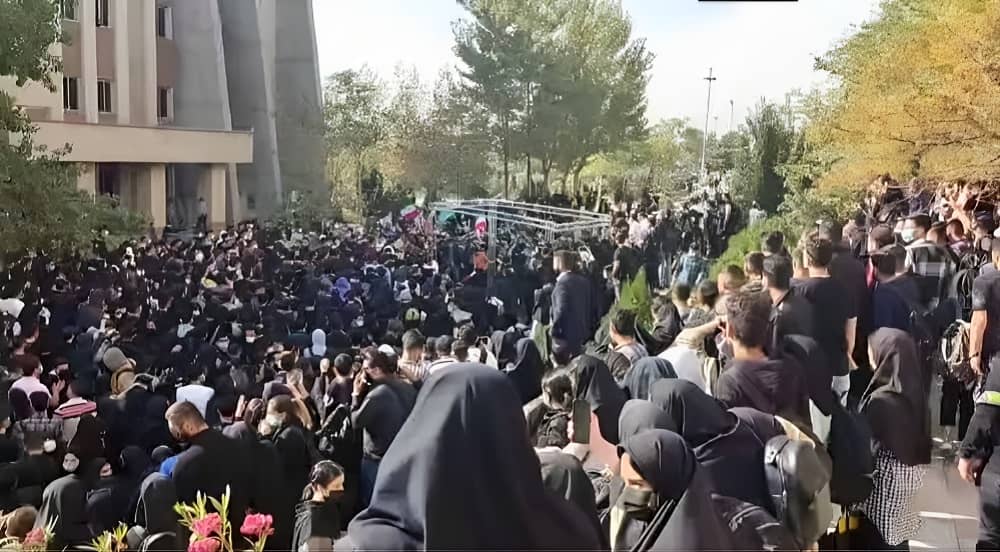
Each December 7th—16 Azar in Iran’s calendar—students commemorate a date that is less anniversary than warning flare. The first blood was drawn in 1953 when security forces killed three Tehran University students protesting dictatorship and foreign interference. Seven decades later, the portraits of those young men circulate in a country where the university has been methodically repurposed.
The transformation is not metaphorical. Cameras blanket hallways. Entrances and exits are recorded. Security officials mingle with students as casually as teaching assistants. The university—designed for questions—is reshaped into an annex of the security state, where curiosity is treated as a liability.
What’s behind #Tehran University’s Controversial Admission of Hashd-al-Shaabi Forceshttps://t.co/LdCGboOeuW
— NCRI-FAC (@iran_policy) August 19, 2024
Virus Season in the Academy
The regime speaks often of “ideological immunity,” as if dissent were a contagion. Students have adopted the metaphor—only inverted. They describe what’s happening to their campuses as deliberate infection: an attempt to numb a generation into passivity.
The first symptom is visible repression: expulsions, interrogations, the persistent hum of fear. Then comes the subtler form, what students call “white repression”: the infiltration of addiction, the cultivation of cynicism, a slow erasure of ambition. You do not need to jail people if you can convince them nothing matters.
Finally, the intellectual surgery: respected professors—those with scholarly gravitas and independent reputations—are eased out or exiled. Their replacements are loyalists whose chief qualification is ideological reliability. A campus that once faced outward toward the world is forced inward, into a single, airless narrative. The university’s purpose is not simply policed; it is rewritten.
A young Tehran University student questions the inaction of political groups in the face of Iran’s regime crimes in continuing the war while peace was within reach in Iran Iraq war. #IranRevolution #Iran #IranRevoIution2023#مرگ_بر_ستمگر_چه_شاه_باشه_چه_رهبر pic.twitter.com/7YRRTLWqLN
— NCRI-FAC (@iran_policy) January 22, 2023
The Erasure of Memory, and the Memories That Resist
Authoritarianism does not merely want obedience; it wants amnesia. In Iran, history classes are being reshaped into instruments of forgetfulness. Students emerge believing Dr. Mohammad Mossadegh, Iran’s late prime minister who nationalized the country’s oil resources, is recast as an agent of foreign powers, and 16 Azar is misrepresented as commemorating the 1979 embassy takeover rather than a massacre under the Shah. The genealogy of the student movement—from 1999 to 2009 to the 2017–18 uprising and the 2022 revolt—is scrubbed from official syllabi.
And yet, memory is stubborn. It survives in smuggled books, whispered stories, encrypted channels. It glows in dates that refuse to be domesticated: the 1999 dormitory raids; the 2009 uprising; the 2017 chant “Reformist, Hardliner—The Game Is Over”; the 2019 fuel protests; the nationwide rebellion after Mahsa (Jina) Amini’s death in 2022. Each moment is a reminder that efforts to pacify students have failed in every decade.
#Iran News in Brief
"While the MEK flaunts in the Sharif University, the Minister is asleep," a website affiliated with Saeed Jalili warned about the #IranianResistance network across Iran's academia during #IranRevolution.https://t.co/x6UUiou4YB pic.twitter.com/z68xYjHcFX— NCRI-FAC (@iran_policy) December 8, 2022
Covenants from Prison Cells
The most haunting texts emerging from Iran today are not manifestos but letters—handwritten, smuggled, urgent. Their authors are young scholars now recast as enemies of the state: Olympiad medalists like Ali Younesi and Amir Hossein Moradi; students like Ehsan Faridi, awaiting execution in Tabriz.
Their messages share a single theme: 16 Azar is not a ritual—it is a covenant. “Death to the oppressor, whether Shah or Leader” is not an archaic chant but a framing of the struggle. Freedom, they insist, cannot be outsourced. Not to reformists who promise gentler chains, nor to foreign powers whose missiles will not deliver democracy. If the country has become a prison, then liberation must be built by those locked inside.
These letters are remarkable not for their despair but for their clarity. Even under threat of execution, these students refuse the safety of cynicism. They describe the Iran they want with the unembarrassed precision of people who expect to see it.
#Iran News in Brief
In its today's issue, the state-affiliated newspaper Etemad examined the expulsion of #university staff and stated, "58 professors were expelled, suspended, detained, summoned, or forced into early and compulsory retirement from the beginning of the Raisi… pic.twitter.com/60O7pxiN1U— NCRI-FAC (@iran_policy) August 24, 2023
White Coats, Clear Voices
If the prison letters reveal the moral anatomy of this movement, a recent statement by students at Tehran University of Medical Sciences shows its institutional pulse.
The declaration begins with the urgent: classmates detained, one facing death. But it widens quickly. Tuition inflation, collapsing dormitories, commercialized education, and restricted scientific internet access are not technical complaints—they are evidence of a systematic effort to break the university as a space of dignity.
And then comes the line the authorities dread: “16 Azar belongs to the independent voice of students.” In a country that choreographs public life with the precision of a surveillance panopticon, this sentence is explosive. It asserts that legitimacy flows not from official podiums but from the lived experience of the campus itself.
More Than 32,000 Associate Professors Dismissed from #Iran’s Azad Universityhttps://t.co/HpziEJai1B
— NCRI-FAC (@iran_policy) October 23, 2023
The Uncaptured Hand
On 16 Azar, the state will perform its scripted ceremony; the students will answer with something the regime has never managed to control. Decades of indoctrination, Basij infiltration, and the militarization of campuses have failed. Each uprising has exposed the same truth: the university remains Iran’s moral high ground and the intellectual compass of its revolts, not the clerics’ laboratory of obedience.
So, when a hand rises in a classroom where questions are forbidden, it is more than defiance—it is the regime’s defeat made visible. The state knows it. The students know it. And on 16 Azar, they refuse not just to remember, but to rebel.