
Three-minute read
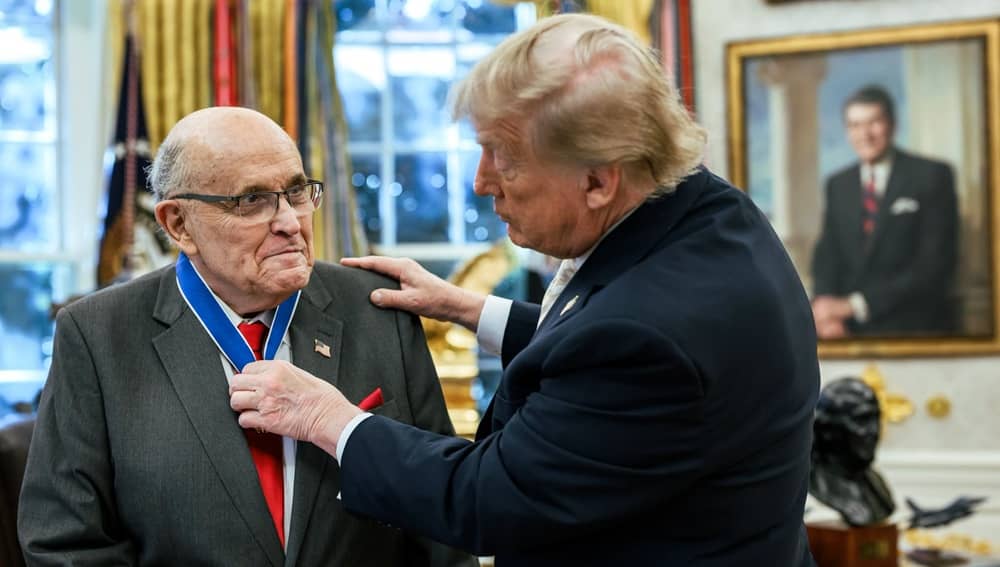
When Rudy Giuliani received the Presidential Medal of Freedom from the US President, Donald Trump, on November 24, the official recognition was rooted in his service to the United States: his years as a federal prosecutor, his leadership as mayor of New York, and his role after the September 11 attacks.
For the Iranian Resistance, the word freedom attached to Giuliani’s medal carries an additional and deeply significant historical meaning.
For more than a decade, Mayor Giuliani used his standing in American public life to support Iranians fighting the clerical regime—first when thousands of members of the People’s Mojahedin Organization of Iran (PMOI/MEK) were trapped in Iraq and facing repeated attacks, and later by advocating a political transition toward a democratic republic chosen by the Iranian people.
That record is worth recalling because Mayor Giuliani’s relationship with the Iranian Resistance was never limited to speeches from a conference podium.
Rudy Giuliani has long stood shoulder to shoulder with the Iranian resistance, proudly supporting the NCRI’s fight for freedom, liberty, and democracy.
Now, as President Trump has announced Mayor Rudy will receive the Presidential Medal of Freedom, it’s a reminder of just how… pic.twitter.com/3krYJW4K6Q
— Kylie Jane Kremer (@KylieJaneKremer) September 2, 2025
When the Question Was Survival
After the 2003 Iraq war, MEK members at Camp Ashraf ceded their weapons under arrangements with U.S. forces. The United States could hardly treat Ashraf as someone else’s problem. Its forces had disarmed the residents and given them assurances of protection. Yet as Washington withdrew and Tehran’s influence over Baghdad deepened, Ashraf came under deadly attack. By 2012, the State Department itself was insisting that Iraq ensure the residents’ “safety, security, and humanitarian treatment” and facilitate their relocation to third countries.
Mayor Giuliani became one of the most visible members of a bipartisan group of former senior U.S. officials who pressed for those commitments to be honored.
The danger was not theoretical. Camp Ashraf had already been attacked repeatedly: Iraqi forces killed 11 residents in July 2009 and 36 more in April 2011. Then, on September 1, 2013, gunmen killed 52 of the remaining residents and seven others disappeared. After residents were moved to Camp Liberty near Baghdad airport, attacks continued.
Mayor Rudy Giuliani: We must recognize #Iran'ian Resistance movementhttp://t.co/fnq95XPqec#IranFreedom pic.twitter.com/N8oOXWCywD
— NCRI-FAC (@iran_policy) September 11, 2015
Following a deadly rocket attack on Liberty in February 2013, Mayor Giuliani argued that the residents should be recognized as refugees and removed from danger. His position was simple: the United States had obtained their disarmament and could not then look away while they were attacked.
Months later, after further attacks, he went further. If Iraq could not protect them, he said, they should be transferred to safety—even to the United States if necessary.
More Than Public Advocacy
Mayor Giuliani was not acting alone.
He worked alongside former cabinet members, national security officials, governors, and senior figures from both major American parties. State Department officials publicly acknowledged maintaining contacts with former U.S. officials who had established relationships with the MEK and were helping communicate between the different sides during the Ashraf relocation process.
Their eventual relocation became one of the most consequential chapters in the relationship between the Iranian Resistance and its international supporters. Albania ultimately provided the principal haven, allowing the residents to leave Iraq and rebuild their community outside the reach of the immediate threats surrounding Ashraf and Liberty.
Mayor Rudy Giuliani: As Madam Rajavi said it’s the time to declare #IRGC a terrorist organization. #FreeIran #MEK #Iran #Paris pic.twitter.com/BqNYGd4aEj
— NCRI-FAC (@iran_policy) July 1, 2017
Mayor Giuliani remained engaged after that objective had been achieved. He visited the relocated Resistance members in Albania and continued publicly supporting their political cause. In 2019, at Ashraf 3, he again argued that political change in Iran should come through the Iranian people and their organized opposition.
From Protecting Lives to Defending a Political Choice
Over the years, Mayor Giuliani’s argument broadened from protecting Iranian dissidents to addressing what should follow the clerical regime.
He rejected the idea that Iran must choose between the existing theocracy and another form of authoritarian rule.
In April 2026, at a conference explicitly titled “Towards a Democratic Republic,” the former New York City mayor joined Iranian Resistance figures advocating a political order based on popular sovereignty rather than either clerical rule or restoration of the monarchy.
Speaking again in Italy in July, he described his support for the NCRI and MEK as extending back roughly 14 years and said the objective was “a democratic republic—without a king, without a dictator, and without a theocracy.”
Mayor Rudy Giuliani presents the letter by 33 American dignitaries and former U.S. officials in the Free #Iran – The Alternative, Gathering – Villepinte, June 30, 2018#FreeIran2018#IranRegimeChange pic.twitter.com/NGNZMzSvz7
— Maryam Rajavi (@Maryam_Rajavi) June 30, 2018
That continuity gives the Medal of Freedom a particular resonance in this context.
For Americans, Mayor Giuliani’s public identity was forged in New York—in the courtroom, City Hall, and especially during the trauma of September 11.
For members and supporters of the Iranian Resistance, there is another memory: a prominent American political figure who continued raising their case when Ashraf was attacked, when Camp Liberty was under fire, when relocation appeared uncertain, and when governments had to be persuaded to provide safe destinations.
Throughout these years, Mayor Giuliani remained at their side as the struggle moved from survival to the larger objective that had always defined it: a free Iran governed by a democratic republic.
Rudy Giuliani: #Iran’s reign of terror is on its last legs. While corrupt media & politicians cover for the regime, @Mojahedineng & @Maryam_Rajavi have shown unwavering courage for years. The road is long, but freedom will come. pic.twitter.com/p9J4ns7SEH
— NCRI-FAC (@iran_policy) August 19, 2025
When that day comes, many will want to associate themselves with a liberated Iran—with its people, its enormous potential and the opportunities of a prosperous future. But nations emerging from tyranny have long memories. Iranians will remember not only those who arrived when freedom was within reach, but those who stood with them when the outcome was uncertain, the risks were greatest, and their friends were few.
For many in the Iranian Resistance, Rudy Giuliani belongs to that latter group.