

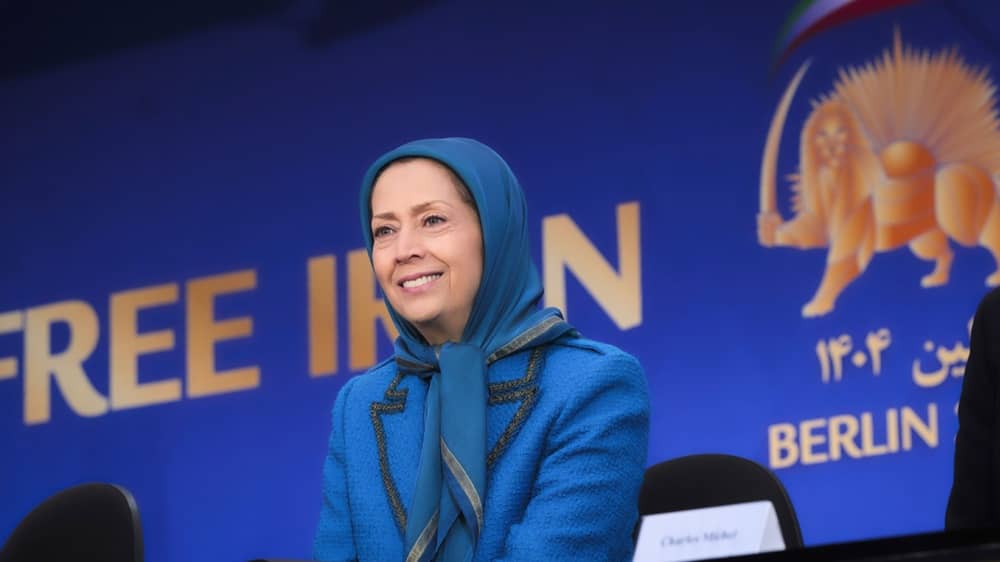
In an opinion piece for the German paper die WELT, Mrs. Maryam Rajavi, President-elect of the National Council of Resistance of Iran, argues that the current protest movement is not a repeat of earlier unrest but a “matured” phase of confrontation with the clerical system that has reached a point “from which there is no going back.”
She makes clear that the idea of internal reform has effectively collapsed in public opinion, citing the 2017 slogan rejecting both “reformists” and “hardliners.” Mrs. Rajavi also dismisses foreign military intervention as an answer, arguing that strikes may damage state structures but would not bring down the regime.
Instead, she said the only viable route is overthrow “by the people themselves” in tandem with an organized resistance — highlighting the role of youth and the PMOI-led Resistance Units in linking dispersed protests into a nationwide movement and raising the costs of repression.
Mrs. Rajavi attributes the unrest to economic breakdown, near-45% inflation (as she writes, by the authorities’ own figures), poverty, and chronic water and energy crises, and says protests spread to roughly 400 cities. She outlines a transition roadmap: a provisional government, elections for a constituent assembly within six months, and principles including separation of religion and state, gender equality, an independent judiciary, and abolition of the death penalty.
A translated version of Mrs. Maryam Rajavi in die Welt follows:
Von diesem Punkt gibt es kein Zurück mehr https://t.co/21btrZ9SKW pic.twitter.com/awXqo1SiYB
— WELT (@welt) February 8, 2026
From This Point There Is No Going Back
By Maryam Rajavi
What is currently unfolding in Iran is neither a repetition of earlier uprisings nor an emotional reaction to a temporary crisis. This movement marks an advanced and matured phase in the people’s struggle against the regime—a process that began years ago and has now reached a point from which there is no going back.
Until recently, the key assumptions of the global powers were that the clerical regime in Iran was stable and that a collapse was not realistically to be expected. Today, however, many—including openly—are speaking about the possibility of its collapse. The European Union’s decision to classify the Islamic Revolutionary Guard Corps as a terrorist organization after the brutal suppression of the wave of protests was a sign of a new understanding of the regime’s true condition.
Two fundamental questions arise from this. First: How is regime change achieved? Second: What are the prerequisites for a peaceful transition—and is such a transition possible?
Today, practically no one still believes in change from within. During the 2017 wave of protests, people in Iran declared the end of the reform illusion with the slogan: “Reformist, hardliner—the game is over.”
Free Iran Rally in support of the people’s uprising for democratic republic in Iran
The 2026 uprising shook Iran and the world with a galaxy of martyrs and the fury of a nation.
Time to recognize 44 years of Iranian resistance. #BerlinFreeIranDemopic.twitter.com/1g9RsHHWp4— Maryam Rajavi (@Maryam_Rajavi) February 7, 2026
Nor is the other option—foreign military intervention—the answer to Iran’s crisis, as recent experience has shown. Airstrikes may damage power structures, but they will not bring about the regime’s overthrow.
Among all conceivable options, there is only one practical path: the overthrow of the regime by the people themselves and their organized resistance. This path is not easy, but it is achievable—and the most recent uprising is clear proof of that.
This uprising is the result of 47 years of accumulated anger, political awareness, and historical experience in a society that has reached a final conclusion: the problem is not a policy or a faction, but the entire system of the Velayat-e Faqih (the supremacy of the clergy). These protests have clear causes: the collapse of the national economy; an inflation rate that, according to the regime’s own figures, has reached nearly 45 percent; widespread poverty; and chronic water and energy crises. The regime has no solutions to these problems—and the situation is worsening day by day.
A defining feature of this phase of protest is the simultaneous participation of different social groups. The spread of protests to 400 cities—by the regime representatives’ own admission—shows that the rift between society and the ruling establishment has reached a qualitative breaking point.
A key distinguishing feature of this uprising, however, lies in the leading role of organized forces—especially the youth and the Resistance Units. They have succeeded in linking scattered protests into a nationwide movement, wresting the initiative from the repressive apparatus in various places, and increasing the costs of suppression for the regime. The answer to the question of how the regime can be overthrown lies precisely in this connection between the popular uprising and an organized, determined force—a connection that was continuously effective throughout these protests but, in the face of certain propaganda campaigns, did not receive the attention it deserved.
And you, bereaved mothers and fathers, who, instead of mourning and grief, call for the continuation of the uprising with raised hands and beating feet. You forge victory out of the depth of sorrow. Like Aziz, the mother of the martyred Rezaei brothers and sisters, who, after her… pic.twitter.com/EcCDz8dpn5
— Maryam Rajavi (@Maryam_Rajavi) February 7, 2026
Democratic transfer of power
This organized force is the product of a decades-long struggle—a struggle that has exacted the price of more than 100,000 deaths, including 30,000 political prisoners who were massacred in 1988. This terrible toll testifies to the social roots, organizational capacity, and legitimacy of this resistance within Iranian society.
The answer to the second question—how a peaceful transition can be achieved—is likewise grounded in the same reality. Only a movement rooted in popular resistance, with a broad network on the ground, a clear roadmap and a defined program, proven organizational capabilities, sufficient experience, and international recognition, can guarantee a calm and democratic transfer of power.
The existence of such an alternative is the key condition to prevent chaos. The coalition of the National Council of Resistance of Iran, to which I belong, has long prepared and set out the framework for the transitional phase: the formation of a provisional government; holding free elections for a constituent assembly within no more than six months; and a complete transfer of sovereignty to the people’s elected representatives. Core principles are the separation of religion and state, full equality of women and men, freedom for political parties, an independent judiciary, and the abolition of the death penalty.
In Iran, a return to the past is impossible. A society that has endured nearly five decades of repression and structural corruption is today more conscious than ever regarding freedom and the rejection of despotism. The young generation leading the uprising rejects both monarchical dictatorship and—for years now—the illusion that the existing system can be reformed. This generation pursues the goal of a democratic republic.
Free Iran Rally in support of the people’s uprising for democratic republic in Iran
With its lightning assault, the January 2026 uprising showed that even a fully armed regime can be overthrown. The world witnessed how the Resistance Units and the culture of revolution advanced… pic.twitter.com/eJEj8axVF8— Maryam Rajavi (@Maryam_Rajavi) February 7, 2026
In this context, the role of women is decisive. Women who for decades were victims of systematic discrimination and repression have now become the driving force of the uprising. Their leading presence has changed the psychological balance of power within society and serves as a guarantee against the return of any form of despotism in the future.
The Iran of the future will be a democratic, secular, pluralistic, and non-nuclear republic—at peace with the world.
At this moment, the responsibility of the international community is clear: it must increase the costs of repression through targeted sanctions, especially by stopping oil exports. It must demand legal accountability for the architects of the crimes, expel the regime’s security agents, recognize the right of the people and the youth to defend themselves against repressive forces. The international community must stand on the right side of history—on the side of a people paying the price of freedom with their own blood.