

 By Andrew Rettman
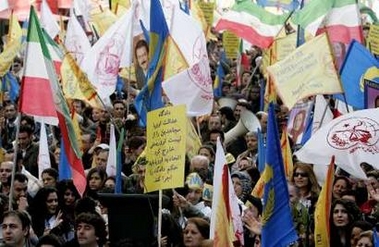
EUOBSERVER / Brussels – Thousands of people attended a rally in Brussels on Thursday (8 March) by Iran opposition group NRCI calling for EU states to take its sister-organistaion, PMOI, off the EU’s terror list in line with a recent court ruling, with senior figures from the European establishment saying PMOI is the "only chance" for reversing Iran’s nuclear arms programme.
"EU must implement court’s ruling" yellow and blue banners said in reference to a December 2006 Court of First Instance verdict annulling a 2002 EU decision to put PMOI on the register, because no evidence of recent terrorist activity had been submitted to the court. EU states have kept PMOI on the list however, saying the verdict does not cover a subsequent May 2006 EU decision to leave PMOI on the register.
The Thursday street protest was attended by NRCI leader Miriam Rajavi as well as a group of 18 members of national parliaments, senators, MEPs and ex-judges from the UK, France, Belgium, Spain, Norway, Portugal, Poland, Lithuania, Germany, Italy and the Netherlands, including Lord Slynn (a former EU Court of Justice judge) and Lord Taverne QC (a UK Liberal Party member).
Lord Slynn told the gathering the EU is breaking its own laws by keeping PMOI on the list. But Brussels categorically rejects the accusation, while promising a thorough review in July of the terrorist register in line with the court’s demands for more evidence. "I am totally confident there is no legal gap," an EU official said, with the 104 groups and individuals on the EU list facing a fund-raising freeze and political stigma in the meantime.
The legal niceties of the situation quickly faded into the background at the rally however, with PMOI supporters more interested in driving home the idea that they represent the western world’s best chance of regime change in Tehran – short of sending in US troops.
"I call on EU heads of state to reconsider their policy," Ms Rajavi said. "We offer the world an Iran free of nuclear [weapons], seeking peace and security in the region, respecting human rights and democracy," she added, amid chants such as "PMOI yes! Mullahs no! They are terrorists! They must go!" in a slick piece of campaigning timed just hours before the 27 EU leaders gathered for their spring summit 200 metres away.
The People’s Mujahidin Organisation of Iran (PMOI) started out in 1965 as a Marxist-Islamist anti-corruption movement but fled after suffering purges that saw over 150,000 members slaughtered by the post-cultural revolution Islamic regime. PMOI organised cross-border raids against Iran from bases in Iraq in the 1990s but renounced the use of arms in 2001, with a 2003 US army report saying the Iraq PMOI wing no longer has any guns.
NRCI’s foreign affairs spokesman, Mohammad Mohaddesin, told EUobserver the "real reason of the EU [terror list] policy is that they are still trying to reach agreement with the [Iranian] regime" in a bid "to buy time" for EU diplomacy to get Tehran to halt uranium enrichment. He said the terrorist register sends the "negative political message that Europe does not support the Iranian resistance" cramping its work in Iran.
The UK’s Lord Slynn said that in the US – which also lists PMOI as a terrorist group – Denmark, Ireland and Norway there are "signs of movement" on possible future cooperation with the mujahidin. "As far as I can see, the only hope is the PMOI – that doesn’t mean I’m starry-eyed about them and that they will be model liberal democrats [if they get into power]," he added, in a note of caution about the group’s agenda.
What is PMOI?
The NRCI presents itself and the PMOI – which has a much stronger political profile inside Iran than the NRCI – as a grass-roots movement historically funded by ordinary Iranians and interested purely in the creation of democracy. The activists reject any suggestion the PMOI Iraq wing killed Iranian civilians in the 1990s or that it still harbours secret arms caches as "a campaign of disinformation by Iranian agents."
The fact Tehran sees PMOI as a threat to its grip on power seems evident from its actions – Iranian diplomats told press in Brussels a few days before the NRCI rally that PMOI still has weapons at its Ashraf camp in Iraq and that the Brussels protest will be swelled by African migrants promised help with residency applications in Europe in return for their presence on Thursday. "I am here because I support PMOI as a Muslim," a Sudanese man at the rally told EUobserver.
Some 10 years ago gunmen tried to kill Mr Mohaddesin on his way to Istanbul airport, with a hail of machine gun fire gravely injuring his colleague, Hossein Abedini, and with 300 opposition activists killed outside Iran since the advent of the Ayatollahs. Security was tight in Brussels on Thursday, with the Belgian government fielding dozens of body guards to keep unknown faces away from Ms Rajavi’s tent.