
Three-minute read
The most revealing developments inside Iran over the past 48 hours have not come from foreign-policy headlines but from the regime’s own economic and security reporting: industrial prices are accelerating at triple-digit rates, businesses say forced shutdowns cost tens of billions of dollars, the formal labor market is shedding workers, and authorities are arresting people whose online advice could accelerate capital flight.
Taken together, these are signs of a crisis moving beyond deteriorating living standards. Tehran is increasingly treating public reaction to the economy itself as a security problem.
Production Costs Jump 147 Percent
New data from the regime’s Statistical Center showed that industrial producer prices in summer 2026 were 147.3 percent higher than a year earlier, up from 109 percent in the previous quarter. Annual producer inflation reached 97.3 percent, while prices rose another 28 percent in just three months.
While the clerical regime projects defiance abroad, its officials and media daily expose a state paralyzed by #economic collapse, factional fights over survival, and murderous efforts to delay an imminent nationwide uprising.
By @shahriarkiahttps://t.co/eM5MbtiUOJ— NCRI-FAC (@iran_policy) August 6, 2026
The significance is forward-looking. Producer inflation measures price pressures before they fully reach consumers. Official data notes that producer inflation also exceeded 100 percent in mining and electricity, indicating that cost pressure is spreading across the productive economy rather than being confined to household consumption.
Food inflation has already reached that stage. Statistical Center data put October’s year-on-year inflation for food, beverages and tobacco at 113.4 percent, marking the ninth consecutive month of triple-digit food inflation. Fats and oils were up more than 250 percent from a year earlier.
Businesses Count $34 Billion in Lost Activity
The Iran Chamber of Commerce has now put a price on another structural failure.
Its latest assessment estimates that mandatory closures and disruptions cost economic activity about $34 billion in the Iranian year ending March 2026. Businesses recorded 61 full days of forced closure and another 190 days in which at least one major disruption—electricity or gas shortages, internet restrictions, pollution, unrest or wartime conditions—interfered with operations. The Chamber estimates that roughly 22 percent of potential working time was lost.
Iran’s Regime Fears Another Uprising as Economic Crisis Deepenshttps://t.co/13Y7EIV1f7
Officials increasingly cast economic distress as a security concern months after the January uprising#IranUprising #FreeIran— NCRI-U.S. Rep Office (@NCRIUS) October 8, 2026
The figure is not a claim that GDP fell by 22 percent. It is a measure of lost operating capacity. But the underlying admission is stark: businesses were operating normally on barely a fraction of the calendar without some state-generated or infrastructure-related disruption.
The labor market is transmitting the damage.
Labor Ministry deputy Malek Hosseini recently said 1.15 million mandatory-insurance contributors left the formal labor market between March and August, while only around 300,000 entered unemployment insurance. He warned that if contraction continues, between 1.2 million and 1.4 million additional jobs could disappear by year-end.
The ministry also admitted that 54 percent of employment is now informal, with recent crises pushing more workers toward insecure and underemployed work.
Economic Anxiety Meets Police Power
The regime’s reaction is increasingly coercive.
State media reported this week that four members of the so-called Asma Academy had been arrested. Among the accusations listed by the IRGC-affiliated outlet was encouraging people to withdraw money from banks and buy gold and foreign currency. Others associated with the network were summoned for questioning.
Iran’s War of Survival: Why Economic Pressure May Matter More Than Bombardment https://t.co/jyvkf7aUDw
— NCRI-FAC (@iran_policy) August 12, 2026
The arrests fit a broader pattern. The Central Bank previously referred 271 individuals with some 300 trillion tomans in allegedly “suspicious” transactions for prosecution, while authorities have blocked accounts, summoned currency-market operators and shut social-media pages accused of contributing to exchange-rate instability.
The state is therefore confronting economic deterioration on two fronts: attempting to administer shortages while policing the public’s response to them.
Repression and Resistance Continue in Parallel
The same pressure is visible politically.
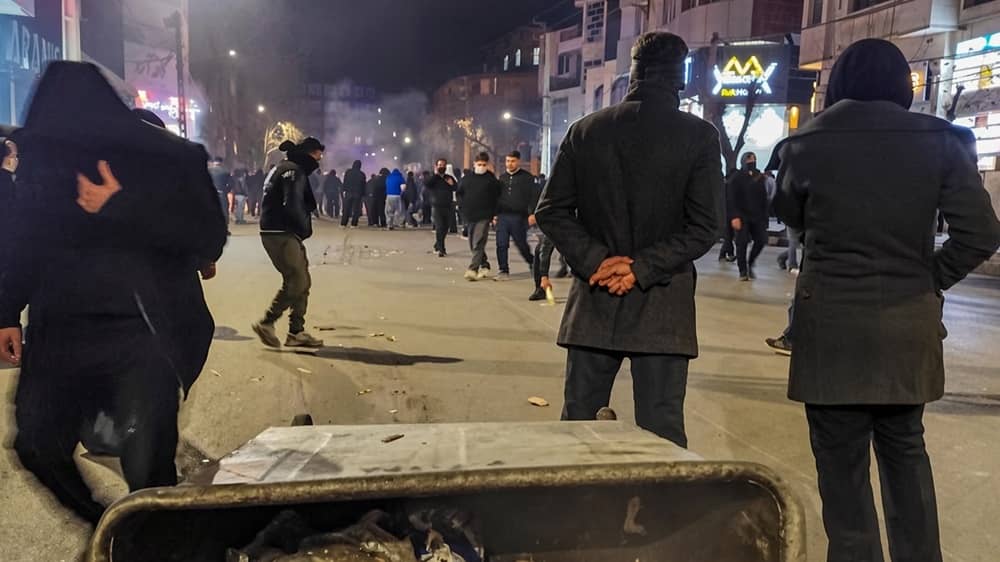
On November 3, the regime executed Amir-Hossein Ebrahimi and Amir-Hossein Maleki, both 20 years old and arrested during the January uprising. Two days later, the People’s Mojahedin Organization of Iran (PMOI/MEK) reported that Resistance Units carried out 30 operations in Tehran and 16 other cities, targeting Basij, IRGC and other regime-affiliated centers in response to the executions.
#Iran’s #Economic Collapse, According to the Regime’s Own Media
Iran’s deepening economic crisis is becoming increasingly evident in statistics and reports published by state-run media. https://t.co/w3IaydnX9Q— NCRI-FAC (@iran_policy) October 24, 2026
The latest actions follow 90 reported Resistance Unit operations on November 2 and continuing anti-execution activities associated with the “No to Executions Tuesdays” campaign.
The regime is therefore facing the combination it has repeatedly sought to prevent: economic deterioration that steadily expands the pool of social grievance, alongside organized networks seeking to turn that discontent into sustained political resistance.
What changed this week is not simply that prices rose again.
It is that regime-produced data now show economic pressure penetrating production, employment and household consumption simultaneously—while the security apparatus is moving against those who respond by taking money out of banks, protesting, or challenging the state politically.
The economy is no longer merely weakening the regime’s social base. It is increasingly becoming part of the regime’s internal-security battlefield.