

Over a highly volatile week from June 27 to July 4, a coordinated network of underground opposition forces launched an unprecedented wave of asymmetric operations stretching across Iran. From the capital of Tehran to the restive southeastern hub of Zahedan, Resistance Units affiliated with the People’s Mojahedin Organization of Iran systematically targeted the regime’s repressive infrastructure, security headquarters, and ideological symbols. This concentrated seven-day surge in nationwide defiance comes amidst acute political vulnerability for the ruling clerical establishment, which has accelerated its state-sanctioned execution campaign in a desperate bid to project control following the death of its supreme leader and a deeply contested succession. By channeling compounding domestic crises into organized political revolt, the Iranian Resistance is openly challenging the state’s facade of absolute authority, revealing a critical vulnerability at the heart of the theocracy.
July 4, 2026
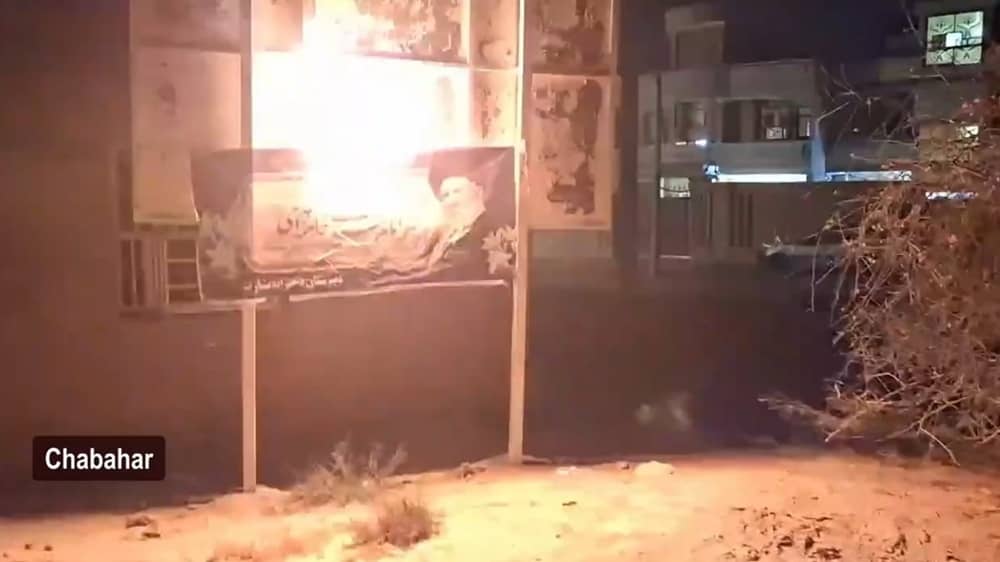
On July 4, 2026, the domestic resistance network executed a massive wave of 30 synchronized “anti-suffocation” operations aimed directly at the regime’s centers of power and security installations. These actions took place against a grim backdrop: the state judiciary had recently executed at least 134 prisoners within a single month, sending 20 people to the gallows over a mere 48-hour span, while simultaneously handing death sentences to political dissidents in sham trials. In a direct response to this terror campaign, operatives struck multiple Islamic Revolutionary Guard Corps (IRGC) and Basij installations. Strategic targets included Basij centers in Sari, Nowshahr, Nishapur, Torbat-e Jam, and Zahedan, alongside a dual strike on a Basij base and an artillery and missile group club in Torbat-e Heydarieh. Sabotage operations also targeted state infrastructure, including a fire at the Rajaei cultural center in Mahshahr and a blaze at a municipality building used for state plundering in Esmailabad. Concurrently, massive ideological banners and billboards depicting the current and former supreme leaders were systematically torched on a highway bridge in Shahriar, and across public spaces in Fooladshahr, Rezvanshahr, Isfahan, Mashhad, Qaemshahr, Tehran, Karaj, Shiraz, Ardabil, Lahijan, Behshahr, Chabahar, Saveh, and Rask.
July 3—Zahedan, southeast Iran
PMOI/MEK Resistance Units resume their weekly activities, defying the regime's apparatus of repression and rejecting all forms of dictatorship, whether the rule of the mullahs or the shah. pic.twitter.com/jNsGPV7JqI— People's Mojahedin Organization of Iran (PMOI/MEK) (@Mojahedineng) July 4, 2026
July 3, 2026
On July 3, 2026, the focal point of the organized opposition shifted toward channeling the country’s severe economic collapse into open political defiance. In the restive southeastern hub of Zahedan, Resistance Units staged weekly public demonstrations, explicitly linking skyrocketing inflation and systemic poverty to the state’s prioritization of military expansionism. Activists distributed literature noting that while the official minimum monthly wage sits at approximately 166 million rials against a cost-of-living line exceeding 450 million rials, the ruling elite has diverted essential public resources to fund nuclear, missile, and foreign proxy conflicts. The protests directly called upon students and educators to expand their strikes and unify their ranks. Simultaneously, specialized teams of young rebels executed targeted visual operations in Shiraz and Karaj, utilizing public graffiti and imaging campaigns to project slogans demanding democracy, equality, and the total dismantling of both monarchical and clerical forms of governance.
July 2, 2026
On July 2, 2026, the momentum of the domestic struggle was carried forward through the structured “No to Executions Tuesday” campaign, which mobilized networks inside prisons and across major metropolitan areas to protest the judiciary’s reliance on sham trials and death sentences. In Qazvin, activists placed a memorial wreath for the executed dissident Akbar Daneshvar Kar, while sweeping flyer campaigns and placards were placed in public spaces across Isfahan, Roodsar, and Sanandaj. In the religious center of Qom, the underground network issued defiant declarations commemorating their executed commander, Vahid Bani-Amerian, explicitly warning the ruling clerics that the accelerating pace of state executions would not go unanswered. Similar declarations condemning capital punishment as a political tool to suppress public uprisings were distributed in Shiraz, Tehran, Tabriz, Semnan, Ramsar, Ahvaz, Shahinshahr, Jahrom, and Mashhad, where operatives declared an unyielding commitment to resist the state apparatus until the final overthrow of the theocratic system.
🚨 Iran: PMOI Resistance Units Report 30 Operations Across the Country
Exclusive footage obtained by Simay Azadi shows members of the PMOI Resistance Units carrying out 30 anti-repression operations across Iran today, targeting IRGC Basij bases and other regime-affiliated sites… pic.twitter.com/FAFuKu7lMz
— SIMAY AZADI TV (@en_simayazadi) July 4, 2026
June 30, 2026
On June 30, 2026, the domestic resistance units initiated a broad, multi-city propaganda offensive explicitly designed to popularize a transitional democratic alternative for the country. Operatives distributed digital media and physical leaflets in numerous urban hubs, publicly pledging allegiance to a progressive ten-point democratic platform. The coordinated actions aimed to counter the regime’s intense domestic security clampdown, which had resulted in the arrest of over 6,500 people since the outbreak of recent regional hostilities, by demonstrating that the underground opposition’s operational capability remains entirely intact despite mass arrests.
June 29, 2026
On June 29, 2026, the operational network executed a highly coordinated domestic campaign specifically designed to echo the political outcomes of the Free Iran 2026 summit recently held in Paris. Operatives flooded high-traffic public spaces in Tehran, Isfahan, and Tabas with placards, graffiti, and posters showcasing the core tenets of the National Council of Resistance of Iran’s political platform. The displays explicitly emphasized a future blueprint for the nation rooted in the strict separation of religion and state, absolute freedom of faiths, and a comprehensive commitment to individual and social rights aligned with the Universal Declaration of Human Rights. By bringing the messaging of the international summit directly onto the streets of major Iranian cities, the units sought to demonstrate a unified operational front bridging the exiled leadership and the domestic vanguard.
Resistance Units target the regime’s repressive apparatus amidst a wave of state executions https://t.co/w4ZQjoZBWo
— People's Mojahedin Organization of Iran (PMOI/MEK) (@Mojahedineng) July 4, 2026
June 28, 2026
On June 28, 2026, a massive wave of 35 coordinated armed and arson operations targeted state security headquarters and judicial buildings across the country. In the western city of Saqqez, operatives carried out consecutive fires targeting both a plundering government municipality and the local State Security Force command headquarters. In Kermanshah, a Basij base utilized for monitoring student populations was set ablaze, while a major fire rocked the 230th Anti-Imam Ali Battalion and its adjacent IRGC Basij headquarters in Khash. Additional arson attacks struck a religious fundamentalist center in Borujen and the Pardis counter-revolutionary court complex in Tehran, where banners of the supreme leadership were reduced to ashes. The offensive extended to the systematic destruction of state security signs and propaganda posters by specialized teams operating in Mashhad, Isfahan, Karaj, Shiraz, Sari, Kerman, Qazvin, Yazd, Hamadan, Bandar Abbas, Zanjan, Zahedan, Sabzevar, Amol, Saveh, and Shahroud.
June 26, 2026
On June 26, 2026, the capital of Sistan and Baluchestan province, Zahedan, became the epicenter for a renewed political offensive that openly challenged the fragility of the central government. Following the death of the state’s long-serving supreme leader and the controversial, contested ascent of his son Mojtaba, the local resistance units deployed highly visible public placards rejecting all forms of dictatorship. The slogans explicitly repudiated both the current clerical system and any potential restoration of the pre-1979 monarchy, characterizing both as inherently repressive models that rely on security forces like the IRGC or the historical SAVAK secret service to maintain power. The actions highlighted the establishment of a transitional provisional government aimed at organizing free democratic elections, explicitly framing the ongoing regional conflict as a desperate shield used by the ruling elite to distract from the inevitability of a domestic popular revolution.
June 28—Iran
PMOI/MEK Resistance Units respond to the regime's repressive measures and threats by the remnants of the shah regime by targeting regime centers of repression and violence against dissidents, protesters, and ordinary citizens. pic.twitter.com/DpEYkFMYoo— People's Mojahedin Organization of Iran (PMOI/MEK) (@Mojahedineng) July 3, 2026
The expanding scale and sophistication of these underground operations reveal a profound structural deadlock within the Iranian state. Faced with acute internal fracturing following the supreme leader’s death and a highly unpopular dynastic succession, the regime has dramatically accelerated its execution machine in a desperate attempt to project absolute invincibility and freeze a volatile society in place. However, the data indicates that this strategy of state terror has fundamentally backfired. Rather than cowing the population into submission, the wave of hangings has served as a catalyst, transforming deep-seated economic desperation and political disenfranchisement into an organized, militant resistance. The ability of the Iranian Resistance to execute highly synchronized attacks against fortified IRGC bases and judicial centers—even amidst a nationwide security lockdown—demonstrates that the state’s apparatus of repression is no longer an absolute deterrent. By systematically rejecting both the current clerical fascism and the authoritarian remnants of the past, these underground networks are actively forging a path toward a democratic republic, proving that the regime’s internal crisis has reached a point where state execution is no longer a sign of strength, but a symptom of terminal vulnerability.