

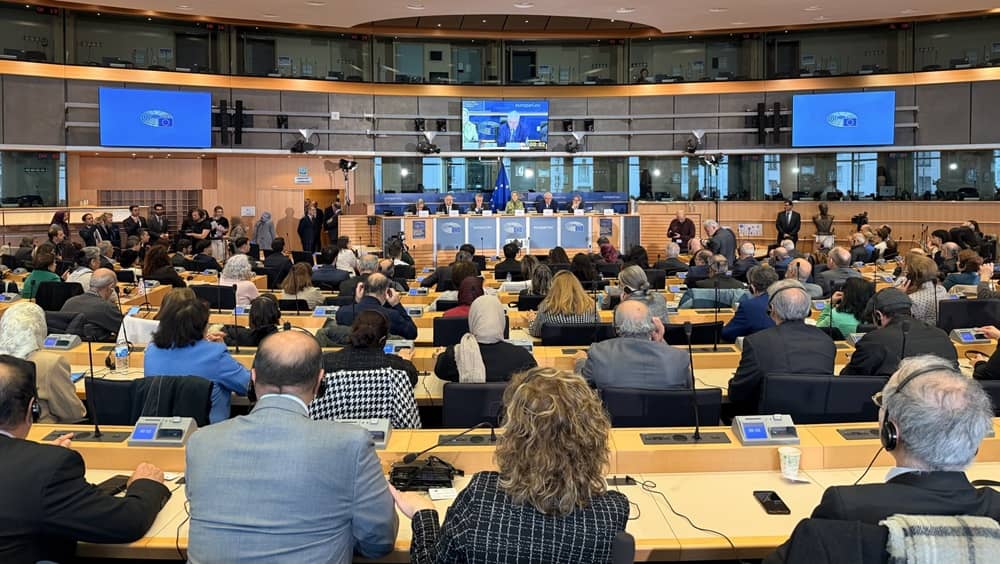
On December 10, 2025, in Brussels, at a major conference in the European Parliament marking Human Rights Day, lawmakers from across Europe joined former prime ministers, senior parliamentary leaders, and human rights advocates to declare that the time has come for the European Union to adopt a serious, principled policy toward Iran—one that recognizes the Iranian people’s right to resist and to overthrow religious dictatorship. The keynote address by NCRI President-elect Maryam Rajavi warned that Iran has reached an “exceptional moment,” with the clerical regime facing an irreversible crisis marked by collapsing legitimacy, accelerating repression, economic free-fall, regional isolation, and a rapidly expanding Resistance movement inside the country. She urged Europe to end its silence, designate the IRGC as a terrorist organization, and refer the regime’s human rights violations to the UN Security Council.
Throughout the conference, speakers condemned soaring executions, the targeting of women and youth, and the regime’s attacks on political prisoners, including 18 Resistance supporters currently on death row. Many underscored the collapse of appeasement, the role of the PMOI Resistance Units, and the global implications of Iran’s struggle, situating it within a broader contest between democracy and autocracy. Repeated calls were made for Europe to recognize the NCRI and Maryam Rajavi’s Ten-Point Plan as a democratic alternative.
MEP Milan Zver stated that Iran represents one of the world’s most severe human rights and security crises, stressing that Tehran’s repression and regional militancy demand a serious European response. He underscored that despite being blacklisted by the regime, many MEPs continue to support the Iranian democratic opposition, adding that the conference must “shape a more serious and principled European policy” toward Iran.
During her speech, NCRI President-elect Maryam Rajavi urged Europe to “recognize the Iranian people’s right to struggle for the overthrow of religious tyranny,” arguing that Iran has entered a decisive phase in which the clerical regime faces an existential crisis. She said the collapse of the regime’s regional “Axis of Resistance,” combined with economic breakdown and nationwide protests, has left the rulers “devoid of any capacity for political or economic reform.” The most serious threat to the regime, she stressed, is “the advance of the Iranian people and Resistance toward an organized uprising,” supported by a rapidly expanding network of Resistance Units across Iran.
Conference at the European Parliament featuring European lawmakers and distinguished public figures#HumanRightsDay#StandUp4HumanRights pic.twitter.com/Us1zc3FT2e
— Maryam Rajavi (@Maryam_Rajavi) December 10, 2025
Mrs. Rajavi declared that all supposed alternatives—reformists, foreign intervention, and appeasement—have failed, while events have validated the NCRI’s Third Option: the overthrow of the regime by the Iranian people and their organized Resistance. She emphasized three principles that now define consensus within Iran’s democratic movement:
-
The overthrow of the velayat-e faqih system by the people themselves.
-
The explicit rejection of both the Shah and the mullahs as forms of dictatorship.
-
The separation of religion and state.
She reaffirmed the NCRI’s commitments to democracy, gender equality, autonomy for Iranian Kurdistan, abolition of the death penalty, and a nuclear-free Iran. Mrs. Rajavi condemned Tehran’s demonization campaign, sham trials of PMOI members, and the execution threat against 18 political prisoners. She called on the EU to designate the IRGC as a terrorist organization and bring Iran’s human rights dossier to the UN Security Council, concluding that the regime has “only one trajectory: downfall,” and the Iranian people have only one path: a democratic republic.
She emphasized that Iranian society “will neither return to the Shah’s dictatorship nor remain trapped under clerical rule,” marking a complete break with all forms of autocratic past.
MEP Petras Auštrevičius said the death sentences for 17 political prisoners supporting the PMOI show the regime is preparing to repeat the atrocities of the 1980s. He noted that the UN Fact-Finding Mission has gathered substantial evidence of crimes against humanity. He urged the EU to support Mrs. Rajavi’s call to refer these crimes to the Security Council and to work with the NCRI on universal jurisdiction cases. He emphasized that the only long-term path forward is Mrs. Rajavi’s Ten-Point Plan, calling it the democratic vision Europe must officially recognize.

MEP Francisco Assis said the recent executions of PMOI supporters are a warning that “a potential new massacre” is unfolding. He argued that the EU must avoid repeating its failure during the 1988 massacre, now officially recognized by the UN. He called for halting diplomatic relations with Tehran until executions stop and UN experts gain access to prisons. He urged closer cooperation with the NCRI, recognizing its democratic alternative and Mrs. Rajavi’s Ten-Point Plan.
Assis noted that Europe must support a democratic alternative, not a return to any prior authoritarian model that once denied Iranians their rights.
MEP Leoluca Orlando described the NCRI and PMOI as a unique organized resistance that has withstood decades of repression, stressing that their survival offers “hope… for justice and democracy.” He highlighted the political significance of women leading the Resistance, calling it a direct challenge to the regime’s misogyny. He affirmed that the NCRI’s opposition to both monarchy and theocracy represents the only viable democratic trajectory.
MEP Orlando underlined that the PMOI’s sixty-year struggle against both the Shah and the mullahs demonstrates that Iranians reject all forms of autocracy, whichever symbol—crown or clerical authority—it carries.
European Parliament – Brussels.
MEP @MilanZver Co-chair of Friends of a Free Iran opening speech before introducing Maryam Rajavi , Leader of Iran's Democratic Opposition @iran_policy @EP_President @vonderleyen @davidmcallister pic.twitter.com/dVvZjTQ6YE— Firouz Mahvi (@FirouzMahvi) December 10, 2025
MEP Andrey Kovatchev said the recognition of the 1988 massacre in the UN’s Third Committee resolution is a critical step toward accountability and “marks a crucial first step” in confronting the regime’s impunity. He condemned death sentences against PMOI supporters and urged Europe to support Mrs. Rajavi’s demand for a Security Council referral. He called for unity within the Resistance, noting that “90% of the Iranian people are fed up with this regime.”
MEP Pekka Toveri said Iran is witnessing the rise of “a powerful force”—the expanding PMOI Resistance Units, which coordinate protests and strikes under lethal surveillance. This, he argued, proves that unrest is not spontaneous but “a structural struggle for democratic change.” He stated that Mrs. Rajavi’s Third Option is “the only credible policy” and rejected any return to monarchy, declaring that Iran’s future “is a democratic secular republic.”
MEP Toveri stressed that Iran must not “return to another autocracy in the form of a monarchy,” insisting that neither a crown nor a clerical turban has legitimacy in Iran’s future.
Former MEP and former Belgian PM Guy Verhofstadt said 18 political prisoners on death row have reaffirmed support for a democratic republic “even under the threat of execution,” demonstrating the political resilience of the Resistance. He condemned the killing of more than 2,600 people in sixteen months and said appeasement “achieved nothing at all.” He urged the EU to recognize the democratic opposition—“especially Mrs. Rajavi”—as the true representative of the Iranian people, list the IRGC as a terrorist organization, and increase sanctions tied to executions.
MEPs greeting @Maryam_Rajavi at her arrival to the European Parliament today to participate in two panels on Iran on #HumanRightsDay
She had a clear message: Europe 🇪🇺 must choose side, it must stand with the people of Iran pic.twitter.com/8V53PcEIOL— Hanif 𝕏 FreeIran (@HanifFreeIran) December 10, 2025
Italian Senator and former PM Matteo Renzi said the regime’s brutality—such as 46 prisoners killed in five days—reveals extreme weakness. After a decade of failed diplomacy, he concluded: “We have to admit that it is impossible” to moderate the regime. The only viable path is to support the movement led by Mrs. Rajavi, whose credibility inside and outside Iran makes democratic change possible.
Former MEP Ryszard Czarnecki emphasized the PMOI Resistance Units’ operations—including burning regime propaganda and Basij centers—as evidence that “the Iranian people will not surrender.” He highlighted the NCRI’s exposure of the nuclear program as a major contribution to global security. He condemned medieval-style public hangings and expressed hope to see “Maryam Rajavi walking freely through the streets of Tehran.”
MEP Rasa Juknevičienė warned that democracies risk repeating mistakes of appeasement seen before major global conflicts. Identifying Russia, Iran, and North Korea as a unified “Axis of Evil,” she urged Europe to intensify support for democratic movements like the NCRI. She echoed Mrs. Rajavi’s message that the fight must continue “before it’s too late.”
Iranian opposition leader Maryam Rajavi
European Parliament Free Iran Conference in Brussels pic.twitter.com/NS4KxSXqXq— Firouz Mahvi (@FirouzMahvi) December 10, 2025
Former MEP Paulo Casaca said the NCRI’s movement has become “more powerful, more united, and more determined” to secure the Iranian people’s fundamental rights. He condemned Iran as a regime that leads the world in per-capita executions and kills people “for having a different opinion.” Casaca called for a global blacklist and sanctions regime targeting all judges, prosecutors, and officials involved in executions, describing them as “criminals against humanity” who must eventually be brought to trial. He said such pressure is an essential tool to strengthen the Iranian people’s struggle “under the leadership of Madam Rajavi” and affirmed that Iran can again embody the humanistic principles symbolized by the Cyrus Cylinder.