

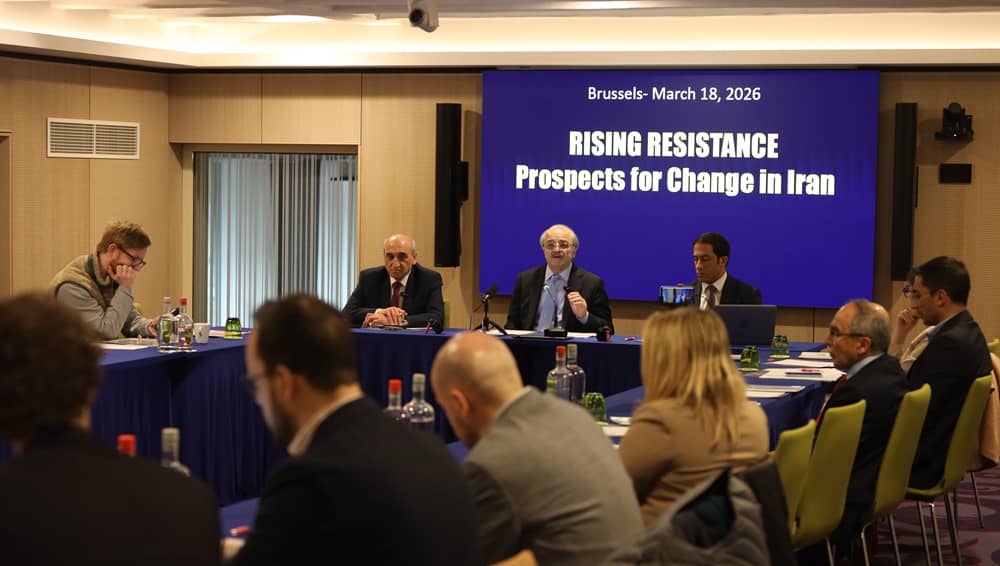
BRUSSELS, March 18, 2026 — Mohammad Mohaddessin, chair of the Foreign Affairs Committee of the National Council of Resistance of Iran, urged European leaders on Wednesday to abandon failed appeasement toward Tehran and instead support “regime change by the Iranian people and their organized resistance.”
Speaking in Brussels on the eve of a European Union summit, Mohaddessin blamed the region’s turmoil on “two key factors: first, the Iranian regime and its conduct; and second, the West’s policy of appeasement.” He argued that negotiations and concessions had helped sustain the Iranian system for more than four decades and enabled the current crisis.
“We have repeatedly warned that this regime is incapable of reform,” Mohaddessin said. “It will not abandon its pursuit of nuclear weapons, its warmongering in the region, or its violations of agreements.”
He added that “appeasement of this regime is like nurturing a snake in one’s sleeve — it inevitably leads to war,” and said Europe’s policy had been “the most significant external factor in sustaining the regime and preventing its overthrow.”
Mohaddessin said the current conflict had only reinforced the NCRI’s longstanding position that neither diplomacy with Tehran nor foreign military intervention could solve the Iran crisis. “The only solution to this crisis is regime change by the Iranian people and their organized resistance,” he said.
Third option is neither appeasement nor war but regime change by the people of Iran and its Resistance#iran
— Maryam Rajavi (@Maryam_Rajavi) June 22, 2013
A central theme of his remarks was that the fall of the Iranian system would not come through spontaneous collapse or media activism alone. “Experience in recent years has proven that illusions such as regime collapse on its own, or change through social media networks and satellite television, are baseless,” he said. “Overthrow requires a powerful, indigenous force rooted within Iranian society.”
He identified that force as the resistance movement led by the People’s Mojahedin Organization of Iran, or MEK, and its network of Resistance Units inside the country. Mr. Mohaddessin said, these units have operated across all 31 provinces for nearly a decade and are “gradually evolving into a liberation army.” He said they had carried out 3,000 operations in the past year alone and had played a “decisive role” during the January uprising by organizing protests, confronting security forces and protecting demonstrators.
Mohaddessin said more than 2,000 members of the Resistance Units went missing during that uprising. He described the February 23 attack on Ali Khamenei’s compound and other heavily secured sites in Tehran as “a major turning point.” He said 250 members of the National Liberation Army took part in the operation, that 100 fighters were killed or arrested, and that 150 returned to their bases. He said the Resistance had submitted to the United Nations the names and details of 82 people killed or detained in the operation, ranging in age from 18 to 69.
At today’s press conference in Paris, I emphasized a simple reality: Foreign war cannot overthrow #Iran’s regime. Only a popular uprising backed by organized resistance can bring democratic change.https://t.co/s5xsoONBVT pic.twitter.com/fzPCiHHW04
— Mohammad Mohaddessin (@Mohaddessin) March 12, 2026
“This operation … sent a powerful message: that a capable and organized force exists within Iran that can confront the regime at the highest levels, even in Tehran,” he said.
He also cited more recent operations, including a March 16 attack by a National Liberation Army unit on the governor’s office in Ahvaz in response to the repression and torture of prisoners in Khuzestan. He said resistance forces had carried out 31 operations on March 3 and 20 more on March 15 targeting the Revolutionary Guards, the Basij and other state institutions.
Turning to the political situation in Tehran, Mohaddessin said the ruling system have become “a hereditary clerical monarchy” with the appointment of Mojtaba Khamenei as supreme leader. He said the move had narrowed the regime’s base further, making it more dependent on the Revolutionary Guards and intelligence services and therefore more fragile.
He said the appointment had faced resistance even within the establishment, saying that more than 30 percent of the Assembly of Experts boycotted the vote and that only 44 members supported Mojtaba Khamenei. He also said the new leadership of threatening to expand the war, close the Strait of Hormuz and deepen reliance on proxy groups.
Tonight, the absolute clerical rule (Velayat-e Faqih) has effectively turned itself into a hereditary monarchy by placing Mojtaba Khamenei on the throne.
But it cannot save the shipwrecked vessel of religious fascism.
Once again, this regime, just like the monarchical… pic.twitter.com/oXigoVaOJ7— Maryam Rajavi (@Maryam_Rajavi) March 9, 2026
Mohaddessin further stated that Mojtaba Khamenei controls assets exceeding $1 trillion through major economic conglomerates and that four regime-linked entities account for 60 percent of Iran’s national wealth while remaining exempt from taxation.
He said the authorities were taking extraordinary steps to prevent another uprising. “The regime is employing various measures to prevent another uprising while attempting to boost the morale of its increasingly fearful and fragmented forces,” he said, listing the heavy deployment of armed personnel in public spaces, shoot-to-kill orders, street maneuvers, the use of proxy forces and internet shutdowns.
He also said, remnants of the former royal system were being used to divide Iranian society and the diaspora. “The Iranian people have made their position clear with the slogan: ‘Down with the oppressor, whether Shah or Supreme Leader,’” he said. “They reject any return to the past.”
Twenty-one years ago, at the European Parliament, I declared: The solution for Iran lies neither in appeasement nor in war, but in a third option: regime change by the people of Iran and the organized resistance.
And today, we see that appeasement has indeed led to the imposition… pic.twitter.com/AV07f6idqv— Maryam Rajavi (@Maryam_Rajavi) June 18, 2025
Mohaddessin pointed to the NCRI’s February 28 announcement of a provisional government, based on Mrs. Maryam Rajavi’s Ten-Point Plan, and said its mission would be to transfer sovereignty to the Iranian people within six months of the regime’s overthrow. He said the initiative had already won the support of more than 1,000 parliamentarians and political figures in the United States and Europe.
In his closing appeal, Mohaddessin said the opposition was not asking for foreign troops, money or weapons. “We are not asking for money, weapons, or foreign troops,” he said. “We call for an end to appeasement.”
He urged governments to recognize the provisional government, acknowledge the Iranian people’s right to resist the Revolutionary Guards and overthrow the regime, close Iranian embassies, expel regime agents and prosecute Tehran’s leaders under universal jurisdiction for crimes against humanity and genocide.