
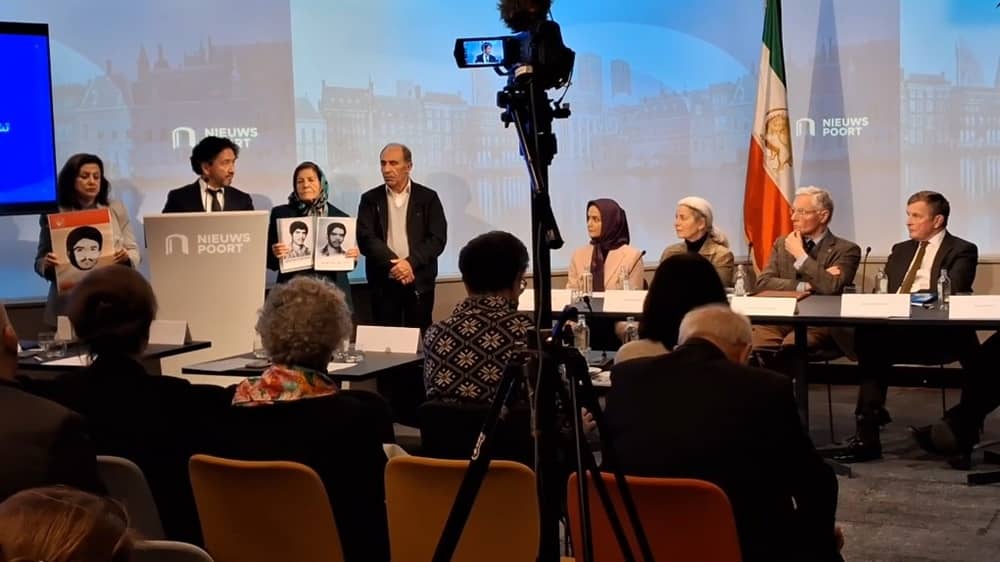
THE HAGUE, Netherlands, November 25, 2026 — Dutch lawmakers, former European and British officials, human-rights advocates and members of the Iranian community gathered in The Hague on the International Day for the Elimination of Violence against Women for a policy conference on Iran, focusing on executions, repression of women, political prisoners and the role of organized resistance inside the country. Speakers argued that intensified repression reflected the clerical authorities’ fear of another uprising rather than political strength, and called on European governments to move beyond managing Tehran’s behavior and support the Iranian people’s right to determine their own future.
Participants also rejected both foreign-imposed regime change and efforts to restore the former monarchy, while several called for direct engagement with the NCRI and greater recognition of the Resistance Units operating inside Iran.
Mrs. Maryam Rajavi, President-elect of the National Council of Resistance of Iran (NCRI), addressed the conference in a message, saying systematic discrimination against women was inseparable from the broader machinery of repression used to contain a society demanding change.
Mrs. Rajavi said November 25 highlighted the institutional nature of misogyny under the clerical system, pointing to compulsory veiling, discriminatory laws and violence against women both by the state and within families.
“The suppression of women is part of a systematic strategy used to contain a society that is demanding change,” Rajavi said.
She cited political prisoners Zahra Tabari and Arghavan Fallahi among women facing death sentences and argued that the regime’s laws had created impunity for so-called honor killings and other forms of violence by male relatives.
“In contrast,” Mrs. Rajavi said, “the leading and pioneering role of women in the Iranian Resistance will both uproot this misogynistic tyranny and guarantee freedom, democracy, and equality in Iran’s future democratic republic.”
Message to the conference in the Netherlands on the International Day for the Elimination of #ViolenceAgainstWomen
The leading and pioneering role of women will both uproot this misogynistic tyranny and guarantee freedom, democracy, and equalityNovember 25th, the International… pic.twitter.com/LLy7YJFQHe
— Maryam Rajavi (@Maryam_Rajavi) November 25, 2026
Mrs. Rajavi said Tehran’s instability was rooted less in its external confrontation than in its conflict with Iranian society. She linked the increase in executions, particularly of PMOI members and protesters, to efforts to deter another uprising and discourage young people from joining the organized opposition.
She emphasized the growing importance of the Resistance Units.
“The continuous activities of an organized resistance, namely the People’s Mojahedin Organization of Iran, both inside and outside Iran have placed this struggle on a strong foundation,” the NCRI President-elect said. “The network of Resistance Units, who confront the IRGC, Basij, and other repressive forces in most Iranian cities, is a significant expression of this resistance.”
Mrs. Rajavi described the Iranian Resistance as “the decisive factor” in future developments and criticized European policies that, in her view, continued to overlook it. She also slammed attempts to promote Reza Pahlavi as an alternative, arguing that such efforts strengthened the clerical authorities by reviving a false choice between two forms of dictatorship.
She called on European governments to make relations with Tehran conditional on stopping executions and the killing of protesters, close Iranian embassies she accused of facilitating intelligence and IRGC activities, and recognize the Iranian people’s struggle against the regime and rebellious youth confronting the Revolutionary Guards.
Op de internationale dag voor uitbanning van geweld tegen vrouwen en meisjes sprak ik over het geweld van het Iraanse regime tegen de eigen bevolking. Ik steun de Iraanse bevolking in hun streven naar een vrij en echt democratisch Iran. pic.twitter.com/q2U0Ef9s2S
— Boris Dittrich (@DittrichBoris) November 25, 2026
First Vice President of the Dutch Senate Boris Dittrich, a former Human Rights Watch advocacy director, placed the Iranian situation within the wider global crisis of violence against women.
Citing UN data, Dittrich said violence against women remained one of the world’s most pervasive human-rights abuses and argued that Iran represented an especially severe intersection of gender repression, executions and political persecution.
He said Tehran had launched an unprecedented wave of political executions following the January uprising, targeting political prisoners, young activists and members of the PMOI.
According to figures cited in his speech, around 60 political prisoners had been executed and at least 100 others, including women, remained on death row.
Dittrich said the purpose was clear: “The regime is doing that to avert another popular uprising.”
He also warned against viewing repression as confined to Iran, citing alleged assassination plots and other acts of transnational repression in Europe.
“The regime is not only suppressing and attacking its own people inside Iran, but also in Europe and also in a country like the Netherlands,” Dittrich said.
He urged opposition groups to seek common ground, saying democratic pluralism required cooperation rather than mutual exclusion.
“A divided house doesn’t have a strong foundation,” he said, while also calling for international legal mechanisms to end impunity for Iranian officials accused of serious human-rights abuses.
@TweedeKamerTwit @2eKamertweets https://t.co/4wI3EMUHAN
— Dorien Rookmaker (@RookmakerDorien) November 26, 2026
Former European Parliament member Dorien Rookmaker, who opened the policy discussion, said the gathering took place at a moment when Tehran was increasingly vulnerable but more repressive.
“Executions, arbitrary arrests, torture, and persecution have become instruments of political survival,” Rookmaker said. “It’s not a demonstration of strength; it is evidence of fear.”
She said women had played leading roles in the uprisings of 2019, 2022 and January 2026 and had also taken leadership positions within the organized Resistance.
“They are not merely demanding change; they are helping to get it,” she said.
Rookmaker said Europe had spent too long approaching Iran through negotiations and attempts to manage the regime’s conduct while neglecting the question of who should determine the country’s future.
“Iran’s future must be decided by its people, not by the ruling clerics, not by foreign governments, or through the restoration of another dictatorship,” she said.
She criticized Pahlavi for relying on foreign support rather than an organized domestic movement and argued that hereditary and religious dictatorship had both failed Iran.
Rookmaker contrasted that with the NCRI’s Ten-Point Plan, which she said offered a program for a secular, non-nuclear republic based on free elections, political pluralism, women’s equality and abolition of the death penalty.
“I believe European governments and parliaments should engage seriously with the NCRI as a democratic alternative rather than perpetuate the false choice between the current dictatorship and a return to the past,” she said, stressing that engagement did not mean choosing Iran’s leaders, which remained the exclusive right of Iranians in free elections.
De internationale gemeenschap mag niet zwijgen over de toenemende executies in Iran. Steun de Iraanse bevolking in haar strijd tegen onderdrukking en voor een vrij, democratisch Iran.#StopExecutionsInIran #FreeIran pic.twitter.com/fiUWcxOrNI
— Iranian van NL(انجمن ایرانی ضد اعدام در هلند) (@humanitaire123) November 25, 2026
Caroline van der Plas, a member of the Dutch House of Representatives, expressed solidarity with political prisoners, families of victims and Iranians campaigning outside parliament.
She said Dutch lawmakers had a responsibility to keep attention focused on repression even when Iran disappeared from the immediate headlines.
“If the people are not here outside the building, it doesn’t mean Iran is a peaceful state with democracy and freedom,” she said. “It is every day.”
Van der Plas said she was particularly affected by the cases of young people imprisoned, tortured or killed “for only one thing, and that is speaking out for freedom.”
She also warned that Iranian activists in the Netherlands remained vulnerable to surveillance by Tehran and said Dutch democracy gave parliamentarians a responsibility to speak for people denied similar political freedoms.
Gisteren in Den Haag spraken we over mensenrechtenschendingen en de toename van executies in Iran. Dank aan de @2eKamertweets en haar leden voor de ruimte om onze stem te laten horen en hun steun voor een vrij #Iran zonder dictatuur. #StopExecutionsInIran pic.twitter.com/wJTHcvGg4t
— Jong Iraans Nederland (@JongIraansNL) November 26, 2026
Former UK Cabinet minister David Jones, who served as Secretary of State for Wales and is co-president of the British Committee for Iran Freedom, said more than two decades of following the Iranian opposition had convinced him that repression had failed to destroy organized resistance.
“Repression, however brutal, has failed to stop the Iranian resistance,” Jones said.
He cited the November 2019 uprising, the 2022 protests and the January 2026 revolt, and said the NCRI’s network of Resistance Units played “a central role in sustaining opposition to the regime.”
Jones called for international accountability over killings and executions and said The Hague’s role in international justice gave the Netherlands a special responsibility.
“The world has got to go beyond merely condemning the Iranian regime,” he said. “We must all do what we can to put an end to its impunity.”
He highlighted the case of political prisoner and boxing champion Mohammad Javad Vafaei Sani, who recently received a Magnitsky Human Rights Award while remaining under a death sentence.
Jones also emphasized the historical depth of the organized Resistance, noting that the PMOI was founded in 1965 and had opposed both the Shah and the clerical system.
“A democratic future cannot be constructed by whitewashing the past,” he said.
Jones distinguished the former Shah’s rule from constitutional monarchies such as those in the Netherlands and Britain, pointing to SAVAK’s record of surveillance, imprisonment and torture. He also raised concerns about proposals to preserve elements of the current security apparatus without accountability.
“Can we preserve the structures of dictatorship, recycle, if you like, elements of its repressive apparatus without accountability and call that a democratic transition? Of course we can’t,” he said.
Jones said no opposition group should claim an exclusive right to speak for Iran and cautioned against treating selective protest footage as evidence that any single movement commanded nationwide support. Ultimately, he said, Iran’s political future had to be settled by Iranians themselves.
He nevertheless urged Dutch parliamentarians to engage seriously with the NCRI’s Ten-Point Plan, describing its commitments to popular sovereignty, political freedoms, equality, minority rights, judicial independence and abolition of the death penalty as “fundamental democratic principles.”
On the International Day for the Elimination of Violence Against Women, a conference in the Netherlands focused on Iran’s escalating human rights crisis.
Rising executions, systematic repression and the urgent need for democratic change were central themes.
The message was…
— Nasser Razii (@n_m_raz) November 25, 2026
Dutch MP Christine Teunissen focused on the persecution of women, particularly the case of singer Parastoo Ahmadi, who she said had recently received 74 lashes after performing without compulsory hijab.
“Seventy-four lashes for singing,” Teunissen said, describing the punishment as emblematic of institutionalized gender inequality.
She called on the Netherlands to continue pressing for strong sanctions against Tehran and said gender discrimination and violence had to be addressed as serious international human-rights violations.
“We see your grief and we share your anger about this injustice,” she told Iranian participants. “We admire your courage and we stand side by side with you for democratic rights in Iran, a free Iran.”
Dutch Senator Frans van Knapen said the combination of war, economic deterioration and political repression had created a cycle in which Tehran portrayed domestic dissent as foreign subversion and used that narrative to justify arrests and executions.
He rejected the idea that Pahlavi could offer a democratic solution.
“The idea that the son of the late and former Shah, Reza Pahlavi, could be an instrument for the regime change in order to create a future democratic Iran is wishful thinking,” he said.
“Never again a monarchy. Let the people choose.”
Van Knapen said the NCRI represented the stronger democratic option and praised Mrs. Rajavi’s Ten-Point Plan as a practical framework for Iran’s future.
De internationale gemeenschap mag niet zwijgen over de toenemende executies in Iran. Steun de Iraanse bevolking in haar strijd tegen onderdrukking en voor een vrij, democratisch Iran.#StopExecutionsInIran #FreeIran pic.twitter.com/X1ThFMNgyR
— Iranian van NL(انجمن ایرانی ضد اعدام در هلند) (@humanitaire123) November 25, 2026
Dr. Azadeh Akhbari, an academic and government adviser who also moderated part of the conference, gave a personal account of having been imprisoned as a child with her parents and younger brother in Vakilabad Prison, where her grandmother and uncle were executed in 1982.
Akhbari said that experience shaped her understanding of the Resistance Units operating today.
“What matters to me about the Resistance Units is how they break the silence imposed by repression,” she said. “They connect protests that might otherwise stay isolated, and they keep hope alive for change from within in Iran.”
She also emphasized the leadership of women in the organized opposition, saying that by taking responsibility in Resistance networks and protests, women were already asserting their right to equal leadership.
Akhbari rejected both foreign military intervention and Pahlavi’s political strategy, saying war would allow Tehran to accuse protesters of collaboration with an enemy and intensify repression.
She also accused Pahlavi’s supporters of divisive tactics and intimidation, based in part on her own experience in diaspora political gatherings.
Akhbari concluded by calling attention to Vafaei Sani, who remains imprisoned in the same Vakilabad prison where her own family had been held.
“For a family waiting outside the prison gates, tomorrow can be too late,” she said, urging lawmakers to intervene publicly on behalf of prisoners facing execution.
De toekomst van Iran moet door het Iraanse volk zelf worden bepaald, via vrije en democratische verkiezingen. Geen religieuze dictatuur, geen terugkeer naar de monarchie, maar een vrije republiek.#stopexcutioniniran
#FreeIran pic.twitter.com/scLIYoOw0M— Iranian van NL(انجمن ایرانی ضد اعدام در هلند) (@humanitaire123) November 25, 2026
Pouya Bolandmartabeh, representing Iranian youth organizations, argued that neither decades of engagement with Tehran nor foreign wars had produced democratic change.
“Neither appeasement nor war is the solution to the crisis in Iran,” he said. “The Iranian people themselves must bring about this change.”
He described the Resistance Units as the “most important force for change” inside Iran and said their role had expanded during successive uprisings despite arrests, disappearances and executions.
The speaker also strongly criticized Pahlavi, accusing his supporters of intimidation and saying the former Shah’s son had no comparable organized network inside Iran.
“The Iranian people are not fighting to replace one dictatorship with another,” he said. “They want freedom, a democratic and secular republic, and the right to determine their own destiny.”
Dr. Parissa Kamali, a former senior research fellow at Harvard Medical School, said Iran’s human-rights crisis was systematic rather than a collection of isolated abuses.
She highlighted executions, torture, coerced confessions, denial of legal representation and intimidation of families, but said repression was particularly visible in the treatment of women.
Dr. Kamali cited several young women and political prisoners who had been sentenced to lengthy imprisonment or death after participating in protests.
#BELANGRIJK 🇳🇱 Vandaag in Nieuwspoort: Families van geëxecuteerde politieke gevangenen spreken Senatoren en Tweede Kamerleden toe tijdens een conferentie over Iran, de toenemende executies en de noodzaak van een democratische oplossing.#StopExecutionsInIran #SaveMohammadJavad pic.twitter.com/iL35BPaAEQ
— Pouya BMT (@BMT_FreeIran) November 25, 2026
“International silence is not neutrality,” she said. “Silence creates space for impunity.”
She called on Dutch parliamentarians and senators to demand an immediate end to executions, press for the release of political prisoners, keep individual death-penalty cases on the political agenda and support the Iranian people’s Resistance movement.
The conference also heard an emotional appeal concerning Mohammad Javad Vafaei Sani from Reza Shayesteh of Iranian associations in the Netherlands who said members of his own family had been executed in Vakilabad Prison in the 1980s.
He described Vafaei Sani as a symbol of a generation willing to pay a heavy price for freedom and appealed directly to Dutch lawmakers.
“Your voice and your political influence can save lives,” he said, urging them to oppose Vafaei Sani’s execution publicly, seek cancellation of his death sentence and continue raising the cases of political prisoners facing execution.
Across the conference, speakers returned repeatedly to three connected themes: that the execution surge was intended to suppress another uprising; that women and organized Resistance networks had become central actors in challenging the system; and that Europe should stop treating Iran’s future as a choice between accommodation with the clerical regime, foreign military intervention or restoration of monarchy.
The alternative advanced by most participants was political change driven from within Iran, backed by organized Resistance Units and framed by a democratic program based on free elections, secular government, gender equality and abolition of the death penalty.
On a day dedicated internationally to ending violence against women, that argument took on an additional dimension: speakers portrayed Iranian women not simply as victims of repression, but as a central force in the struggle to replace it.