

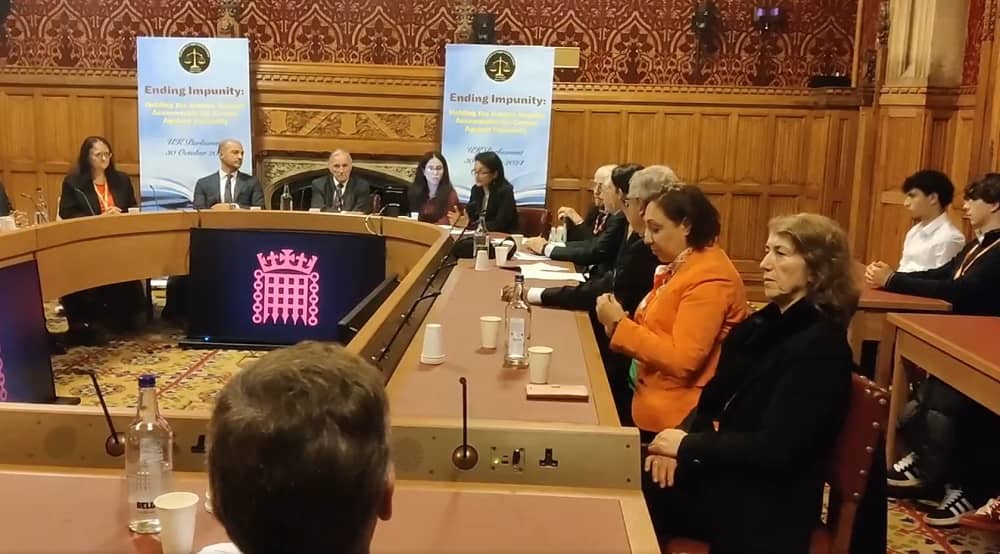
London, October 30 – In a forceful parliamentary conference, the Anglo-Iranian Lawyers Committee gathered on Wednesday, uniting members of the UK Parliament, legal experts, human rights advocates, and Iranian community members to advocate for accountability on Iran’s human rights abuses. The conference, attended by representatives from both Houses of Parliament, tackled the growing demand for an end to impunity in Iran, escalating executions, and international recognition of the 1988 mass executions as genocide. Among the prominent speakers were Councilor Robert Ward, Lord Bruce, and human rights activist Professor Sara Chandler, all calling for unified international action and stronger support for Iranian citizens.
Hosting the event, Neda Zabeti, Secretary of the Iranian Lawyers Committee in the United Kingdom, recalled the horrific abuses faced by women and children under Iran’s regime. “Almost every Iranian has a personal story of friends or family who suffered arrest, torture, or worse,” she said, sharing her own family’s tragic experiences. Zabeti cited the regime’s responsibility for widespread human rights abuses, noting, “Iran’s 853 confirmed executions in 2023 alone make it the world leader in state executions.” She implored the UK to “recognize former UN Rapporteur Dr. Javaid Rehman’s report” and “list the IRGC as a terrorist group,” concluding with Martin Luther King Jr.’s words: “Injustice anywhere is a threat to justice everywhere.”
Lord Bruce, co-host of the conference, commended the resilience of the Iranian diaspora and the courage of those in Iran, highlighting parallels between the Iranian struggle and historic movements like the Solidarity campaign in Poland. “Your persistence and bravery inspire deep respect,” he said, encouraging attendees to “never give up.” Reflecting on the progress of international support, Lord Bruce acknowledged the UK’s role but called for stronger, more effective measures to assist the Iranian people in achieving a free and democratic Iran.
Azadeh Zabeti, Chair of the Anglo-Iranian Lawyers Committee, opened her speech by highlighting the Iranian people’s aspirations for “a free republic with separation of religion from the state.” She recounted the regime’s repression since 1979, noting that “hundreds of thousands of political prisoners have been executed” while Iranians live “under siege by a brutal regime.” Zabeti underscored the regime’s violent methods against civilians, including tear gas, and steel batons, and reported cases of sexual violence against detainees.
پارلمان انگلستان – چهارشنبه ۳۰ اکتبر
کمیته وکلای ایرانی در انگلستان در یک کنفرانس پارلمانی با شرکت نمایندگان پارلمان از دو مجلس و وکلای برجسته و شهرداران و شخصیتهای دانشگاهی و فعالان حقوق بشر و حقوق زنان برگزار کردند.
در این کنفرانس سخنرانان خواستار اقدام بین المللی برای حسابرسی… pic.twitter.com/swVpsjNAlR— Mohamad Imani (@mehr4ashraf) October 30, 2024
Councilor Robert Ward of Croydon, a known supporter of Iranian rights, voiced frustration over the UK’s lack of action on the Islamic Revolutionary Guard Corps, urging immediate steps to designate it as a terrorist organization. “To hesitate over designating the IRGC is preposterous,” Ward stated, pointing to the organization’s role in “hundreds of thousands of deaths across the Middle East.” Comparing Iran’s potential for democratic change to the unexpected fall of the Soviet Union, Ward expressed optimism, saying, “I look forward to the day we can say the same for Iran.” He further emphasized the regime’s repression of basic freedoms, where something as minor as a “crooked hijab” can lead to life-threatening consequences.
MP Jim Shannon, Chair of the All-Party Parliamentary Group on Freedom of Religion or Belief, framed his comments around the regime’s long-standing pattern of human rights abuses and its repression of religious and political freedoms. “Human rights and persecution are married together,” he stated, underscoring the plight of political prisoners and the regime’s extensive record of executions. Shannon urged the UK government to formally recognize the 1988 massacre of 30,000 political prisoners as genocide, stressing, “This acknowledgment is long overdue,” and denouncing the UK’s past “soft line policy.” He called for immediate sanctions against Supreme Leader Khamenei and advocated for placing the IRGC on the UK’s terrorism list.
Human rights lawyer Professor Sara Chandler, a former chair of the Law Society’s Human Rights Committee, added urgency to the call for international accountability, referencing the UN Special Rapporteur’s recent findings on the 1988 massacre and the regime’s 2022 crackdown on protesters. Chandler cited both the UN fact-finding mission report and the recent work of Dr. Javaid Rehman, which classified the massacre as genocide and crimes against humanity. “It’s critical,” she urged, “that the international community steps up with universal jurisdiction to ensure justice.” Chandler also advocated for support for Iranian human rights defenders and encouraged lawyers and activists worldwide to press for actions within the UN and International Criminal Court.
Lord Hacking emphasized the importance of “holding Iran accountable through international mechanisms.” He endorsed the push for the UK government to partner with international allies in bringing Iran to justice through the International Criminal Court and through sanctions.
Masoud Zabiti, President of the Iranian Bar Association in the UK, highlighted the Iranian regime’s global threat and criticized the West’s longstanding “appeasement” strategy, which he argued has only emboldened the regime’s aggressive actions. “For years, successive governments have believed in the illusion of a ‘moderate mullah,’” Zabeti stated, urging immediate policy change. He emphasized the need to list the IRGC as a terrorist organization, asking, “What are we hesitating about?” Citing the IRGC’s role in conflicts across the Middle East, Zabeti stressed that the regime’s impact reaches beyond Iran’s borders, affecting global security. He warned, “Lives are lost not just in Iran but across the world due to policies that embolden Tehran.
As the conference closed, the Anglo-Iranian Lawyers Committee reaffirmed its commitment to advocating for democratic reform in Iran, with speakers agreeing that the price of freedom may be high but is essential for Iran’s future stability and the peace of the region.