

Four-minute read
The clerical regime is broadcasting a new doctrine at home: détente failed; only raw power protects the state. In practice, that “paradigm shift” functions as an ideological cudgel to criminalize the previous negotiating track, discipline wobbly elites, and paper over an economy in deep distress. Over the past week, regime media and officials fused three themes—repudiation of engagement, juridical intimidation of former decision-makers, and celebration of nuclear and missile restoration—to manufacture momentum where little exists.
Kayhan, overseen by the Supreme Leader’s representative, set the line. It declared that the 1990s-born policy of “tension-reduction” had “failed to sustainably secure national interests and security,” because it rested on “optimism toward the structure of the international system.” The paper framed a “paradigm transformation” as “inevitable,” insisting policy must “shift from engagement-centrism to power-building.” This is less analysis than indictment. By declaring détente a flawed premise rather than a mistimed tactic, Kayhan delegitimizes an entire current inside the state and licenses punitive measures against its figures.
Khamenei Rejects U.S. Overtures, Says Conflict with U.S. Is Permanenthttps://t.co/93WEuazTdr
— NCRI-FAC (@iran_policy) November 3, 2025
Death Sentence for Rouhani
Punishment followed the talking points. Tehran MP Kamran Ghazanfari told the Didban-e Iran website that “people are waiting to see the judiciary issue a death sentence for Hassan Rouhani,” adding that some alleged charges rise to “efsad-fel-arz,” warranting “several executions” if “proven in court.” He derided the former president as “brazen,” claiming he now “acts as if the system owes him.”
The campaign widened. Parliamentary presidium spokesman Abbas Goudarzi demanded action against former foreign minister Mohammad-Javad Zarif, accusing him of “disturbing public opinion” and “feeding the enemy’s mill.” In his telling, today’s crises all stem from Rouhani’s eight-year presidency and a negotiating posture caricatured as “any agreement is better than no agreement,” which allegedly “stopped both national progress and the centrifuges.”
In Friday prayers on October 31, 2025, Khamenei’s appointee in Khorramabad, Ahmadreza Shahrokhi, said the 2013–2021 governments kept Iran “waiting for the empty promises of America and Europe” while failing to use “capacities of other countries,” before praising two rapid trips by the Supreme National Security Council secretary to Moscow as proof of proper alignment.
#Iran’s Ruling Class Turns on Itself as Crises Deepenhttps://t.co/CTjgQXrpTj
— NCRI-FAC (@iran_policy) November 2, 2025
Double Game
To underline that the red line is not diplomacy per se but submission, Ali Larijani—now Secretary of the Supreme National Security Council—offered the calibrated version on November 2, 2025: “We are not saying we won’t negotiate… but it must be real negotiation,” not a process where outcomes are “prewritten” by the other side. He cast external demands as endless: first “no enrichment,” then “reduce missile range,” then “do what we say in the region.”
If Larijani supplied the courtroom tone, his brother Mohammad-Javad Larijani provided the menace. On November 2, 2025, he boasted that Iran is a country that “could have an atomic bomb in less than two weeks,” only to add that the system “decisively does not want” a bomb—an assertion meant to preserve plausible deniability while signaling latent capability.
The regime’s president Masoud Pezeshkian tried to straddle the divide and pleased no one. After visiting damaged nuclear facilities, he vowed on November 2, 2025, that Tehran will “rebuild with even greater power.” He also recycled the official line that a religious edict bars nuclear weapons and argued that Iran’s scientific base makes reconstruction inevitable: “By destroying one or two buildings, they cannot solve the issue… we will rebuild and with more power.” Yet this same president, on August 9, 2025, had warned: “If we rebuild, they will strike again… someone tell me what we intend to do?” The Islamic Revolutionary Guard Corps’ Quds-linked media pounced within hours of his November remarks, blasting “expressions of weakness” that supposedly tell the enemy “There is no image but that of Iran’s ‘weakness.’” The resulting tableau—president as messenger, security organs as editors—captures the system’s hierarchy and its insecurities.
#Iran’s Power Structure Buckles Under Political, Economic, and Nuclear Pressurehttps://t.co/abvkCn5vAj
— NCRI-FAC (@iran_policy) September 9, 2025
Parliament Vents Crisis
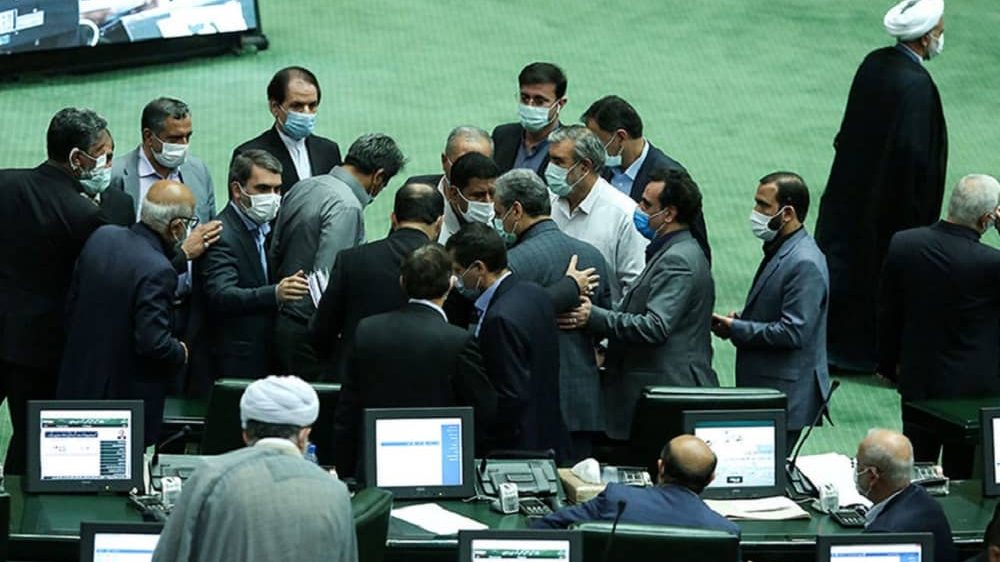
Inside the Majles, the economic crisis dissolved what remained of message discipline. Lawmakers from across the map flooded the floor with warnings. Hossein Samsami, a veteran MP, called an “economic catastrophe” imminent if the government scraps the 28,500-rial preferential exchange mechanism, likening it to the inflationary shock from eliminating the 42,000-rial rate in 2022.
Others said “people can no longer bear these prices and runaway inflation,” and that “every day prices go up but wages are fixed,” while a representative from Sistan and Baluchistan asked the president if he “hears the sound of people’s bones breaking” under “soaring rent,” “collapsed purchasing power,” and “joblessness that forces the young into fuel smuggling—bread at the price of life.”
On the parliamentary floor, Hamid Rasāee accused Vice President Mohammad Reza Aref of holding an “illegal” position because his son holds German citizenship, declaring that “law-breaking begins from here” and warning the speaker that silence amounts to complicity.
Even Speaker Mohammad Bagher Ghalibaf—usually the conductor—was reduced to cutting microphones as deputies accused the executive of “market abandonment,” “law-breaking appointments,” and clandestine digital-platform deals.
#Iran’s Power Struggle Escalates as State Media Admits Setbacks, Snapback Tightens, and the Street Simmershttps://t.co/sxHEeUIuiK
— NCRI-FAC (@iran_policy) October 12, 2025
Unity Narrative Falls Apart
The regime is no longer steering events; it is reacting to overlapping crises it cannot contain. With senior officials calling for Rouhani’s execution, MPs accusing Aref of disloyalty, and security figures contradicting the president on the nuclear file, the system is no longer trying to present a united front. Khamenei’s long-used language of vahdat—unity and coherence—has given way to public disciplining, loyalty tests, and punitive signaling inside the elite.
The world is now witnessing a state trying to hold its own factions in place as the pressure overwhelms them. The crisis is no longer at the edges; it is inside the ruling class.