

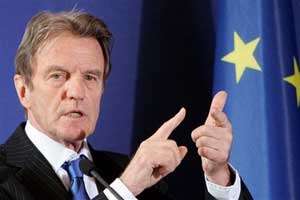
 PARIS (AP)–French Foreign Minister Bernard Kouchner said Tuesday that an incentive package offered by leading powers to draw Iran into dialogue is "very generous" and will be delivered to Tehran within days.
Kouchner, speaking to reporters, wouldn't reveal details of the package before it was seen by Iran. However, he said that if Iran doesn't make the proposal public once it has been delivered, it will be put on the Internet so the Iranian people can learn about it.
"They are very precise and very generous," Kouchner said of the measures being offered by France, the U.S., U.K., Germany, Russia and China.
"Each word was weighed, believe me," he said, adding that he believes they could "change a bit the nature of the game and above all the state of mind."
Kouchner said it wasn't clear who would be taking the proposals to Tehran, which has defied the international community by refusing to suspend its uranium enrichment program.
There is a fear Iran intends to use the process to develop nuclear weapons – something Iran denies. Tehran contends its program is to be solely devoted to civilian energy.
The agreement on the new incentives came at the start of the month, four months after a third set of U.N. sanctions was leveled against Iran.
"It is not a question of Iran renouncing the smallest parcel of energy. On the contrary," Kouchner said of the incentive package.
The minister said it was his hope the proposal would be published by Iran so the Iranian public knows "we are ready to do anything. That is the sense of this proposal. After sanctions, dialogue."
"If not, we will publish it across the world, obviously on the Internet, etc. so that the Iranian people know," Kouchner said.