

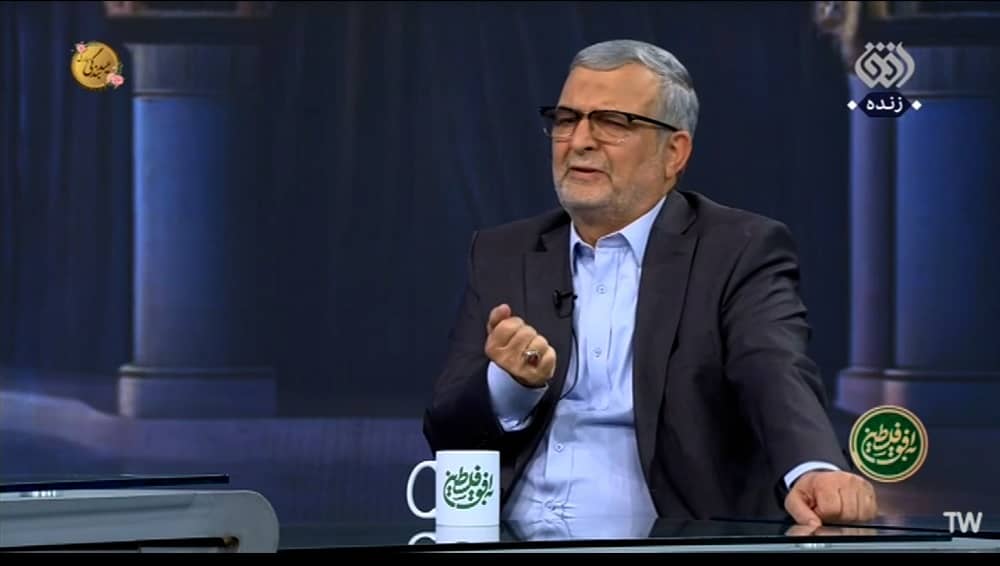
The Iranian regime’s deep-seated fear of collapse was laid bare during a televised interview with Hassan Kazemi Qomi, a former IRGC Quds Force commander and Tehran’s ex-ambassador to Iraq and Afghanistan. Speaking on the state-affiliated Ofogh TV on April 1, Kazemi Qomi made alarming claims about U.S. demands that he alleges target the very foundations of the clerical dictatorship.
Kazemi Qomi asserted that Washington has demanded the disbanding of the IRGC and its integration into the conventional military, the dissolution of regional proxy forces, and a reduction of Iran’s missile range to 200 kilometers. He added that the Americans also demand the eradication of all post-revolutionary institutions, particularly the Office of the Supreme Leader, declaring, “What do the Americans want from us? They want us not to interfere in the region, to reduce our missile range to 200 kilometers, and to disarm all the regional resistance forces. This means dismantling everything that the Islamic Republic has built since the revolution.”
Kazemi Qomi further warned that such alleged demands equate to dismantling the regime’s security architecture, including its regional proxies and missile capabilities. “The American goal is clear: to eliminate our defensive power and all the institutions established to protect the revolution. If that happens, there will be nothing left of the Islamic Republic,” he stated, emphasizing his belief that these demands are meant to dismantle the very structures that keep the regime in power.
The Real Goal of #Iran’s Negotiations: Surviving, Not Settling https://t.co/TaSPUkGx6K
— NCRI-FAC (@iran_policy) January 29, 2025
Who is Hasan Kazemi Qomi
Kazemi Qomi is a long-time figure within Iran’s Islamic Revolutionary Guard Corps (IRGC), particularly its Quds Force, which specializes in extraterritorial operations and unconventional warfare. His background and career trajectory highlight his deep involvement in the IRGC’s efforts to extend the regime’s influence across the Middle East and beyond, often under the guise of diplomatic roles that mask his military and intelligence activities.
As a high-ranking commander in the Quds Force, he developed a reputation for orchestrating terrorist activities and building networks of operatives loyal to Tehran’s terrorist agenda. Kazemi Qomi was not only involved in military operations but also played a key role in intelligence gathering and covert operations within the region.
According to reports from the Iranian Resistance, Kazemi Qomi operated a network of agents and proxies under the supervision of Iran’s embassy in Baghdad, exploiting diplomatic cover to conduct espionage and terrorism in Iraq. He maintained close ties with senior IRGC Quds Force commanders, including Brigadier General Ahmad Forouzandeh and Brigadier General Hamid Taghavi. Additionally, he facilitated the training of militant groups through collaboration with the Badr Organization, sending operatives to Iran under the pretext of religious pilgrimages for terrorist training.
During his tenure as ambassador to Iraq, Kazemi Qomi was actively involved in efforts to eliminate the People’s Mojahedin Organization of Iran (PMOI/MEK) from Iraq, a key objective for the regime’s strategy in the region. Even after his ambassadorship ended, the regime retained him in Iraq under the title of ‘Head of the Headquarters for the Reconstruction of Holy Shrines,’ which allowed him to continue his operations without drawing diplomatic scrutiny.
#Iran’s Leadership Unites Behind #Khamenei’s Hardline Stance Against U.S. Negotiationshttps://t.co/cNKeSgWHql
— NCRI-FAC (@iran_policy) February 9, 2025
Under the presidency of Ebrahim Raisi, he was appointed Special Representative of the President to Afghanistan, further solidifying his role in Iran’s aggressive regional policy. His statements during the interview are considered significant, given his prominent role in Tehran’s regional strategies and his deep ties to the regime’s most militant factions.
Kazemi Qomi’s comments reflect the regime’s core belief system: It will not survive if forced to abandon its long arms of terror, weapons of mass destruction, and its medieval reign of an unelected and tyrannical Supreme Leader. While the U.S. has never officially stated it seeks regime change, Tehran’s leadership is evidently too weak to withstand any change in its oppressive policies and terrorism, highlighting that its very survival depends on perpetuating its repressive and destabilizing tactics.