

Four-minute read
Iran’s grid and water systems are buckling under a mix of chronic mismanagement and entrenched corruption—despite the country’s vast energy endowment. In the past week, senior officials have publicly conceded that “managerial imbalance” is driving power and fuel shortages, while new data and satellite analyses show Tehran’s reservoirs at historic lows. Emergency shutdowns, rolling blackouts, and warnings that the crisis will extend into winter underscore a deeper breakdown that years of oil and gas wealth have failed to prevent.
Admissions
Parliament Speaker Mohammad-Bagher Ghalibaf acknowledged on September 16, 2025, that Iran controls “about 19.5 percent of the world’s oil and gas,” yet still faces electricity and gas cuts. He blamed a self-inflicted failure of governance: “These problems are exactly where we lack systemic thinking… we either don’t know or don’t want data governance… I have said before that managerial imbalance has brought us imbalances in gas, water, and electricity; unless we fix that, nothing else will be fixed.”
The head of the state power utility (Tavanir), Mostafa Rajabi-Mashhadi, reinforced the message a day earlier, warning on September 15 that “the severe electricity imbalance will not end soon; we must prepare for the cold season.” His remarks made clear that shortages will persist past summer peaks and into winter, when gas demand surges.
Why #Iran Is Running Out of Water, Power — and Patiencehttps://t.co/9ZghlJCNpO
— NCRI-FAC (@iran_policy) August 13, 2025
Grid strain
The admissions arrive after a summer of crisis management rather than solutions. On August 5, 2025, authorities closed government offices and banks across much of the country to relieve the overtaxed grid during extreme heat—at least the second such shutdown this summer. News agencies cited a yawning gap between roughly 62,000 MW available and about 80,000 MW needed at peak, with rolling cuts of around two hours that officials warned could extend to four.
The closures—unusual for the capital—were an admission that the grid cannot meet routine demand spikes without resorting to blunt tools. They followed earlier emergency measures and public appeals to reduce consumption amid forecasts of temperatures reaching 50°C in several provinces.
November 19 – Isfahan, central #Iran
Thousands of locals are joining farmers protesting for their share of water from the local Zayandeh-rud River. Regime officials have long rerouted the waters for their own purposes.#IranProtests#اعتراضات_سراسریpic.twitter.com/OCnuGUSEYM— People's Mojahedin Organization of Iran (PMOI/MEK) (@Mojahedineng) November 19, 2021
Water crunch
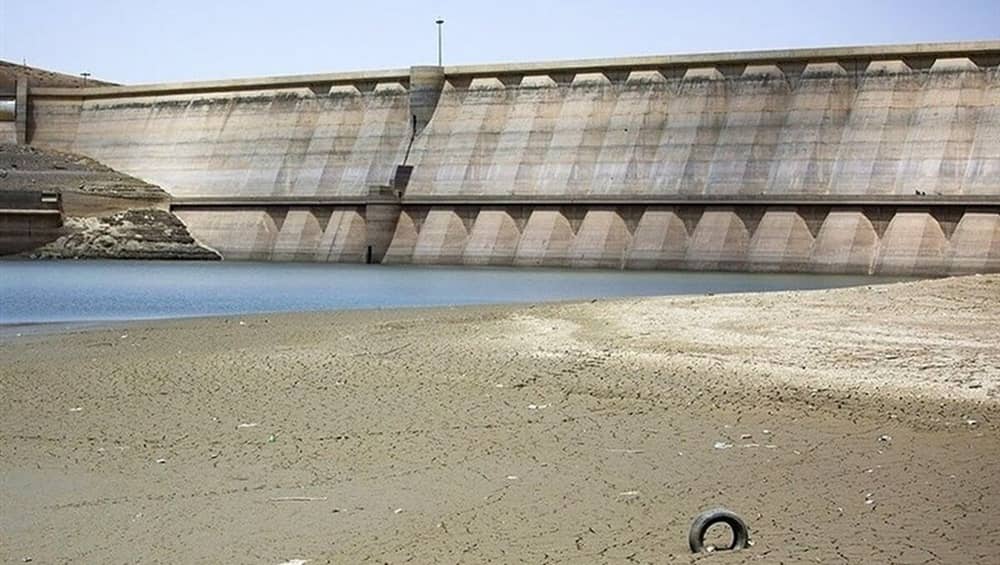
Power insecurity is magnified by a parallel water emergency. A detailed assessment published on September 21, 2025, reported rainfall down about 42 percent versus the long-term average and 19 major dams at critically low levels. Tehran’s key reservoirs—Lar, Malu, and Amir-Kabir (Karaj)—were described as nearly depleted, increasing the risk of supply restrictions inside the capital.
Independent satellite analysis earlier showed the deterioration in stark terms: on August 13, 2025, Lar Dam—a main supplier for eastern and northern Tehran—had fallen below 10 percent of capacity, while Amir-Kabir held about six percent of its usable volume. The images captured exposed lake bed where water once stood, placing Tehran at “unprecedented risk.”
The broader ecosystem is also in free fall. Lake Urmia, once the Middle East’s largest saltwater lake, is again on the brink, with exposed salt flats fueling dust storms and soil salinization across the region, the latest satellite-based reporting noted on September 10, 2025.
#IranRevolution has rendered the morale of state officials and security forces to an all time low. Watch and judge how this particular #IRGC commander is warning his audience to prepare for what's ahead. pic.twitter.com/bTgPtql2CJ
— NCRI-FAC (@iran_policy) December 31, 2022
Corruption and governance
While authorities frequently cite sanctions or weather for supply failures, governance indicators point to a systemic problem. Transparency International’s 2024 Corruption Perceptions Index ranks Iran 151st of 180 countries with a score of 23/100, among the worst globally, underscoring the distortions and leakages that starve infrastructure of maintenance and investment.
Those distortions show up in daily life. In early September, reports documented widespread frustration as blackouts and water cuts disrupted families and public services, while officials rotated between appeals for patience and promises of improvement.
This collapse also stems from the regime’s own budget priorities as much as mismanagement. On September 13, EghtesadOnline reported that Tehran steers vast sums to ideological and para-state bodies instead of fixing the grid, dams, and basic services: the Islamic Propagation Organization totals 6,258 bn tomans (core 2,969 bn plus side lines like 295 bn “cultural grants,” 250 bn for so-called, 50 bn to a Quranic fund, and multiple Table-12 tranches including 200 bn “strategic Quran,” 25 bn “Mahdaviat,” 50 bn family/“youthing,” 30 bn pro-natalism, 50 bn “hijab”); its high-profile affiliates draw separate lines—Institute for the Compilation of the Works of Khomeini (334 bn) alongside 210 bn for the Khomeini shrine and 41.6 bn for its research arm (together 595.6 bn), Setad Amr-be-Ma’ruf (259 bn), Research Institute for Islamic Culture & Thought (135 bn), Islamic Encyclopedia Foundation (121.5 bn), and the Computer Research Center of Islamic Sciences (163 bn).
The Supreme Council of Seminaries rises to 9,051 bn (including 7,379 bn for the main council and 1,482 bn for the women’s network). The Ahl-al-Bayt World Assembly still receives 291 bn; Jame’at-al-Mostafa al-Alamiyyah climbs to 1,955 bn; the Imam Khomeini Education & Research Institute (founded by Mesbah-Yazdi) reaches 454 bn. The Baqiatallah Cultural & Social HQ books 1,954 bn plus 30 bn in Table-12—and an extra €30 million (≈ 3,360 bn tomans at ~112,000 per euro) under a defense-oil clause, taking it near 5,344 bn. Above all, IRIB expands far beyond its headline 29,631 bn base once add-ons are counted—roughly 43,000 bn tomans after extras like 8,000 bn for productions, a ~2,996 bn provincial “minimum 7%” earmark, and several Table-12 allocations (1,500 bn, 100 bn, 100 bn, 60 bn, 50 bn, 40 bn, 8.2 bn).
Read the exclusive interview with Mr. @Mohaddessin on #IranRevolution
"What are the perspectives of ongoing protests in Iran that many consider as an uprising? Why has the uprising persisted in the last 100 days?" https://t.co/3IgEdFDYAr— NCRI-FAC (@iran_policy) December 29, 2022
The winter test
With winter approaching, Iran faces the prospect of dual shortages: electricity and gas. Officials have floated plans for a “winter drill” while warning the public to expect continued conservation orders. The latest energy commentary suggests the gas deficit could widen substantially over the next decade without sweeping reforms, a forecast that mirrors the electricity sector’s stresses.