

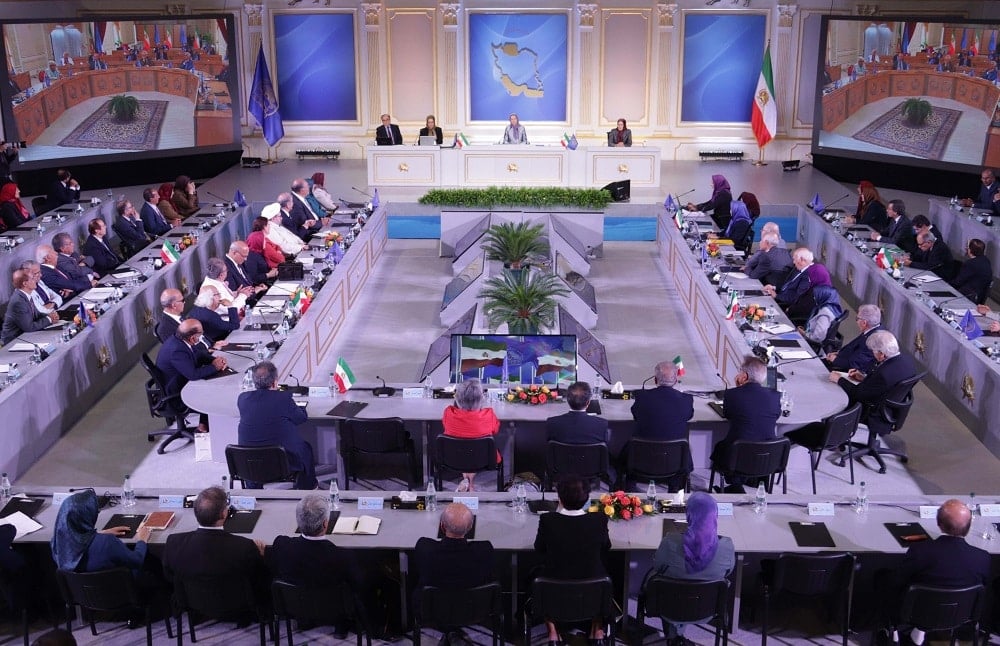
On July 21, 1981, marking the anniversary of the Iranian people’s uprising in support of the revered Prime Minister of Iran, the late Dr. Mohammad Mossadegh, and one month after the onset of mass executions of opponents of the Iranian regime, the formation of the National Council of Resistance (NCRI) was announced in Tehran by Mr. Massoud Rajavi, then-leader of the People’s Mojahedin Organization of Iran (PMOI/MEK) . Immediately, several other Iranian groups and prominent individuals joined the coalition.

Subsequently, Mr. Rajavi traveled to Paris and resided in Auvers-sur-Oise north of Paris, where NCRI held its sessions.
In Autumn 1981, the NCRI, during a series of comprehensive sessions formulated, approved and published its program. Additionally, the NCRI ratified its internal procedures, which were later expanded with further ratifications and details.
The NCRI has stipulated that the provisional government will be in power for only six months and its main and urgent responsibility is to hold free and fair elections for a National Legislative and Constituent Assembly and to transfer power to the representatives of the people of Iran. Once this assembly is formed, the National Council of Resistance will dissolve, and the provisional government will submit its resignation to the Constituent Assembly.
The Constituent Assembly is tasked with drafting the constitution of the new republic, appointing a new government, and legislating to govern the country until the new constitution is ratified. The term of the Constituent Assembly is limited to a maximum of two years.
Vote for NCRI President-elect
The NCRI Secretariat announced on October 22, 1993, that in a landmark plenary session, the NCRI voted unanimously to elect Mrs. Maryam Rajavi as the President-elect for the transitional period after the downfall of the religious dictatorship regime. Her mandate is to oversee the peaceful transfer of power to the Iranian people following the regime’s overthrow.
In this capacity, Mrs. Rajavi has mounted an extraordinary political, social, cultural, and ideological challenge to the ruling mullahs in Iran. Under her leadership, women have risen to hold leading positions in the Iranian Resistance. Over half of NCRI members are women.
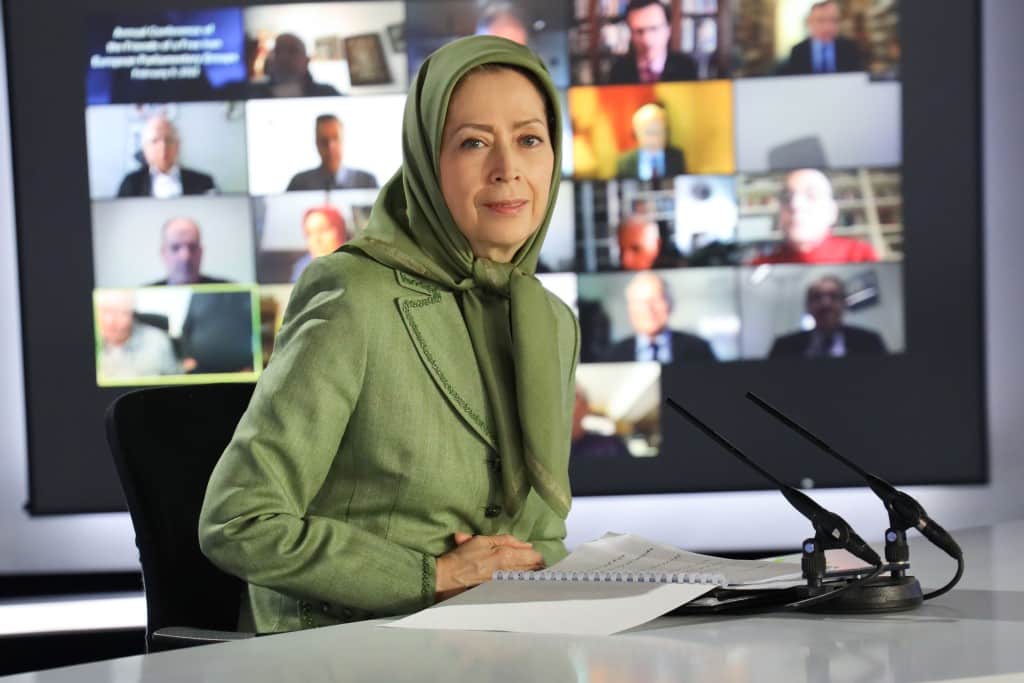
The NCRI has approved a number of plans for Iran’s future, including:
- The Peace Plan of the National Council of Resistance, adopted on March 13, 1983 to end the war with Iraq.
- The Plan for the Autonomy of Iranian Kurdistan, adopted on November 8, 1983.
- The Plan on the Relationship between State and Religion, adopted on November 12, 1985.
- The Plan for Women’s Freedom and Rights, adopted on April 17, 1987.
- The NCRI Resolution on Permanent Representatives and the Senior Secretary, adopted on October 16, 1991.
- The NCRI resolution on the election of Mrs. Maryam Rajavi as President-elect for the transition period, adopted on August 28, 1993.
- The NCRI resolution on adopting the Lion and Sun as the official emblem of the NCRI, adopted on August 29, 1993.
- The National Solidarity Front plan for overthrowing religious dictatorship, adopted on November 4, 2002.
- The Ten-Point Plan for the Future of Iran, introduced in April 2006.
The NCRI operates as a parliament in exile and a legislative body. It has 450 members, 56% of whom are women, and is organized into 25 committee that act as shadow ministries. According to its internal regulations, council meetings are convened with a quorum of one-half plus one of its members, and decisions are passed by a majority of one-half plus one of those present.
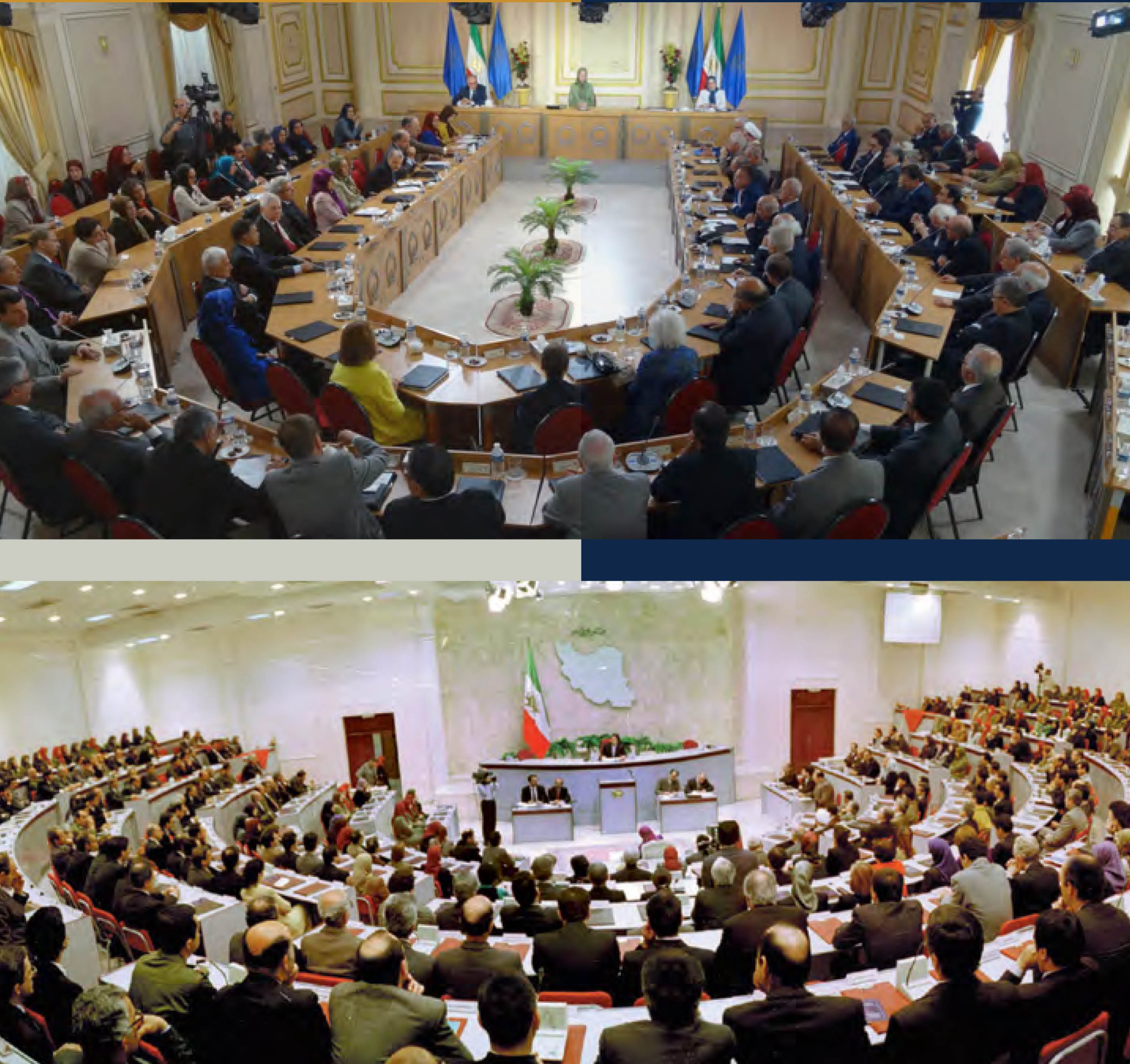
However, throughout its existence, the council has based its decision-making process on the principle of consensus and has endeavored to include diverse opinions and opposing views in its resolutions, ratifications, and decisions.
The NCRI represents the religious and ethnic diversity of Iran, including Kurds, Baluchis, Arabs, Turks, Persians, Turkmens, Muslims, and non-Muslims. It brings together representatives from a broad spectrum of Iranian society, encompassing various political views, ideologies, followers of different faiths, and even atheists.
Members of the NCRI include artists, writers, doctors, merchants, entrepreneurs, university professors, military personnel, athletes, politicians, experts, and industrialists.
NCRI Charter
The NCRI’s charter was approved unanimously during its first session in February-March 1982 and amended unanimously on September 30, 1997. Excerpts are:
- The National Council of Resistance of Iran was formed to overthrow the Khomeini regime and establish a provisional government.
- The NCRI will temporarily assume legislative and supervisory roles over the country’s administration until the National Constituent and Legislative Assembly is formed and operational.
- Every individual or political entity accepted as a member of the NCRI is granted one vote.
- The NCRI’s sessions are considered official with the presence of at least half plus one of its members. Decisions are made with the majority of those present.
- The NCRI’s decisions are binding for its members and the provisional government.
- Within the framework of the NCRI’s resolutions, the right to question and impeach the provisional government or any of its members is reserved for all NCRI members.
- NCRI members must personally attend council meetings and are not permitted to send a representative or substitute in their place.
- The NCRI’s expenses are financed through membership dues and voluntary contributions from supporters in and out of Iran, who are committed to Iran’s freedom and independence.
NCRI Bylaws
(Approved unanimously at the first NCRI session in February and March 1982, and amended unanimously on September 30, 1997). Excerpts are as follows:
- At the suggestion of any member and with the approval of the NCRI President, or at the suggestion of at least three members, an item can be placed on the NCRI’s meeting agenda, respecting the order of proposals. Presenting matters outside the agenda, in sequence, is allowed for a total duration of up to one hour.
- To introduce urgent, out-of-turn proposals, the approval of one-third of the members present is required. Voting takes place after hearing explanations from the proposer in favor and one person against, unless prior written consent from 10 members has been obtained.
- Any member may propose a vote on whether the deliberations are sufficient. If an absolute majority (of the members present) is achieved, the sufficiency of the discussion (end of debate) is declared.
- The NCRI’s decisions and discussions will remain confidential until the establishment of the provisional government within the country, except for topics that the NCRI Chairman deems permissible to make public.
Note: If it is not possible to convene and gather NCRI members, decisions will be made through written consultations with all members. The approval of at least two-thirds of the members is required. The consultation forms will be sent to the members’ last known address on record with the Secretariat. If no response is received within one week of the dispatch, the member will be considered absent from the consultation.
5. The management of the NCRI’s ongoing affairs, its committees, and the coordination of internal relations according to NCRI regulations is the responsibility of the NCRI’s Senior Secretary. To this end, the Senior Secretary will convene necessary meetings, inviting the members deemed essential.
6. The responsibility for appropriately refuting accusations made against the NCRI or its members lies with the relevant member or NCRI body.
7. The expulsion of a violating member from the NCRI will be carried out according to Article 1 of this bylaw and Article 4 of the NCRI’s charter. The grounds for expulsion are as follows:
a. Violation of the commitments specified in Article 5 of the NCRI charter, especially breaches of political demarcations with the Shah’s regime and the clerical regime.
b. Failure to adhere to NCRI decisions, which are deemed binding under Article 6 of the charter.
c. Non-compliance with Article 4 of the NCRI’s bylaws.
d. Absence from NCRI meetings for more than three consecutive sessions without prior notice or a valid excuse.
e. Engaging in consistent actions against the unity, cohesion, and advancement of the NCRI’s objectives.
8. The continuation of membership for individuals accepted into the NCRI based on their affiliation with an organization is contingent upon their continued membership in that organization.
9. (Article approved on October 5, 2014): The procedure for resignation from the NCRI is as follows:
a. If the resignation is for personal reasons, it will be resolved with the Senior Secretary in accordance with Article 7 of the bylaws.
b. If the resignation is politically motivated, the resigning member will attend the NCRI meeting to explain their reasons. The discussions will be recorded and made public. The member may also request limited sessions in accordance with Article 7 of the internal bylaws.
c. At the same time, the resigning member will hand over any responsibilities and duties to the NCRI’s Secretariat and settle any financial matters in accordance with Article 10 of the charter.
This process distinguishes a natural and honorable resignation from acts of betrayal, political opportunism, or backstabbing, which are manifestations of the Velayat-e Faqih regime’s attempt to undermine the sole democratic alternative.
Ten-Point Plan by NCRI’s President-elect, Maryam Rajavi on the Future of Iran
The Ten-Point Plan for Iran’s Future was first presented by Mrs. Maryam Rajavi in December 2006 at a session of the Council of Europe in Strasbourg, France. This plan encapsulates the aspirations of the Iranian people and the Iranian Resistance for a future Iran: a pluralistic republic based on the separation of religion and state, gender equality, the abolition of the death penalty, peace, coexistence, the elimination of double oppression against Iran’s ethnic and national minorities, and a non-nuclear Iran. This plan has been repeatedly recognized by resolutions from the U.S. Congress, several European parliaments, and prominent international figures as a vision for a free Iran.
- Rejection of velayat-e faqih (absolute clerical rule). Affirmation of the people’s sovereignty in a republic founded on universal suffrage and pluralism.
- Freedom of speech, freedom of political parties, freedom of assembly, freedom of the press and the internet; Dissolution and disbanding of the Islamic Revolutionary Guard Corps (IRGC), the terrorist Qods Force, plainclothes groups, the unpopular Basij, the Ministry of Intelligence, Council of the Cultural Revolution, and all suppressive patrols and institutions in cities, villages, schools, universities, offices, and factories.
- Commitment to individual and social freedoms and rights in accordance with the Universal Declaration of Human Rights. Disbanding all agencies in charge of censorship and inquisition. Pursuit of justice for massacred political prisoners, prohibition of torture, and the abolition of the death penalty;
- Separation of religion and state, and freedom of religions and faiths;
- Complete gender equality in the realms of political, social, cultural, and economic rights and equal participation of women in political leadership. Abolition of any form of discrimination; the right to choose one’s own clothing freely; the right to freely marry and divorce; and to obtain education and employment. Prohibition of all forms of exploitation against women under any pretext;
- An independent judiciary and legal system consistent with international standards based on the presumption of innocence, the right to defense counsel, the right of appeal, and the right to be tried in a public court. Full independence for judges. Abolition of the mullahs’ Sharia law and dissolution of Islamic Revolutionary Courts;
- Autonomy for and removal of double injustices against Iranian nationalities and ethnicities consistent with the NCRI’s plan for the autonomy of Iranian Kurdistan;
- Justice and equal opportunities in the realms of employment and entrepreneurship for all of the people of Iran in a free market economy. Restoration of the rights of blue-collar workers, farmers, nurses, white-collar workers, teachers, and retirees;
- Protection and rehabilitation of the environment, which has been massacred under the rule of the mullahs;
- A non-nuclear Iran that is also devoid of weapons of mass destruction. Peace, co-existence, and international and regional cooperation.

NCRI’s plans
The NCRI’s Plan on Women’s Freedoms and Rights
17 April 1987
In honor of the remarkable sacrifices and unforgettable resistance of all women fighters and activists in our homeland against Khomeini’s inhumane regime, and with the conviction that discrimination against women is contrary to justice and human dignity, we emphasize the necessity of abolishing all forms of oppression, coercion, and discrimination imposed by Khomeini’s reactionary regime regarding women in our country.
With a commitment to “full equality of social, political, cultural, and economic rights for both women and men,” and in pursuit of “comprehensive rights for all women in the country, free from any inequality and exploitative limitations,” which rejects any commodification of women and aims for the historical liberation of both Iranian men and women, we outline the following as guiding principles and the action plan of the provisional government of the Democratic Islamic Republic of Iran:
- The right to elect and be elected in all elections and appointments and the right to suffrage in all referendums.
- The right to employment and free selection of profession, and the right to hold any public or government position, office of the profession, including the presidency or judgeship in all judicial institutions.
- The right to free political and social activity, and travel without the permission of another person.
- The right to freely choose one’s clothing and attire.
- The right to use, without discrimination, all instructional, educational, athletic, and artistic resources; and the right to participate in all athletic competitions and artistic activities.
- Recognition of women’s associations and support for their voluntary formation throughout the country; consideration of special privileges in various social, administrative, cultural, and particularly educational fields in order to abolish inequality and the dual oppression of women.
- Equal pay for equal work; prohibition of discrimination in hiring and during the term of employment; equal access to various privileges such as vacations, retirement benefits, and disability compensations; enjoyment of child and marital benefits and unemployment insurance; the right to salary and special accommodations during pregnancy, childbirth, and care of infants.
- Full freedom in choosing a spouse and entering into marriage shall occur only with the mutual consent of both parties and must be registered with the appropriate legal authority. Marriage before reaching the legal age is prohibited. In family life, any form of coercion or imposition on women is strictly forbidden.
- Equal right to divorce: Divorce shall take place through competent judicial authorities. Men and women are equal in presenting grounds for divorce. Custody of children, their financial support, and the settlement of financial matters will be determined in the divorce ruling.
- Support for widowed and divorced women, as well as children under their care, shall be provided through the national social security system.
- Elimination of legal inequalities in matters of testimony, guardianship, custody, and inheritance.
- Polygamy is prohibited.
- Any form of sexual exploitation of women, under any pretext, is forbidden. All customs, laws, and regulations that allow parents, guardians, or others to transfer a girl or woman to someone else for sexual gratification or exploitation, under the guise of marriage or any other title, shall be abolished.
The above declaration was unanimously ratified and signed on April 17, 1987, by all member organizations and personalities of the National Council of Resistance of Iran.
The NCRI’s Plan on religion and denomination – Excerpts
November 1985
- All forms of discrimination against the followers of various religions and denominations in the enjoyment of their individual and social rights are prohibited. No citizens shall enjoy any privileges or be subject to any deprivations in respect of nomination for election, suffrage, employment, education, or becoming a judge of any other individual or social rights for the reason of belief or non-belief in a particular religion or denomination.
- Any form of compulsory religious or ideological instruction, as well as any coercion regarding the practice or non-practice of religious rituals and customs, is prohibited. The right of all religions and denominations to teach, proselytize, and freely practice their rituals and traditions, along with the protection and respect of their places of worship, is guaranteed.
- Judicial authorities shall not exercise jurisdiction based on religious or ideological beliefs. Only laws enacted by the country’s legislative body shall have official sanction and validity.
Along with the annulment of the rules of qesas (retaliation), hudud (punishments like amputation, stoning, executions, etc.), ta’zirat (punishments), and diyat (religious penalties) imposed by the inhumane clerical regime, and the dissolution of the so-called revolutionary courts, prosecutors’ offices, and shari’a courts, which are among the immediate tasks of the Provisional Government, all judicial processes, including criminal investigations and the resolution of claims and trials, will be conducted within the unified judicial system of the Republic, based on universally recognized legal principles and in accordance with the law. - Government authorities and affiliated public institutions are strictly prohibited from conducting religious, denominational, or ideological inquisitions in any form.
This declaration, consisting of a preamble and four articles, was unanimously approved during the National Council of Resistance of Iran’s session on November 12, 1985.
Excerpts of NCRI’s Plan on the Autonomy of Iranian Kurdistan
8 November 1983
The National Council of Resistance of Iran announces the present plan for securing the autonomy of Iranian Kurdistan in order to secure and strengthen as much as possible the popular sovereignty, territorial integrity, and the national consolidation and unity of the country, and in view of the just struggles of the people of Kurdistan for the provision of democracy in Iran and autonomy in Kurdistan and in order to overcome the double oppression of the oppressed Kurdish nationality.
This plan is capable of being effected within the framework of the program of the National Council of Resistance and the Provisional Government of the Democratic Islamic Republic of Iran and the Immediate Tasks of the provisional Government , and has been specifically drawn up and ratified on the basis of Article 3 of the Immediate Tasks of the Provisional Government, that the anti-popular war waged against the people of Kurdistan must be brought to an end by declaring autonomy for Kurdistan within the framework of Iran’s territorial integrity, (and) attempts must be made to eliminate the consequences of this war. The plan shall guide the future actions of the Provisional Government over the autonomy of Iranian Kurdistan. The arrangements and manner of execution of the present plan shall be specified by the Provisional Government of the Democratic Islamic Republic of Iran. The Provisional Government is bound to make the necessary efforts to fulfill this plan.
- The autonomous region encompasses all of Iranian Kurdistan. The geographical domain of this region shall be determined by reference to the general vote of the people in the region occupied by the Kurds.
- The legislative organ in the internal affairs of the autonomous region is the Supreme Council of Kurdistan, the members of which shall be elected through free elections with a general, direct, equal and secret ballot.
The general laws of the Republic are binding in the autonomous region. The ratification made by the Supreme Council of Kurdistan must not violate the general laws of the Republic. - The administration of all affairs of the autonomous region of Kurdistan, a part from the affairs cited below that are recognized to be within the authority of the Central Government, falls within the authority of the organs of autonomy.
The determination of the highest organs of running these affairs and for monitoring their activities is the responsibility of the Supreme Council of Kurdistan. - The maintenance of internal security in the autonomous region is the responsibility of the organs of autonomy, which shall organize an appropriate force for this task with observance of Article 2 of the present plan.
- Affairs related to foreign policy and foreign relations, national security of the Republic and national defense (consisting of protection of the borders, preservation of territorial integrity and unity of the Republic) are within the authority of the Central Government. The Armed Forces in the autonomous region, as in other parts of Iran, do not have the right to intervene in internal security affairs.
- Affairs related to foreign trade and Customs, determination of the monetary and financial system of the country, execution of the duties related to the Central bank, drafting of the general budget and economic programs that are of national importance or that require considerable investments, are within the authority of the Central Government.
Administration of other economic affairs of the autonomous region fall within the authority of the organs of autonomy. Exploitation of natural resources and general assets of the country that are of national importance is within the authority of the Central Government and shall take place to the benefit of the entire population of Iran. In the autonomous region of Kurdistan, the organs of autonomy shall assist the central Government to exploit these resources and assets. - The Kurdish language is the official language for teaching and internal correspondence in the autonomous region, and the right to learn in the Kurdish language is officially recognized for all inhabitants of the region. The Farsi tongue is the official language in the autonomous region as in other region of Iran, and shall be taught in schools alongside the Kurdish language. The Kurdistan autonomous region’s administration shall correspond with the capital, with other regions, as well as with the departments attached to the Central Government that are in the autonomous region, in Farsi. All non-Kurdish inhabitants in autonomous Kurdistan are free to practice their own culture and have the right to receive education in their own language.
- All rights and freedoms stipulated in the Universal Declaration of Human Rights and the international covenants related to it, such as the freedom of belief and expression, freedom of the press, freedom of the formation and activity of political parties and organizations, trade, workers and rural unions and councils, democratic associations, freedom to choose occupation and place of residence, and freedom of religion shall be guaranteed in Kurdistan as in other parts of Iran. All inhabitants of Kurdistan, be they women or men, shall enjoy equal social, economic, political and cultural rights, as in other regions of Iran, without any form of sexual, tribal, ethnic or religious discrimination.
- There is a single judicial system in the Republic and in the autonomous region the courts will deal with claims in accordance with laws of the Republic and also laws passed by the Supreme Council of Kurdistan. The security forces of autonomous Kurdistan, like the security forces of other parts of the country, will act as the bailiffs of the judicial Ministry and are bound to implement the verdicts, orders and arrangements of the courts and judicial authorities.
- The organs of autonomy are bound to refrain from interfering in the affairs recognized to be within the special authority of the Central Government, and are obliged to assist the Central Government to carry out its duties in the region. In the same manner, the Central Government and its executive organs of autonomy to carry out their duties.
- The Central Government, in carrying out its duties in securing the rapid progress and development of the backward regions of the country, is charged to allocate a greater share of public revenues to overcome the backwardness of the autonomous region of Kurdistan.
- The people of the autonomous region of Kurdistan, like the rest of their compatriots throughout Iran, will participate in running the affairs of the country through legal channels and without any form of discrimination.
The present plan, consisting of an introduction and 12 articles, was unanimously approved by the National Council of Resistance of Iran on November 8, 1983.
Excerpts of Plan for National Solidarity Front to Overthrow the Religious Tyranny in Iran
Dear compatriots,
Freedom-seeking and independence-oriented political forces in Iran,
We recall when Mrs. Maryam Rajavi, the President-elect of the National Council of Resistance of Iran for the transition of power to the people of Iran, described national solidarity as a symbol of the determination and fervor of all components of the great Iranian nation in their quest for liberation from clerical oppression. She emphasizes that this solidarity transcends any group or political interests, reflecting the deepest aspirations for freedom among the Iranian people of all beliefs, ideologies, and ethnicities, and embodies their unwavering resolve to overthrow Khomeini’s inhumane and unpatriotic regime (July 20, 1994).
In response to the requests, proposals, and inquiries from those eager for freedom regarding ways to strengthen and expand national solidarity, the NCRI announced:
To facilitate united action among political forces seeking collaboration in the struggle, but who, for any reason, do not wish or are unable to adhere to the NCRI’s programs and resolutions, the NCRI has approved a plan for a National Solidarity Front aimed at overthrowing the religious dictatorship. This plan has been proposed to all freedom-seeking and independence-oriented political forces in Iran, testing our capacity for solidarity, willingness to collaborate, and ability to unite.
Text of the plan:
- The National Council of Resistance of Iran (NCRI) underscores the commitment of its members to NCRI’s platform, provisional government, its plans, adopted documents and its political structure, and announces the Plan for National Solidarity Front for the Overthrow of the Religious Tyranny in Iran. The NCRI is willing to cooperate with other political forces within the framework of this Front.
- The National Solidarity Front encompasses all forces seeking a republic committed to full rejection of the velayat-e faqih system (absolute rule of clerics) with all its internal factions and groupings, and those who struggle for the establishment of a democratic and independent political system based on separation of religion and state. The National Solidarity Front regards any propaganda in favor of the clerical regime and its factions, as well as negotiations or establishing contacts with them, as a red line in its pro-democracy efforts and a crucial patriotic boundary separating the Iranian people from clerical rule. This serves as a criterion for distinguishing friend from foe and for defining the nature of relations with all political individuals and groups.
- Those who wish to join the Front must pledge their commitment to Article 2 of this plan. During the Front’s inaugural session, all matters concerning the Front, including the review of membership applications, the drafting and adoption of relevant guidelines, and the internal elections of the Front, will be addressed.
This Plan was adopted with three articles and a note by the National Council of Resistance of Iran on 4 November 2002.