

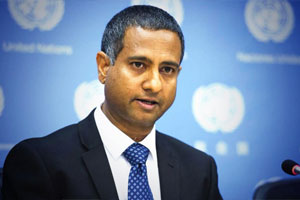
The special United Nations investigator of human rights in Iran presented a highly critical report on Tuesday that contradicted the Tehran government’s own assessment, describing a record rate of executions, a deeply flawed judiciary and repression of journalists, dissidents, women and freedom of expression, The New York Times wrote reported on Wednesday.
The conditions described by the investigator, Ahmed Shaheed, a former Maldives foreign minister and an expert on human rights in Muslim-majority countries, belied the image of moderation and eased constraints that the Iranian regime’s President Hassan Rouhani has sought to project since taking office in 2013.
In some ways, Mr. Shaheed said, Iranians are worse off than during the era of Rouhani’s predecessor, Mahmoud Ahmadinejad. Amendments to a criminal procedure law, for example, impose new restrictions on access to legal counsel. Some defendants must now choose lawyers from a pool selected by the head of the judiciary.
“The human rights situation in the country remains dire,” Mr. Shaheed said in a briefing at the United Nations. Despite Rouhani’s pledge to lighten the repressive atmosphere that prevailed during the Ahmadinejad years, Mr. Shaheed said, there was a “strong disconnect between the professed policy of engagement and the behavior of authorities on the ground.”
It was Mr. Shaheed’s fifth report on Iran since he was appointed to the post of special rapporteur in 2011, and his first since the completion of a nuclear agreement in July between Iran’s regime and the major world powers, which will end many isolating sanctions on the regime in exchange for a halt to some atomic work.
Much of Mr. Shaheed’s report focused on what he described as the Iranian regime’s shortcomings and failures to honor basic tenets of United Nations human rights doctrine. The report exhorted Tehran to improve “its engagement with United Nations human rights mechanisms,” including monitoring provisions.
Iran’s regime has consistently barred Mr. Shaheed from visiting the country.
Mr. Shaheed said his latest assessment was based partly on more than 40 interviews with aggrieved Iranians during visits to Germany, Norway and Spain in May, as well as 30 interviews conducted via secure Skype conversations in Iran and elsewhere between January and June.
It also included citations of rights violations reported by other groups based outside Iran.
His most striking criticism dwelled on what rights advocates have called the Iranian regime’s increasing rate of executions, mostly for nonviolent drug offenses, under Rouhani’s administration, which has given Iran’s regime the distinction as the top employer of the death-penalty per capita of any country. Mr. Shaheed described the trend as an “unprecedented assault on the right to life in Iran.”
He said executions had been rising “at an exponential rate” since 2005, totaled at least 753 in 2014, and continued to accelerate this year, with at least 694 people hanged as of mid-September — including 10 women and one juvenile — the highest rate in 25 years.
Overshadowing advances in women’s education and health, Mr. Rasheed said, is the prevalence of gender-based discrimination in civil, political, social and economic rights. Citing data compiled by the World Economic Forum, for example, Mr. Rasheed said Iran ranked 137 out of 142 countries assessed on women’s political empowerment in 2014.
He said several laws and practices, including arbitrary detentions, “continue to undermine the rights to freedom of expression, association and peaceful assembly” in Iran. At least 46 journalists and social media activists had been taken into custody or sentenced for peaceful activities as of April, he said.