

THIS PAGE WILL BE UPDATED WITH THE LATEST NEWS
UPDATE: 6:30 PM CEST
UK Announces Sanctions against Iranian Military Figures and Organisations Following Attack on Israel

The UK has today (14 October) announced a new round of sanctions targeting senior Iranian military figures and organisations for their role in attempting to destabilise the Middle East. In response to Iran’s attack against Israel on 1 October, today’s package targets senior figures who facilitate this behaviour, in the Islamic Republic of Iran Army, Iran’s Air Force and the IRGC Intelligence Organisation.
The package will also designate Farzanegan Propulsion Systems Design Bureau (FPSDB), which designs and manufactures parts that can be used in cruise missiles, as well as the Iranian Space Agency, which develops technologies that have applications in ballistic missile development.
Calling Out Executions in Iran Could Solve Many Problems in the Region

In anticipation of the recent World Day Against the Death Penalty, the Iranian human rights activists, namely Iran Human Rights Monitor issued a statement regarding a campaign launched by Iranian resistance movement leader Maryam Rajavi, to stop execution in Iran.
More than 1,500 lawmakers, scholars, and current and former officials, including 455 lawmakers, 34 former presidents, and prime ministers, 59 former ministers and UN ambassadors, 102 international judges and legal scholars, 109 renowned human rights experts, and 46 Nobel Laureates, representing 78 countries signed the petition in support of the call while highlighting an ongoing surge of executions in the Islamic Republic, which has reinforced its status as the country with the world’s highest rate of executions per capita. The statement underscores the need for global action to halt this trend and reiterates the opposition’s commitment to abolishing capital punishment in Iran altogether.
UPDATE: 1:00 PM CEST
Iran Making Billions in Oil Revenues Under Biden Admin as Expert Slams Sanctions Policy for Lack of ‘Pressure’

Iran has increased its oil exports during the Biden administration despite severe and heavy sanctions imposed by the U.S. government, according to a new report.
The Energy Information Administration (EIA) issued its annual report on Iranian petroleum and petroleum product exports, finding that Iran made between $53 billion to $54 billion in 2022 and 2023 – significant increases over $37 billion made in 2021 and $16 billion made in 2020. The EIA report is mandated by Congress.
The 2020 revenue marked a low point since 2018, when Iran earned $65 billion in nominal revenue, based on calculations derived from the National Iranian Oil Company (NIOC) website.
The report’s main takeaway is that China has provided Iran a significant export partner, allowing it to bypass sanctions and continue to rake in profits from its energy exports.
Iran: Seven Individuals and Seven Entities Sanctioned in Response To Iran’s Missile Transfer to Russia

The Council adopted today restrictive measures against seven individuals and seven entities following Iran’s missile and drone transfers to Russia. This decision follows the indication by the European Council in March 2024 that, were Iran to transfer ballistic missiles and related technology to Russia for use against Ukraine, the EU would be prepared to respond swiftly, including with new and significant restrictive measures.
Today’s designation includes individuals and entities responsible for the development and transfer of unmanned aerial vehicles (UAVs), missiles and related technology to Russia in support of its war of aggression against Ukraine, and to armed groups and entities undermining peace and security in the Middle East and the Red Sea region.
The listings include three Iranian Airlines (Saha Airlines, Mahan Air and Iran Air), and two procurement firms. These are respectively responsible for the transfer and supply, through transnational procurement networks, of Iran-made UAVs and related components and technologies to Russia, to be used in its war of aggression against Ukraine. Two companies involved in the production of propellant used to launch rockets and missiles were also listed.
UPDATE: 7:00 AM CEST
Sweden Wants EU to Brand Iran’s Revolutionary Guards ‘Terror’ Group: PM
By Agence France Presse (AFP) – Sweden wants the European Union to officially deem Iran’s Revolutionary Guards a terrorist organisation after several attacks on Israeli targets in Sweden, Prime Minister Ulf Kristersson said Sunday.
Sweden’s Sapo intelligence agency has accused Iran of recruiting members of Swedish criminal gangs to commit “acts of violence” against Israeli and other interests in Sweden, a claim Iran has denied.
Three attacks have been carried out against the Israeli embassy in Stockholm in the past year, and two attacks have targeted an Israeli military technology firm in the past six months.
Maryam Akbari Monfared Faces Continued Persecution after 15 Years of Imprisonment
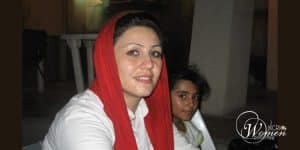
Iranian political prisoner Maryam Akbari Monfared was due to complete her 15-year sentence on October 12, 2024. Despite spending the entire sentence without a single day of medical leave, the Iranian regime’s judiciary has blocked her release by imposing an additional sentence. According to the regime’s own laws, Akbari, one of the longest-serving female political prisoners in Iran, should have been freed in 2019 after serving 10 years. Her case has become emblematic of the regime’s cruelty and determination to suppress dissent, particularly from those who dare to seek justice for past atrocities.
As previously noted by the Secretariat and Women’s Committee of the National Council of Resistance of Iran (NCRI), the Ministry of Intelligence fabricated two cases to block Akbari’s release. In two show trials held in Semnan and Evin, she received additional prison sentences. One charge was for “propaganda against the regime,” and the other was for “insulting the leadership, conspiracy, assembly, spreading lies, disturbing public opinion, and inciting people against national security.”
Mai Sato’s First Report on Human Rights in Iran: A Critical Overview

In September 2024, Mai Sato, the newly appointed UN Special Rapporteur on the situation of human rights in the Islamic Republic of Iran, delivered her first report to the General Assembly. This report provides a comprehensive vision and outlines the key priorities for her mandate. It also reflects on the responses from the Islamic Republic of Iran regarding the international scrutiny of its human rights record. This article will analyze the key aspects of Sato’s report, her identified priorities, and the broader context in which these issues unfold.
The mandate given to the Special Rapporteur was established by the Human Rights Council in resolution A/HRC/RES55/19. Sato, who began her role in August 2024, has the responsibility of monitoring, investigating, and reporting on human rights violations in Iran. Her report emphasizes the dual approach of addressing the obligations of the Iranian government (referred to as the “duty bearer”) and advocating for the rights of Iranian citizens (the “rights holders”).
The Battle Over Internet Censorship in Iran: Politics, Power, and the VPN Mafia

As the Iranian public eagerly awaits the lifting of internet censorship, hopes were recently dashed when the Minister of Communications, in a conversation with reporters on Wednesday, delayed any concrete action. He vaguely promised changes in the “near future” but offered no specific timeline, leaving many disappointed. The regime’s stance on internet censorship has been staunchly defended by Kayhan newspaper, the official mouthpiece of Supreme Leader Ali Khamenei. In a recent editorial, the newspaper labeled those calling for the removal of censorship as “Western sympathizers” aiming to “open the door to corruption.” This reflects the government’s hardline position, one that has drawn both domestic and international criticism.
Iran’s $7 Billion Trade Deficit and Dependence on a Handful of Countries

Mohammad Ali Dehghan Dehnavi, head of Iran’s Trade Promotion Organization, stated that in the first half of this year (March 21 to September 21), Iran’s non-oil foreign trade deficit reached $7 billion. This is compared to the historic record of $17 billion last year. On October 13, Mohammad Ali Dehghan Dehnavi announced that in the first six months of the year, Iran’s total non-oil exports amounted to $25.8 billion, while imports reached $32.5 billion.
The last time Iran had a positive non-oil trade balance was in 2018. Iran’s trade deficit has grown so much in recent years that since the early months of Ebrahim Raisi’s administration, the regime’s customs included oil exports in their reports to mask the increasing foreign trade deficit.
In Iran, Disabled People Receive Less Than $16 in Pensions

With increasing inflationary pressure in Iran and household livelihoods at risk, people with disabilities face more challenges than ever before, with no clear outlook for their livelihoods. Some disability pensioners say that disabled retirees are now at the bottom of the pension income hierarchy, and with pensions below 10 million rials (approximately 16 dollars), their difficulties have worsened. The state-run ILNA news agency, quoting disabled retirees, reported that in recent years, the prices of many goods have increased by up to 400%, creating a “strange gap” between wages and the cost of living.
The report mentions Article 27 of the Comprehensive Law for the Disabled, which requires the government to ensure that the minimum social security salary is provided to people with severe and very severe disabilities. However, even this minimum is not being paid.
How Hezbollah’s Recent Losses Are Impacting the Iranian Regime

The recent setbacks faced by Hezbollah in Lebanon have dealt a severe blow to the Islamic Revolutionary Guard Corps (IRGC) and Iran’s broader strategy of exporting crisis. These blows, delivered over the past month, represent a significant strategic hit to the Iranian regime and its crisis export policy, deeply shaking its foundations. Four decades ago, Ayatollah Khomeini used the Iran-Iraq War to stifle the progressive and revolutionary forces within Iran, particularly those resonating with the country’s youth at the time. By igniting the eight-year conflict, he sought to suppress these forces. When he ultimately failed, Khomeini was forced to drink from the “chalice of poison,” an admission of defeat that soon led to his demise.
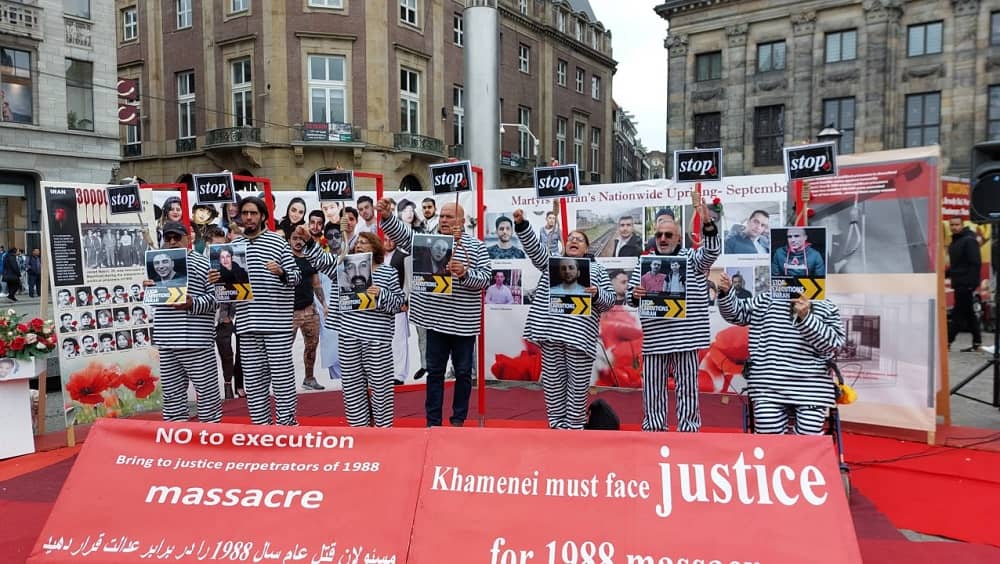
Washington, D.C.—October 10, 2024: MEK Supporters Rally in Support of the ‘No to Executions’ Campaign Against Iran’s Regime

Washington, D.C.—October 10, 2024: Freedom-loving Iranians, and supporters of the People’s Mojahedin Organization of Iran (PMOI/MEK), organized a rally and exhibition in front of the White House on the occasion of the World Day Against the Death Penalty. They protested against the mullahs’ regime and the ongoing brutal executions across Iran. The participants urged support for the Iranian people and their resistance in the struggle to establish freedom, democracy, human rights, and justice in Iran.
The Hague, the Netherlands—October 10, 2024: MEK Supporters Rally in Support of the ‘No to Executions’ Campaign Against Iran’s Regime

The Hague, the Netherlands—October 10, 2024: Freedom-loving Iranians, and supporters of the People’s Mojahedin Organization of Iran (PMOI/MEK), organized a rally and exhibition in front of the Ministry of Foreign Affairs of the Netherlands in Support of the “No to Executions” campaign against the mullahs’ regime. They protested against the ongoing brutal executions across Iran. The participants urged support for the Iranian people and their resistance in the struggle to establish freedom, democracy, human rights, and justice in Iran.
Copenhagen, Denmark—October 11, 2024: MEK Supporters Rally in Support of the ‘No to Executions’ Campaign Against Iran’s Regime

Copenhagen, Denmark—October 11, 2024: Freedom-loving Iranians, and supporters of the People’s Mojahedin Organization of Iran (PMOI/MEK), organized a rally and exhibition in Support of the “No to Executions” campaign against the mullahs’ regime. They protested against the ongoing brutal executions across Iran. The participants urged support for the Iranian people and their resistance in the struggle to establish freedom, democracy, human rights, and justice in Iran.