

Three-minute read
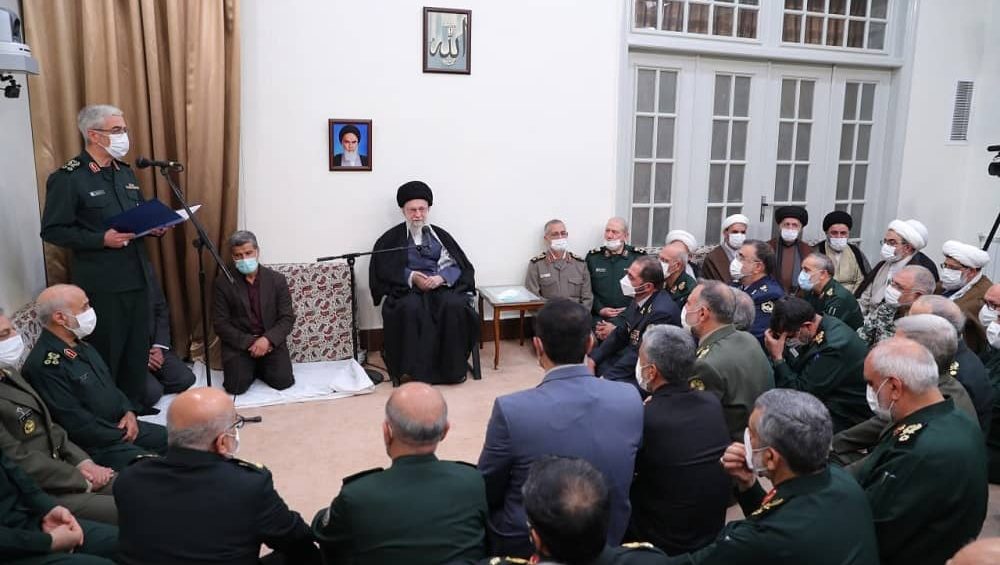
One day after high-level negotiations between representatives of the Iranian regime and the United States took place in Muscat, Oman, Supreme Leader Ali Khamenei appeared in Tehran alongside senior military commanders in what observers describe as a familiar act of face-saving theatrics. Khamenei, along with media outlets affiliated with his office, remained silent on the Oman talks, but his speech was laced with deflection, bravado, and subtle cues aimed at reassuring a shaken political base grappling with the regime’s shift from “no negotiations” to quiet diplomacy with its longtime adversary.
“Today, the enemy is frustrated and nervous about our progress,” Khamenei declared in his April 13 address to the regime’s top military officials. “A lot of the noise you hear in the media and from our enemies stems from their confusion — they have no other option.”
Avoiding any direct reference to the negotiations in Oman, Khamenei instead doubled down on rhetoric glorifying Tehran’s military posture. “Thanks to the activities of our armed forces — the IRGC, the army, the police — the face of the Islamic Republic has become admirable in the eyes of the world,” he claimed. “Those who follow current affairs in different countries and regions look at Iran and feel awe and grandeur.”
In a striking moment of rhetorical deflection, Khamenei appeared to downplay the operational effectiveness of the Iranian regime’s missile program, stating, “It doesn’t matter how many missiles were launched or how many hit the target. These are secondary issues.” By framing precision and outcomes as inconsequential, the Supreme Leader implicitly acknowledged recent military shortcomings—possibly in reference to Tehran’s much-hyped but tactically underwhelming missile barrage against Israel. Yet the intent was clear: to reassure the armed forces that their role remains intact, regardless of battlefield realities or diplomatic backtracking.
Why #Iran's Regime Cannot Negotiate with the U.S.https://t.co/Saa010Slk8
— NCRI-FAC (@iran_policy) February 9, 2025
The speech was staged carefully. On the very day of the Muscat talks, state media broadcast Khamenei’s visit to Qom — a symbolic pilgrimage meant to invoke religious authority and rally the conservative base. Then, within twenty-four hours, the regime arranged his public meeting with the military command. This sequencing followed a well-worn regime playbook: when forced to enter talks it once condemned as traitorous, Tehran shifts into symbolic overdrive — framing the moment as strength, not submission.
But the cracks are showing. Khamenei’s carefully curated address acknowledged “significant challenges” in the economy, admitting, “We have clear problems in the economic sectors, especially in some corners.” Yet he warned against conflating weaknesses in one area with the country’s overall trajectory. “We may have shortcomings in some places, but in other areas, we have excellence and progress — the kind that even makes our enemies express admiration.”
#Iranian Regime Officials Undermine Khamenei’s Authority as Discord Grows Over U.S. #Nuclear Talkshttps://t.co/QU5xbCtUO6
— NCRI-FAC (@iran_policy) April 12, 2025
This mixture of bluster and reluctant admission is telling. For years, Khamenei had drawn a red line around negotiations with Washington, branding any such dialogue “laughable and ridiculous” as early as 1989 and insisting until recently that “no war, no negotiation” was the official stance of the Islamic Republic. Now, in the face of domestic collapse and international pressure, the regime has quietly reversed course — and is relying on military pageantry and anti-Western slogans to distract from that retreat.
In his speech, Khamenei also rehashed one of his favorite narratives: the double standards of “global bullies.” “They allow themselves to be equipped with the most catastrophic weapons,” he said, “but deny the right to defensive progress to others.” He urged Iran’s military to preserve “maximum readiness” and declared that the real battlefield was not missile launches, but the “emergence of the will and power of the Iranian nation.”
Chief of the Armed Forces General Staff, Major General Mohammad Bagheri, echoed this stance, stating, “The armed forces are at full readiness, and our enemies will leave with the regret of having failed in their sinister goals.”
Iran News: #Khamenei Issues Tactical Fatwa to Iraqi Militias Amid U.S. Pressure and #Nuclear Talks – Sourceshttps://t.co/PMu32nsCfM
— NCRI-FAC (@iran_policy) April 11, 2025
But this carefully choreographed show of defiance also betrays a deeper anxiety within the regime’s ranks. The decision to engage with the United States — after decades of labeling it “the Great Satan” — has rattled core segments of the clerical dictatorship’s dejected base. Many regime supporters, already demoralized by economic collapse and internal infighting, now face the psychological strain of justifying what they were long told was a betrayal of the revolution’s founding principles.
In this context, Khamenei’s speech was less a message to the U.S. or the world and more an effort to pacify disillusioned loyalists. The slogans may sound familiar, but the regime’s posture reveals the truth: even the most extremist elements are now compelled to negotiate — and to mask that necessity with the same firebrand theatrics that once made talks with the Trump administration not intelligent, nor wise, or honorable.”