

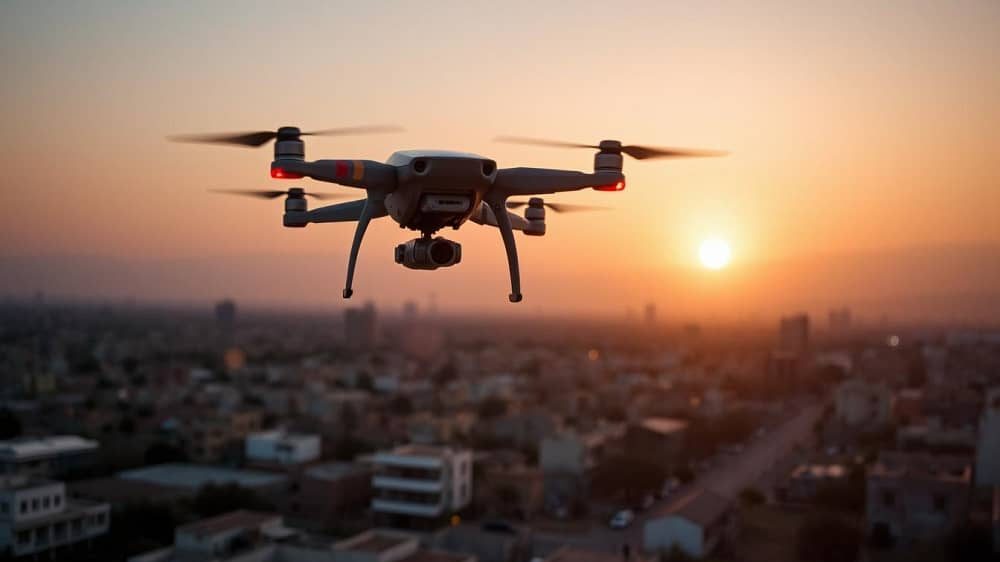
As discontent simmers across Iran and public anger edges toward eruption, the clerical regime has begun deploying military-grade surveillance over Tehran’s outskirts in what appears to be both a preemptive security measure and a warning to a restless population.
On June 3, Tehran Mayor Alireza Zakani unveiled a sweeping aerial monitoring plan covering nearly 6,000 square kilometers of the capital’s so-called “urban perimeter.” Ostensibly framed as a municipal project to fight illegal construction, the plan is being implemented in full partnership with the Islamic Revolutionary Guard Corps (IRGC) and its affiliated Imam Hossein University – a fact that lays bare its true intent.
“If we fail to monitor this space, we’ll face serious security challenges and economic and social corruption,” Zakani said, according to the ISNA News Agency.
The project involves constant drone and satellite surveillance, AI-powered analysis of aerial images, and the creation of high-resolution maps integrated into Tehran’s digital governance system. It is, officials claim, the first time such a program has been rolled out in Iran.
#Iran News: Clerical Regime Deploys 15,000 AI-Powered Cameras in 2025 Crackdown as Infrastructure Collapseshttps://t.co/hKaXhXhcdB
— NCRI-FAC (@iran_policy) April 9, 2025
A Military Operation in Civilian Clothing
While the regime markets the effort as a “smart city” initiative, critics and dissidents say the move is a blatant militarization of urban governance. The project is a thinly veiled attempt to expand IRGC surveillance and psychological control mechanisms in anticipation of mass protests. The timing is no accident: Iran’s political atmosphere remains highly volatile, especially in major cities like Tehran, where waves of protests over economic hardship, corruption, and repression continue to swell beneath the surface.
The plan is being carried out in two aerial phases – one during the green season, and another in dry conditions – using high-precision drone photography (10 cm ground resolution). According to the municipality’s own statements, the goal is to detect “changes” and “violations” in the city’s buffer zones. In reality, it equips the regime with real-time tools to track gatherings, identify dissenters, and tighten its grip on any future flashpoints of unrest.
“We’ll use launch pads, drones, and satellite images to monitor everything from the Alborz mountains to the Imam Khomeini Shrine and the Qom Highway,” said General Hosni Ahangar, head of Imam Hossein University. The 14-month surveillance contract is already active.
#Iran News: IRGC Media Pushes Surveillance in Classrooms Amid Crackdown on #Schoolshttps://t.co/TXQWfZsOB6
— NCRI-FAC (@iran_policy) March 24, 2025
A Capital Under Watch, A Population Under Threat
The deployment of this project comes amid open regime panic over the potential for mass revolt in Tehran – the political, economic, and symbolic heart of the nation. Reeling from growing factional divides, economic freefall, and international isolation, the ruling system now appears laser-focused on deterring urban uprisings through intimidation and hyper-control.
The Shahriar digital platform launched alongside this surveillance network is being sold as a tool for citizen convenience – but it also centralizes public data, building permit activity, property ownership, and even GPS-tracked requests into a single system the state can monitor in real time. What the regime brands as “transparency” is in practice an expansion of state surveillance powers in the name of urban order.
#Iran News: Regime Moves to Indoctrinate #Students as Tehran Frets Over Role of Youth in Uprisingshttps://t.co/X1zDl2IPCM
— NCRI-FAC (@iran_policy) April 21, 2025
Preparing for “The Big One”
Regime insiders are aware of Tehran’s unique explosiveness. Unlike smaller cities, protests in the capital can ignite regime-wide collapse. The new surveillance system — which uses IRGC military hardware to scan, track, and archive — is designed to ensure nothing happens without being seen.
Though officials avoid direct reference to public unrest, their language betrays their intent. “The lack of control in this area would invite serious corruption,” Zakani repeated – a clear euphemism for dissent, defiance, and the regime’s own fear of losing grip.
What they are really preparing for is not zoning violations, but another nationwide uprising – and this time, Tehran will be under the gun, from above.