

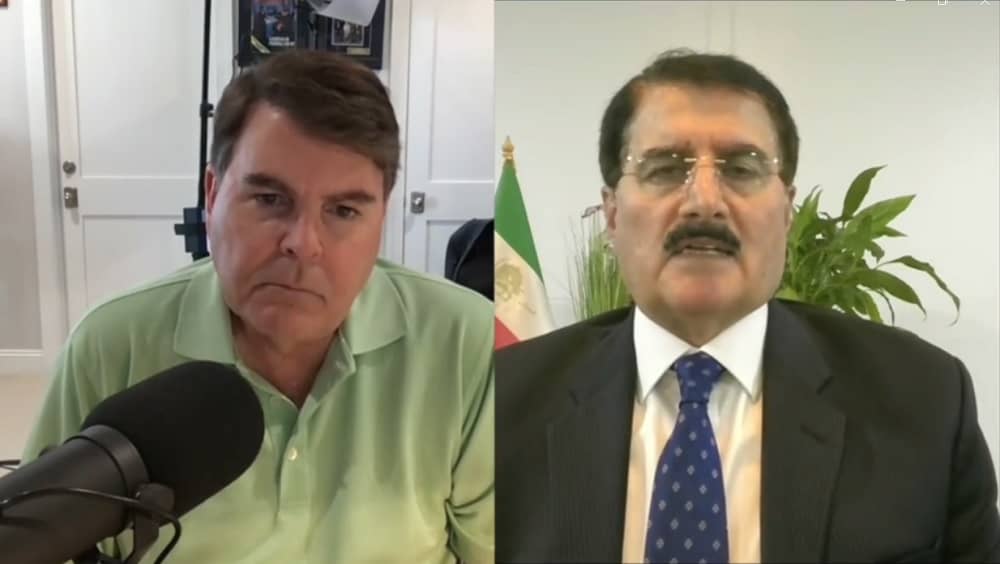
In a sweeping interview on The Greg Jarrett Show, Ali Safavi — a member of the Foreign Affairs Commission of the National Council of Resistance of Iran (NCRI) — laid out a forceful case for a democratic transition in Iran led by its people and organized resistance. Citing decades of brutal repression, international inaction, and the failure of appeasement policies, Safavi called on Western governments to recognize the Iranian people’s right to resist tyranny and support their internal struggle to overthrow the regime.
“The real war in Iran began 44 years ago,” Safavi declared, referencing the clerical regime’s violent crackdown on peaceful dissent since 1979. “And it will continue until freedom and democracy are achieved.”
A Resistance from Within
Safavi emphasized that meaningful change will not come from foreign intervention or economic engagement with the ruling elite, but from within Iran — through the grassroots activities of a widespread internal resistance. He highlighted the work of the Resistance Units, decentralized networks of activists aligned with the NCRI and its principal member, the People’s Mojahedin Organization of Iran (PMOI/MEK).
“These are young men and women operating clandestinely across the country,” he said. “In 2024 alone, they conducted nearly 3,000 operations targeting regime institutions such as the IRGC and Basij bases.”
Safavi insisted that the resistance’s activities, though underreported by mainstream media, reflect the growing momentum for regime change inside Iran. “This is a robust, organized, structured movement. All it needs is recognition and political support.”
Inside Iran with @amsafavi https://t.co/qGDv9MdvHj
— Gregg Jarrett (@GreggJarrett) June 26, 2025
The Third Option: Not War, Not Appeasement
At the core of Safavi’s argument is what the NCRI has long described as the “Third Option,” introduced by NCRI President-elect Maryam Rajavi in 2006: a path forward that rejects both foreign military intervention and Western appeasement.
“Too many have viewed Iran through a false binary — war or diplomacy. That’s the trap,” he explained. “But there is a third way: support the Iranian people and their organized resistance.”
According to Safavi, this option doesn’t call for foreign troops, weapons, or financial aid. Instead, it demands moral clarity and political recognition. “We’re not asking the West to fight our fight,” he said. “We’re asking them to stop empowering our oppressors and start acknowledging those risking everything for freedom.”
Western Policy: A Record of Failure
Safavi criticized decades of failed U.S. policy, arguing that both sanctions (“the stick”) and engagement (“the carrot”) have failed to change the regime’s behavior.
“Some Republican administrations like George Bush and others tried to toughen the sanctions — used the stick, if you will — to moderate the behavior of this regime,” he said. “It didn’t happen. The Democratic administration offered the carrot. That made it even worse… Enough trying to moderate the behavior of this regime. A leopard never changes its spots.”
He cited the billions released to Tehran under the Obama administration’s nuclear deal, saying those funds were diverted to regional proxies and the Assad regime — not to the Iranian people. “In 11 years, Tehran gave Assad $50 billion while ordinary Iranians suffered.”
"Amid ceasefire, struggle for Iranian freedom must accelerate."
Illuminating commentary in @CourantOpinion by Jila Andalib of Free Iran Scholars Network @FreeIranSN. Certainly, worth a read: https://t.co/ktPXK2i51K@MarioNawfal @marklevinshow @MarkHalperin #NCRIAlternative… pic.twitter.com/NlpGZYZFFp— Ali Safavi (@amsafavi) June 25, 2025
A Turning Point
As internal dissent grows and defections ripple through the security ranks, Safavi made a pointed case for recognizing the Iranian people’s right to resist tyranny. Quoting U.S. President John F. Kennedy, he said: “For those who make peaceful change impossible, they make violent change inevitable.”
He elaborated that the Iranian people, faced with decades of brutal repression, have been left with no option but to confront the regime directly. Drawing parallels to historical struggles, he said: “We’re not asking for American boots on the ground. All we are asking is an unequivocal expression of recognition for the desire of the Iranian people to end this regime… just as the Americans did in the War of Independence, or the French patriots did against the Nazi occupation.”
Host Greg Jarrett agreed, noting that Khamenei “is cowering in fear” and will never step down voluntarily. He remarked that, like Syria’s Assad, the only thing that would compel Iran’s rulers to flee is armed pressure from within:
“Assad only left when the rebels, heavily armed, were at the gate. That’s probably the only way Khamenei will leave — people with weapons at the gate and maybe his own military turning against him.”