

Four-minute read
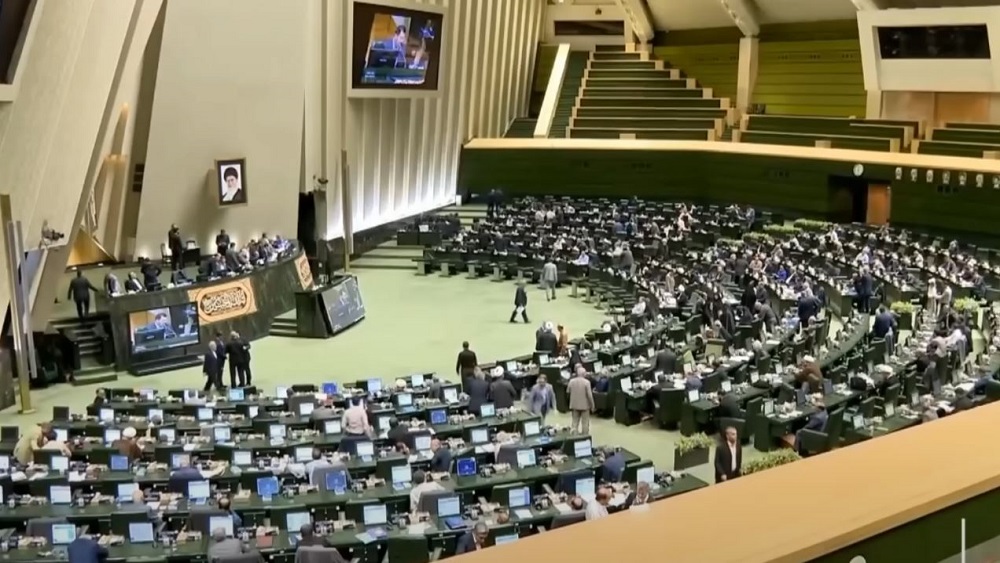
In a major escalation of suppressing the people’s access to internet, the Iranian regime’s parliament passed a widely condemned bill on July 27, 2025, titled “Combating the Spread of Untrue News Content.” Framed as a legal effort to address misinformation on social media, the law has been denounced as a veiled attempt to deepen censorship, criminalize dissent, and consolidate the state’s monopoly over information.
The legislation’s passage comes in the aftermath of the recent 12-day conflict and amid growing domestic unrest over economic, political, and social grievances. The law as part of the regime’s broader effort to suppress any expression of discontent, especially in the digital sphere where Iranians increasingly turn to share truth, organize protests, and resist authoritarian control.
Despite the regime’s claims that the bill aligns with constitutional protections for free speech, the reality is starkly different. Iran’s regime has never respected freedom of expression under its theocratic rule, and this law marks yet another dangerous milestone in its decades-long campaign to silence opposition.
#Iran's Regime Cripples Economy with Internet Shutdown, Now Peddles Failed 'National Network' as Curehttps://t.co/G3we92RgBO
— NCRI-FAC (@iran_policy) July 23, 2025
An Assault on Expression, even by the Regime’s Standards
The law has sparked unusual criticism from within the regime’s own inner circle. A group of parliamentarians wrote to regime president Masoud Pezeshkian, warning that the legislation risks widening the rift between the regime and Iranian society. However, their objections appear driven less by a principled defense of civil liberties than by a growing fear of public backlash, as the regime’s grip on society continues to weaken.
Prominent regime-affiliated commentators have joined in the outcry. Abbas Abdi, writing in Etemad newspaper, warned that the law would “monopolize the truth” and lead to a dangerous spread of propaganda.
Regime-affiliated legal expert Mohsen Borhani, in Shargh newspaper, described the law’s most dangerous feature as replacing the term “spreading lies” with “untrue content”—a phrase that criminalizes even partial truths or factual omissions. He cautioned that such a shift allows for arbitrary enforcement and turns virtually anyone into a potential offender. Borhani also condemned the law’s introduction of severe new penalties: prison terms could now range from six months up to 15 years. Under Article 14, some cases could even be prosecuted under the charge of “corruption on earth,” which carries the death penalty.
“Digital Caste System”: #Iran Codifies Internet Access by Loyaltyhttps://t.co/8uivTthV4y
— NCRI-FAC (@iran_policy) July 20, 2025
A Chilling Effect on Civil Society
Even Nournews, affiliated with the regime’s Supreme National Security Council, questioned whether the bill reflects genuine transparency or is a product of “pressure from supranational institutions and security concerns.”
Regime MP Farid Mousavi warned that in a society plagued by economic hardship, a crisis of trust, and widespread demands for transparency, prioritizing the criminalization of vague online content is “misguided and dangerous.”
Nonetheless, the regime pushed ahead. Legislative Deputy of the President’s Parliamentary Deputy Kazem Delkhosh defended the urgency of the bill, citing Supreme Leader Ali Khamenei’s long-standing demand to tighten control over cyberspace.
In a choreographed vote, the bill passed with 205 votes in favor, 49 against, and 3 abstentions, out of 257 members present.
#Iran’s Digital Apartheid: Regime Loyalists Flood the #Internet While the Rest of the Nation Goes Darkhttps://t.co/qFQw7Bi9wc
— NCRI-FAC (@iran_policy) June 20, 2025
A Repressive Digital Landscape: The “Freedom on the Net 2024” Report
This new law aligns with an already grim digital reality in Iran, as documented by the Freedom on the Net 2024 report from Freedom House. The report categorizes Iran as “Not Free” with a dismal score of 12 out of 100, and highlights a series of developments that demonstrate the regime’s tightening grip over the internet and digital life between June 2023 and May 2024:
Censorship & Isolation
- Expansion of the National Information Network (NIN) to isolate Iranians from the global internet
- Internet service prices raised by 30–40%, with international bandwidth deliberately throttled
- Ban on unlicensed VPNs in February 2024, pushing users toward regime-monitored alternatives
- Continued blocking of major platforms including WhatsApp, Instagram, Signal, Facebook, X, TikTok, and YouTube
Surveillance & Control
- Use of SIAM software to throttle mobile users based on online behavior
- Mandatory SIM registration, geolocation tracking, and real-name identity verification
- Expansion of AI and facial recognition tools to enforce hijab laws on digital platforms
Repression & Arrests
-
- Dozens of journalists, bloggers, and musicians arrested or tortured for online expression
- Death sentences issued under vague charges like “spreading corruption on earth”
- Enforcement of the Hijab and Chastity Bill (2023) both online and offline, with penalties ranging from imprisonment to financial blacklisting
How Iran’s regime tries to maintain its hold on power through internet censorship https://t.co/R33bMY7Lm2
— People's Mojahedin Organization of Iran (PMOI/MEK) (@Mojahedineng) January 28, 2025
Shutdowns & Blackouts
- Nationwide internet shutdowns used as tools of repression, especially in protest-prone regions
- On November 20, 2023, 28 provinces experienced internet blackouts
- Regular disruptions timed with weekly protests, especially in cities like Zahedan
Propaganda & Disinformation
- Large-scale troll farms and disinformation campaigns managed by regime operatives
- Use of domestic apps to replace global platforms and harvest user data
- Systematic editing and manipulation of online content to erase references to regime crimes
Societal Impact
- Widespread self-censorship among users
- Women using the internet to defy compulsory hijab laws face severe retaliation
- Religious minorities, and dissidents face targeted surveillance and entrapment
- Online businesses reported over 50% income losses during mass protests and shutdowns
Cyber Conflict
- State-linked hackers targeted dissidents using spyware and phishing tools
Escalating Digital Repression Under the Guise of “Truth”
With the passage of the “Untrue Content” bill, Iran’s theocratic regime has further weaponized the law to criminalize independent thought, digital activism, and journalistic integrity. While officials claim to uphold constitutional freedoms, the reality on the ground—documented both by domestic voices and international watchdogs—is one of relentless censorship, sweeping surveillance, and deepening fear.
The Iranian people continue to resist, both on the streets and across digital platforms, but the cost of that resistance has never been higher. This bill—and the broader digital crackdown it represents—must be condemned as part of the regime’s escalating attempt to silence dissent and control the narrative, driven by a deepening fear of its own collapse. It’s more than just heightened censorship—it’s the sign of a regime desperately clinging to power.