

Three-minute read
Iranian authorities have sharply escalated internal security measures in the weeks following the killing of Supreme Leader Ali Khamenei and extensive military losses during joint U.S. and Israeli strikes, deploying a combination of street-level enforcement, mass arrests and prolonged internet restrictions that analysts say reflect mounting concern over potential unrest.
The widening crackdown comes as the country struggles to stabilize after a major conflict that degraded significant portions of its infrastructure, while simultaneously exposing vulnerabilities inside the clerical dictatorship.
Checkpoint Expansion and Visible Militarization of Cities
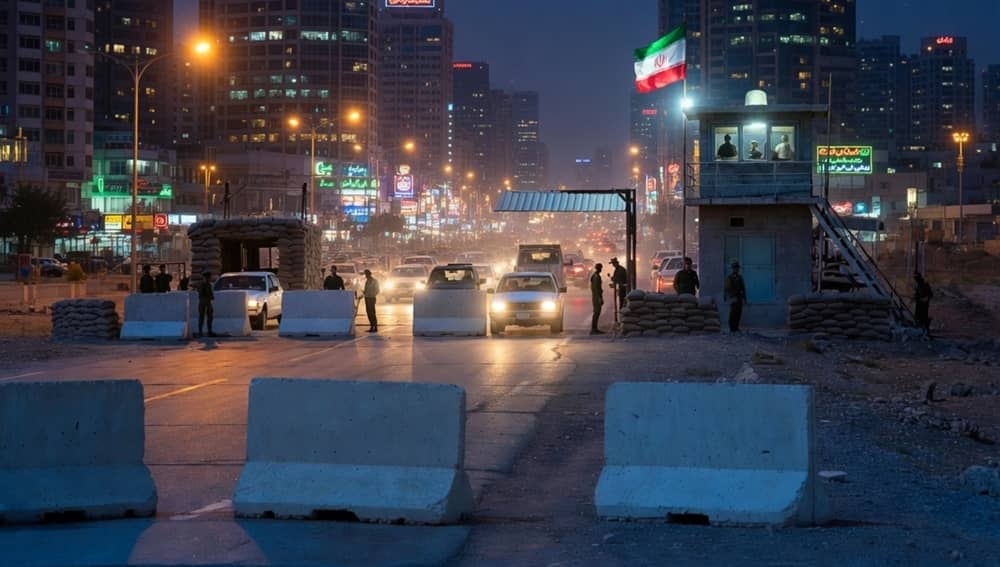
Across major cities, including Tehran, residents report an unprecedented expansion of security checkpoints, where vehicles are routinely stopped, searched and, in many cases, occupants subjected to questioning and mobile phone inspections.
On April 13, Interior Ministry spokesman Ali Zeinivand described the deployment of checkpoints as a decision approved by the National Security Council, while police spokesman Saeed Montazer al-Mahdi said the number of official police checkpoints had reached 1,463. The total figure is believed to be significantly higher when including units operated by the Islamic Revolutionary Guard Corps and the Basij militia, which maintain tens of thousands of bases nationwide.
Witness accounts indicate that many checkpoint personnel operate without visible identification and often conceal their faces. In some areas, the presence of pickup trucks mounted with heavy machine guns—an uncommon sight in urban centers—has further underscored the militarized environment.
"In the aftermath of the #IranWar and amid deepening economic collapse, Iran’s clerical dictatorship has launched a sweeping campaign of repression designed to prevent a new wave of protests from emerging," @SaforaSM writes.https://t.co/bjk5iME9ba
— NCRI-FAC (@iran_policy) April 14, 2026
Mass Arrests and Expanding Charges Against Civilians
Parallel to the physical security buildup, authorities have intensified arrests across the country. State media reports published between April 10, and April 15 indicate that between 50 and 100 individuals are being detained daily on a range of charges.
The regime’s Intelligence Ministry announced the arrest of 35 individuals across six provinces, alleging on April 14 that some were involved in manufacturing explosives or maintaining links to foreign entities. Additional arrests were reported in provinces including Hormozgan, Hamedan and Kerman.
Judicial authorities have also moved to seize assets. On April 15, the prosecutor in Hamedan confirmed the confiscation of property belonging to dozens of individuals accused of cooperating with foreign governments, while further cases have been opened against others on similar charges.
Human rights organizations estimate that total detentions since the onset of the recent conflict range from 2,700 to approximately 4,000 individuals, though the actual number is likely higher. Charges leveled against detainees include espionage, disseminating information to foreign media, online activity deemed destabilizing and alleged connections to opposition groups.
Facing an increasingly explosive society, the Iranian regime has ramped up its rhetoric to signal a “firm” crackdown on any signs of #IranProtests. Judicial and military officials are currently using the pretext of regional conflict to justify aggressive internal suppression,…
— NCRI-FAC (@iran_policy) March 6, 2026
Psychological Pressure Campaigns and Street Mobilization
In addition to coercive measures, authorities have expanded psychological and propaganda operations aimed at controlling public space and shaping perceptions.
Nightly convoys equipped with loudspeakers have been deployed across neighborhoods, broadcasting religious chants and pro-regime slogans. These mobile units, often accompanied by armed personnel, move through residential areas in what officials describe as an effort to reinforce morale and demonstrate state presence.
State Security Forces Chief Ahmad Reza Radan emphasized the importance of such activities on April 14, stating that “your presence is no less important than missile units,” a remark that implicitly equated street-level mobilization with military capability.
At the same time, senior political and religious figures have repeatedly called on supporters to maintain a constant presence in public spaces. Statements issued between April 9 and April 15 framed street presence as both a civic duty and a strategic necessity, with one message attributed to the country’s new leadership urging citizens to remain in public areas “more heavily than before.”
#Tehran’s War Fallout Exposes a Cornered Regime Gripped by Fear, Crackdown, and Global Isolationhttps://t.co/tE9tEIP6H5
— NCRI-FAC (@iran_policy) July 1, 2025
Internet Blackout Enters Seventh Week, Economic Toll Mounts
The domestic crackdown has been accompanied by one of the most extensive internet shutdowns in Iran’s history.
NetBlocks, an independent monitoring group, reported on April 16 that nationwide disruptions had entered their 48th day, causing at least $1.8 billion in direct economic losses. Broader estimates, incorporating indirect effects, place the damage closer to $3.8 billion.
Communications Minister Sattar Hashemi acknowledged in mid-April that restrictions could have “irreversible consequences,” even as state-affiliated media defended internet control as a “global defensive standard” in the context of hybrid warfare.
The shutdown has disrupted not only digital businesses but also education and international engagement. Officials have confirmed that many foreign students have left the country due to the inability to access online services.
"Facing what observers describe as an increasingly volatile and “explosive” domestic climate, Iran’s clerical establishment has dramatically tightened its grip on society during #IranWar," writes @SaforaSM.https://t.co/BFMl6jDAaU
— NCRI-FAC (@iran_policy) April 10, 2026
Isolated Violence and Signs of Internal Instability
Amid heightened security, incidents of violence continue to surface. On April 15, state-affiliated Fars News Agency reported an explosion in western Tehran that injured three people and damaged nearby buildings and vehicles. Authorities described the devices as improvised and sought to downplay the significance of the incident.
The attack, which occurred near a Basij checkpoint according to some reports, underscores the fragile security environment despite the extensive enforcement measures.
Taken together, recent developments point not merely to a multi-layered crisis but to a structural breaking point across Iran’s economy and society. War damage, industrial disruption, digital isolation and collapsing living standards are no longer discrete pressures—they are compounding forces eroding what remains of the state’s capacity to govern. The regime is attempting to respond with intensified coercion, but repression has diminishing returns in a society already pushed beyond material and psychological thresholds. Years of economic decline, widespread poverty and repeated protest cycles have fundamentally weakened the state’s ability to restore control through force alone.