

Three-minute read
The United Nations was created in the aftermath of global war and genocide, with the explicit mandate to prevent tyranny from masquerading as legitimate governance. Its platform was meant to give voice to the peoples of the world, not to their oppressors. Yet the decision to allow Masoud Pezeshkian, the handpicked president of Ali Khamenei, to address the General Assembly calls into question the very credibility of this institution.
Pezeshkian does not embody the aspirations of the Iranian people. He represents a theocratic system whose foundation rests on repression at home and aggression abroad. By offering him the UN podium, the international community risks legitimizing a regime that has committed systematic crimes against humanity, from the 1988 massacre of 30,000 political prisoners to the killing of protesters in 2019 and 2022.
Legitimizing Crimes Against Humanity
This is not a matter of routine diplomacy. It is a matter of principle. The clerical regime’s record includes the export of terrorism across the Middle East, hostage-taking as state policy, pursuit of nuclear weapons, and an economy hollowed out by corruption and militarization. Domestically, it continues to execute citizens at one of the highest rates in the world, silence dissent with imprisonment and torture, and crush every spark of independent civil life.
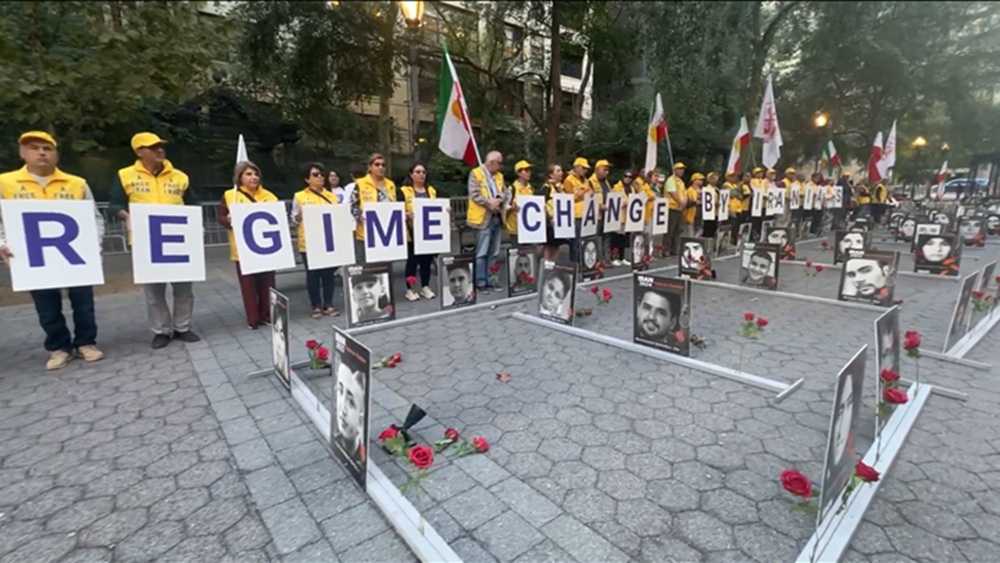
Iranian #Americans are gathering in New York for a major rally of thousands in support of the #IranianResistance to overthrow the ruling regime. It will be held in front of the @UN on Tuesday, Sept 23, at Dag Hammarskjöld Plaza, 9am. pic.twitter.com/7xEnyvrVIy
— NCRI-FAC (@iran_policy) September 20, 2025
To grant Pezeshkian the stage is to disregard these realities. It is to ignore the pleas of victims and survivors who demand justice. The precedents of Nuremberg, the tribunals on Yugoslavia, and Rwanda all affirmed that crimes of this scale cannot be brushed aside under the guise of political normalcy.
The People of Iran Are Not Represented
What makes Pezeshkian’s appearance particularly offensive is the false image it conveys: that the clerical regime represents the Iranian nation. In reality, the Iranian people have rejected the rule of the mullahs repeatedly through uprisings, boycotts of sham elections, and the continued growth of their resistance movement.
The National Council of Resistance of Iran (NCRI) and its principal member, the People’s Mojahedin Organization of Iran (PMOI/MEK), have for decades carried the burden of this historic struggle, sacrificing over 120,000 martyrs. This movement has articulated a clear democratic alternative, embodied in Maryam Rajavi’s Ten-Point Plan, which calls for a secular, pluralist republic grounded in universal human rights.
It is this Resistance—not Pezeshkian’s presidency under Khamenei’s control—that represents the true aspirations of the Iranian nation.
CSW New York Past Chair Susan O’Malley at #UNRally4FreeIran:
We did last year at the @UN_CSW. Iran was behaving terribly and they were one of the 50 countries on the Commission… We kicked them out, and it was NGOs that did that.#ProsecuteRaisiNowhttps://t.co/IXSlpazLmw— People's Mojahedin Organization of Iran (PMOI/MEK) (@Mojahedineng) September 19, 2023
A False Legitimacy Cannot Alter Reality
International recognition of Pezeshkian cannot alter the structural reality of the Iranian regime: it is unreformable, inherently violent, and dependent on repression for survival. No election under the mullahs’ regime has ever reflected the free will of the Iranian people. Pezeshkian’s selection was no exception; it was engineered to maintain the façade of stability while the regime grapples with deep internal crises.
The world must draw the correct conclusion: the problem is not this or that president but the regime itself. Engagement with Pezeshkian is engagement with Khamenei’s machinery of power, and any legitimization strengthens the apparatus of oppression.
The Ethical and Political Imperative
The UN is at a crossroads. Either it remains faithful to its founding principles, or it risks becoming a stage for dictators and executioners. Offering its podium to Tehran’s representative is not neutrality—it is complicity.
The alternative is clear: recognition of the Iranian people’s right to resist, acknowledgment of the NCRI as a democratic alternative, and insistence on accountability for crimes against humanity. The international community must support the establishment of an independent UN inquiry into the 1988 massacre and the repression of recent uprisings. Silence and appeasement will only embolden Tehran’s rulers.
Captured by @AP: On Sept 25, Iranian #Americans and supporters of the Iranian Resistance rallied outside the @UN in New York, protesting the regime’s presence at #UNGA79. Demonstrators demanded freedom, democracy, and an end to Tehran’s human rights abuses. pic.twitter.com/Fw8AgJ3Ufw
— NCRI-FAC (@iran_policy) September 26, 2024
Iran Defined by Its Resistance
Two visions of Iran stand before the world. One is represented by Pezeshkian, a loyal functionary of Khamenei, standing on a legacy of executions, corruption, and terror. The other is represented by a nationwide resistance that continues to fight for freedom, justice, and democracy.
The UN cannot claim to defend human rights while providing its most prestigious stage to a regime that systematically tramples them. The genuine voice of Iran is not Pezeshkian at the UN General Assembly. It is the voice of the Iranian people and their organized Resistance, which will ultimately shape Iran’s future as a democratic and secular republic.