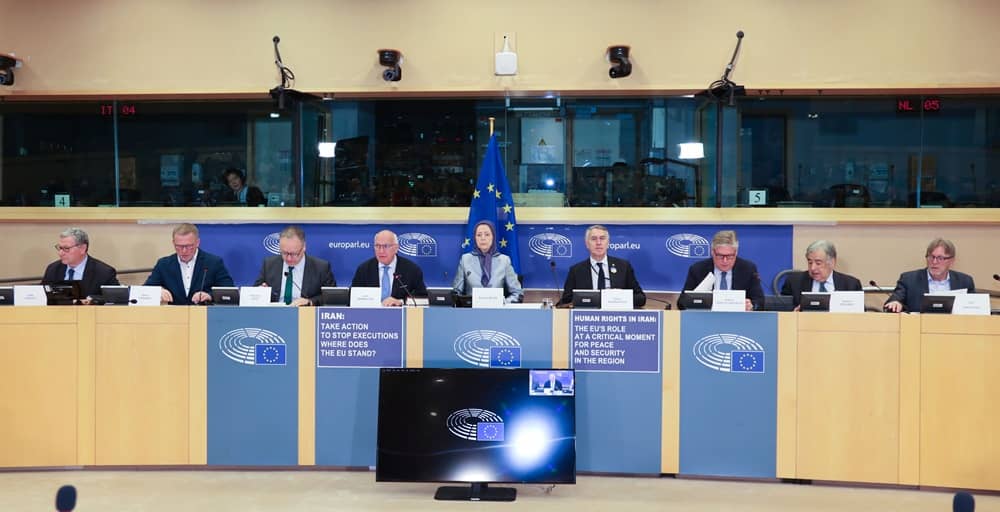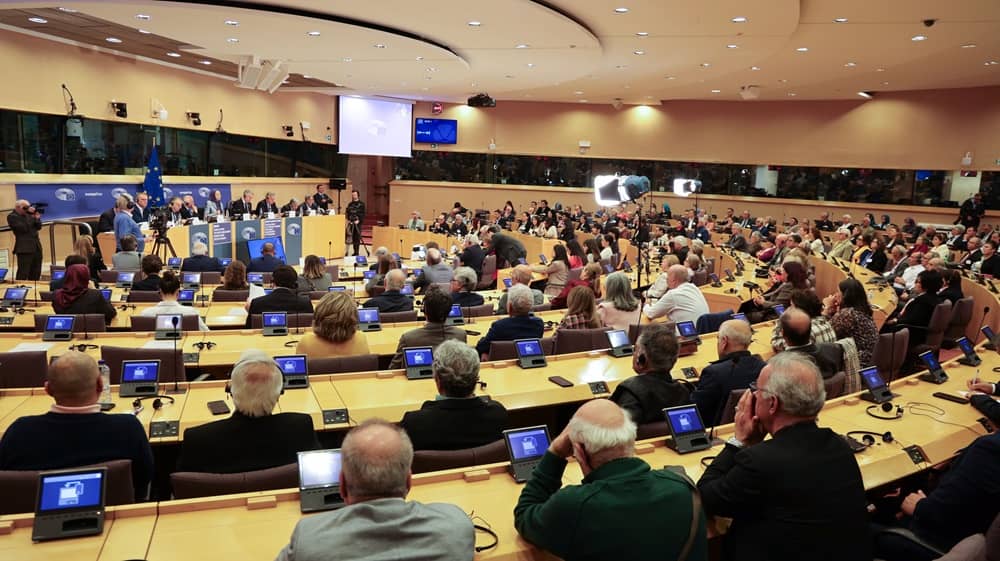
BRUSSELS, April 22, 2026 — As political executions in Iran reach a critical threshold, a high-profile conference at the European Parliament today urged a fundamental paradigm shift in the European Union’s approach to Tehran. The event, titled “Iran: Take Action to Stop Executions — Where Does the EU Stand?”, convened a broad cross-party coalition of lawmakers and international dignitaries to address what they described as the “existential fragility” of the clerical regime and the imperative for the EU to support the Iranian people’s organized resistance. Speakers rejected both the current theocracy and any return to monarchical rule, emphasizing that the National Council of Resistance of Iran (NCRI) and its Ten-Point Plan represent the only viable path to a democratic, non-nuclear republic.
In her keynote address, Maryam Rajavi, President-elect of the NCRI, underscored that the decisive conflict in the Middle East is the one between the people of Iran and the ruling religious dictatorship. She asserted that the regime of Velayat-e Faqih possesses “no capacity for reform or change” and warned that its survival depends entirely on the brutal repression of its citizens.
“The regime does not view external war as the primary threat to its existence, but rather deep-seated popular outrage and organized resistance,” Mrs. Rajavi stated. She revealed critical details regarding the escalating resistance inside Iran, noting that on February 23, 2026, 250 PMOI fighters launched an attack on Khamenei’s headquarters, a strike that “struck fear into the heart of the regime.” She also condemned the recent “atrocious crimes” of the dictatorship, specifically the execution of PMOI members Hamed Validi and Mohammad Massoum Shahi earlier this week.
Mrs. Rajavi delivered a clear mandate for European policy: the recognition of the provisional government announced on February 28, 2026, and the closure of Iranian embassies. She also addressed the “fabricated alternative” of the former monarchy, warning that such projects are “based on distortion and digital engineering” and only serve to prolong the current regime’s life. “The answer,” she concluded, “lies in an organized uprising and a Liberation Army. Those who ignore the factor of the Iranian people end up assisting the survival of the religious dictatorship.”
The mullahs are exploiting wartime conditions to resort to relentless executions to block the path of popular uprisings. Today, political prisoners face the threat of mass killing.
The silence of European Union leaders and member states is unjustifiable.
Presently, 11 political… pic.twitter.com/KIZXlO8Tzt— Maryam Rajavi (@Maryam_Rajavi) April 22, 2026
Opening the conference, Spanish MEP Javier Zarzalejos emphasized that the European Parliament’s support for a democratic Iran is not a matter of political convenience but a deeply held principle. “Our commitment is not circumstantial, it is principled,” Zarzalejos declared. “We have always defended a simple but fundamental idea: The future of Iran belongs to the Iranian people. It is they, and only they, who must decide their destiny.”
Zarzalejos delivered a sharp condemnation of the clerical regime’s recent wave of executions, describing them as a “pattern of repression” that has now escalated into a “despicable act of revenge.” He stated that the international community, and the European Union in particular, “cannot remain indifferent in the face of such extreme and grave violations of human dignity.” He praised NCRI’s Ten-Point platform, noting that it advocates for a democratic republic based on free elections, gender equality, and a non-nuclear Iran. “We believe in an Iran as a land of opportunity, a nation that reflects its extraordinary culture, its rich civilization, and its deep traditions,” he concluded, reaffirming the House’s dedication to a free and stable Iran.
Lithuanian MEP Petras Auštrevičius, who chaired the conference, framed the Iranian crisis as a matter of direct concern for European peace and security. He noted that the reach of Tehran’s rulers is no longer a distant problem, stating, “the missiles of Tehran’s rulers can soon reach many European capitals.” He described the current regime as one that “honors no treaty nor any pledge,” citing the execution of 15 political prisoners—eight of whom were PMOI members—in just the past month as proof of its inherent criminality.
Auštrevičius argued that the “Iranian question will not be solved by foreign war or appeasement” but through the recognition of the forces of change already active within the country. He criticized the European Parliament’s Foreign Affairs Committee for holding hearings with “backers of the former Shah,” which he argued effectively turns a back to the actual desires of the Iranian people. “Helping to resolve the threat posed by the Iranian regime is our duty and our common interest,” he insisted.
Portuguese MEP Francisco Assis focused his remarks on the moral crisis within the European political families, particularly his own. Speaking in French, he deplored the “culture of death” in Tehran and expressed profound “sadness” over the recent executions of young people aged 18 to 30.
Assis argued that the regime is using the cover of external conflict to present itself as a victim while escalating the massacre of its own people. He called for the EU to “subordinate any international agreement with Tehran to verifiable improvements in the human rights situation.” Beyond designating the IRGC as a terrorist organization, he insisted that the EU must “close the regime’s embassies and expel its ambassadors,” whom he described as “instruments of transnational repression.” He concluded that the NCRI’s Ten-Point Plan is the “only credible path” to peace, freedom, and democracy in the region.
Flanked by members of the European Parliament for the Conference on Human Rights in Iran
Role of the European Union in a Crucial Juncture for Peace and Security in the Middle East#FreeIran10PointPlan pic.twitter.com/SddFFhIBFT— Maryam Rajavi (@Maryam_Rajavi) April 22, 2026
Spanish MEP Antonio López-Istúriz White reflected on decades of European policy failures, criticizing governments that for years sought deals with “bloody murderers” under the guise of engaging with “reformist” or “moderate” presidents like Khatami, Rafsanjani, and Rouhani. He emphasized that the Iranian people’s desire is simple: “to live like us” in peace and democracy.
“The regime is profiting from an external war to take action against democrats,” White noted, urging a change in European wording and strategy. He expressed pride in the fact that a cross-ideological majority in the European Parliament now stands behind the Iranian Resistance. “We are not taken by extremes,” he said, “we want the same aim… to achieve the same goals in Iran and in Europe.” He called for the EU to act as a “north” for the Iranian people, providing a steady and clear voice for liberty during these “very doubtful times.”
MEP Leoluca Orlando characterized the Iranian Resistance as an “example of freedom from fear.” He argued that the current theocratic dictatorship is not only a political failure but a spiritual one, stating that the “confusion between religion and state is just an attack, is an injury against state and against religion.”
Orlando shared his full support for the NCRI’s platform, specifically highlighting the need for “full gender equality and the active participation of women in political leadership.” He warned that any ceasefire negotiated by the regime would merely be a tactic to “get international complicity to maintain anti-democratic power.” He asserted that the “future of Iran belongs only to the Iranian people” and their right to a “democratic way to be free.” He reminded the assembly that the credibility of the European Union itself depends on its ability to respect the rule of law and freedom abroad.
Italian MEP Carlo Ciccioli argued that the clerical regime has reached its historical endpoint. “The Iranian theocracy no longer has popular support,” he stated, explaining that it survives only through the “military structure of the IRGC and the Basij” which control “what remains of the great Iran.” He presented grim statistics on the repression, noting that while the number of victims is uncertain, some independent observers speak of up to 75,000 people killed.
“No regime on the planet has killed such a large number of unarmed, peaceful protesters,” Ciccioli remarked. He called for the “maximum unity of the Iranian people” and the creation of a “National Committee of Liberation” to oversee a swift transition. “We must ensure that the agony of this regime is as short as possible, because agonies are always bloody and painful.” He urged both national governments and the European Parliament to adopt a “correct political line” that leads directly to the liberation of the Iranian people through democratic elections.
In the present critical circumstances, when peace and security in the Middle East and the world are tied to the situation in Iran, I speak on behalf of the Iranian Resistance to declare:
The system of Velayat-e Faqih, even under Khamenei’s son, remains the same regime, with the… pic.twitter.com/We8vhyW4M2
— Maryam Rajavi (@Maryam_Rajavi) April 22, 2026
Nicolas Pascual de la Parte, a Spanish MEP, described the Iranian theocracy as the “most criminal and bloody regime on earth,” noting that it performs more executions than any other country. He stated that rhetorical support from the European Parliament, while necessary, is no longer sufficient to meet the crisis.
“We have to support you with deeds, with facts, with financing, with support, with political backing, hand-in-hand,” de la Parte asserted. He identified the NCRI’s Ten-Point Plan as the “best possible program” currently available, asserting that its values are identical to those shared in Europe. He also emphasized a non-negotiable security red line: “Iran can never have the nuclear weapon, as simple as that.” He promised that when the Iranian people rise up, “sooner rather than later,” they will have the full and permanent support of the European Parliament.
Chris van Dijk of the Netherlands challenged the idea that the conflict in Iran is not “our war.” He argued that it is a “material and moral war” for all of humanity because of the shared suffering of human beings and the economic disruption caused by the regime’s regional aggression. He delivered a sharp critique of the United Nations, questioning how the clerical dictatorship could be nominated to committees on women’s rights and human rights.
“How is that possible? That state is nominated for that role… while it is the most cruel, the most inhuman for the whole world,” van Dijk asked. He expressed his deep commitment to the NCRI’s Ten-Point Plan, citing its focus on universal human rights and gender equality. He called for Europeans to stand on the side of the protesters, stating, “I hope that the people of Iran will find the courage day after day to fight for their liberty. That will be a very big step for humanity.”
Anna Strolenberg, a representative from the Netherlands shared a message of solidarity aimed directly at the women of Iran. Speaking “from the heart,” she recounted her recent meetings with Iranian women who had lost family members yet maintained a fierce “fighting spirit” and dedication to change.
“I want to address mainly the women of Iran because you are brave,” Strolenberg said. “I have met and talked to women who have a fighting spirit, who care, who are dedicated… even though they lost brothers, mothers, partners.” She committed her political career to ensuring that the next generation of Iranian women can sit as politicians in a free society, much like she does today. “You will have my dedication… to create a democratic Iran free of executions and where you can have the freedom to express your opinions.”
#Breaking: Simultaneous with speeches at @Europarl_EN, by @Maryam_Rajavi, MEPs, ex-PM @guyverhofstadt, ex-German Justice Min. Herta Däubler-Gmelin, Iranians rallied in Brussels with the chant #No2ShahNo2Mullahs@POTUS @SecRubio @kajakallas #NCRIAlternative #StopExecutionsInIran pic.twitter.com/e6W9KZJrQh
— Ali Safavi (@amsafavi) April 22, 2026
Herta Däubler-Gmelin, Germany’s former Federal Minister of Justice, drew on historical memory to warn against the restoration of the Pahlavi dynasty. Recalling her time as a student in Berlin, she spoke of the “oppressive situations” created by the Shah’s SAVAK security police against young demonstrators. She expressed “disgust” at recent press statements by the Shah’s son, which she said defended his father’s record and proposed an “Emergency Phase” that would reinstate a failed system of rule.
“To say that minorities should be some sort of discriminated [against]… is not only a disaster but that’s a crime,” Däubler-Gmelin stated, referring to the monarchist plan’s rhetoric against ethnic groups like the Kurds. She praised the NCRI’s Ten-Point Plan for its emphasis on the rule of law and pluralism, noting that it provides a “very good place to support the demands of the Iranian people.” She urged European leaders to take “resolute and more effective steps” to support a society based on participation rather than “murderous oppression.”
Former Belgian Prime Minister Guy Verhofstadt delivered a scathing critique of the EU’s “appeasement policy,” which he claimed has led to nothing but “enormous proxy wars, a further nuclearization of the mullah regime, and further oppression.” He expressed frustration with the lack of a serious alternative strategy within the European Council, suggesting that the current approach of “critical engagement” is purely symbolic and illustrates European “impotence.”
“I find it nearly criminal that we say nothing about the executions,” Verhofstadt remarked, calling for the European Council to make a halt to executions a firm condition for any future relations. He urged his colleagues to stop wasting time on internal debates about which factions to invite to hearings and to instead recognize the organized Resistance that has sustained a 40-year struggle. “Sometimes a silence can be a more devastating signal in politics than speaking whatever beautiful phrase,” he warned, demanding that the IRGC be blacklisted as a terrorist organization once and for all. He concluded by suggesting that Mrs. Rajavi should be invited to the European Council building itself to represent the “real strategy of change.”