

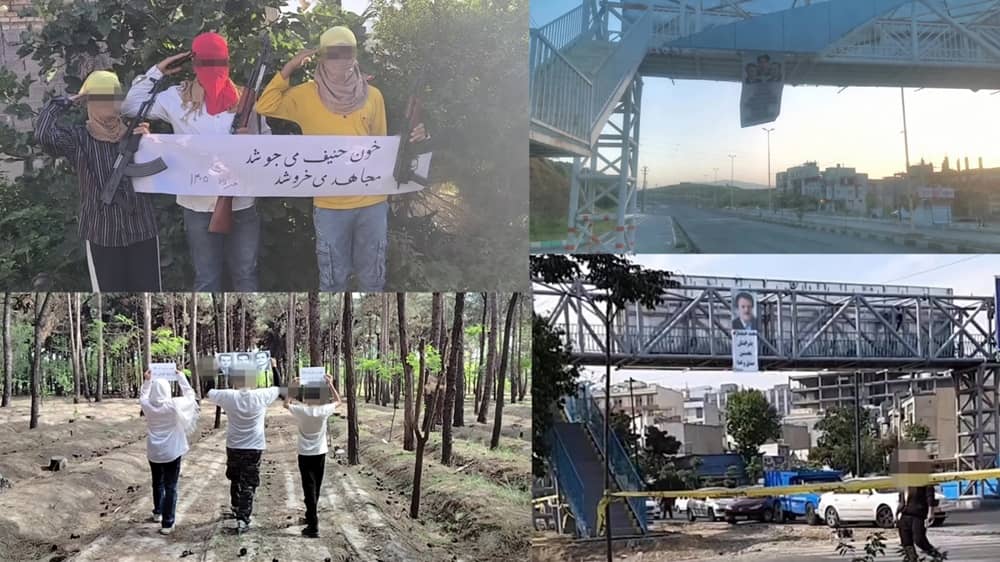
A coordinated wave of anti-regime operations has swept across Iran, dealing a significant blow to the clerical dictatorship’s attempts to project absolute control. From May 24 to May 31, 2026, the PMOI-led Resistance Units mounted a fierce nationwide campaign. Defying a brutal surge in state-sponsored violence—including the recent hanging of eight PMOI Resistance Unit members and up to 20 young protesters—activists struck heavily guarded targets, torched state propaganda, and took over public spaces. This dramatic escalation across dozens of Iranian cities directly challenges a regime currently gridlocked by acute internal crises and the constant nightmare of another popular uprising.
May 29 – 30, 2026
The momentum peaked during these days in the southeastern province of Sistan and Baluchestan, where resistance cells launched an extensive public campaign throughout Zahedan. Activists flooded public spaces with placards proclaiming that the real battle against the ruling regime is taking place today in the ongoing uprisings. Pushing back heavily against both current theological oppression and past monarchical tyranny, the units displayed slogans stating that dictatorship remains dictatorship whether wearing a turban or a crown, declaring that Baluchestan is defiant, awake, and utterly rejects both the Shah and the mullahs. This public defiance occurred alongside stark internal disclosures from the regime’s State Security Force, which admitted to making 6,500 arrests since the outbreak of recent foreign hostilities, explicitly identifying 567 of those detainees as being connected directly to the PMOI.
PMOI Resistance Units in Zahedan defy the regime’s wave of executions https://t.co/71fhzwNcoB
— People's Mojahedin Organization of Iran (PMOI/MEK) (@Mojahedineng) May 30, 2026
May 29, 2026
Under the banner of the “Promise of the Seekers of Justice,” Resistance Units executed coordinated strikes using Molotov cocktails to target the regime’s internal suppression apparatus. These units attacked and set fire to Islamic Revolutionary Guard Corps Bassij bases in Kahnuj (within Kerman province), Karaj, and Iranshahr, while an anti-student Bassij facility was set ablaze in Zahedan. In Doroud, the infrastructure of a Ministry of Intelligence espionage headquarters was completely incinerated. Simultaneously, underground cells systematically torched large-scale propaganda banners featuring Ruhollah Khomeini, Ali Khamenei, and the slain Ebrahim Raisi. These coordinated arson operations struck across a vast geographic spread, neutralizing state displays in Tehran, Rabat Karim, Bagh-e Malek (in Khuzestan), Mashhad, Shiraz, Sabzevar, and Ilam.
May 29—Iran
Resistance Units in Tehran and Karaj honor the memory of PMOI/MEK martyrs Hamed Validi and Mohammad (Nima) Massoum Shahi on the 40th day of their execution by the criminal regime of the mullahs. https://t.co/y8N5KN5VKN pic.twitter.com/KW0MaXGprf— People's Mojahedin Organization of Iran (PMOI/MEK) (@Mojahedineng) May 31, 2026
May 28, 2026
The resistance maintained its pressure through symbolic and political declarations across the country and inside its prisons. Rebellious youths in Tehran and Karaj marked the 40th day since the execution of Resistance Unit members Hamed Validi and Mohammad Masoom Shahi, renewing vows to continue their path. On the same day, political prisoner Parisa Kamali smuggled a message out of Yezd Prison, where she is serving an eight-and-a-half-year sentence for PMOI membership, writing that the dictator tries to survive by elimination and execution, but physical death does not destroy thought. From Ghezel Hessar Prison in Karaj, prominent political prisoner Ali Younesi issued a scathing letter rejecting the co-optation of his plight by monarchist factions, stating that the Shah paved the way for this regime to come to power by killing freedom fighters and asserting that a bloody border of freedom stands between the people and all forms of tyranny.
🚨 Simay Azadi Exclusive – Message by Iranian Political Prisoner Parisa Kamali | May 2026
“I swear that as long as dictatorship and oppression exist, and until our ideals are realized, hand in hand with Massoud and Maryam Rajavi, I will continue this path.”
This message was… pic.twitter.com/a1YMswDand
— SIMAY AZADI TV (@en_simayazadi) May 28, 2026
May 26, 2026
Earlier in the week, the underground movement marked the 122nd consecutive week of the No to Execution Tuesday campaign. Youth and resistance cells organized strikes and distributed literature across an interconnected network of cities, specifically covering Tabriz, Tehran, Hamedan, Bomehen, Abhar, Fariman, Qazvin, Rasht, Kashan, and Lahijan to directly protest the judiciary’s recent hanging spree.
May 24, 2026
At the start of this operational window, specialized teams utilized video projection equipment to display massive images of the movement’s executed historical founders onto public buildings and highway overpasses in Karaj and the Malekshahr district of Isfahan. These projections were accompanied by nationwide commemorative street actions that activated cells across Tehran, Sanandaj, Amol, Tabriz, Shiraz, Rasht, Kerman, Arak, Lahijan, Babolsar, and Karaj.
Iran’s regime executes arrested protester Abbas Akbari amid nationwide surge in death penalties https://t.co/9ug8wFUynv
— People's Mojahedin Organization of Iran (PMOI/MEK) (@Mojahedineng) May 25, 2026
Internal Fractures and the Failure of State Deterrence
The sheer geographical distribution and tactical diversity of these operations reveal a profound structural reality: the Iranian regime is trapped in an unbreakable deadlock. Terrified of the volatile domestic landscape following the January uprisings, the ruling clerics have actively sought to manufacture an aura of invincibility. They have utilized foreign geopolitical conflicts as a smokescreen, while unleashing an unprecedented wave of domestic executions—refusing even to hand over the bodies of the slain to their loved ones in a desperate bid to terrorize the public into submission.
Yet, this calculated strategy of terror has fundamentally backfired. Rather than intimidating the population, the defiant stance of the condemned activists on the gallows has catalyzed a new wave of fury. The fact that the regime’s State Security Forces have had to arrest thousands of citizens—explicitly naming hundreds as organized resistance members—proves that the repressive apparatus is hyper-extended and failing to contain the undercurrent of dissent. By striking the regime’s infrastructure precisely when it seeks to project absolute power, the Resistance Units are demonstrating that the status quo is unsustainable. The Iranian street has moved irrevocably forward, bypassing the dead-end alternatives of both past monarchical dictatorship and present religious fascism, driving instead toward the realization of a pluralistic, democratic republic.