

An escalating wave of civil defiance and underground operations continues to fracture the clerical regime’s illusion of total control across Iran. This weekly news report, highlighting intelligence and field developments for the August 2-8, 2026, reporting window and verified operational updates across the nation, reveals a state locked in an unyielding battle against systemic state terror. From major metropolitan hubs to volatile border provinces, coordinated networks affiliated with the People’s Mojahedin Organization of Iran (PMOI/MEK) have mounted an expansive campaign of anti-execution strikes, and public propaganda destruction. Amid a rampant state execution drive aimed at choking off the lingering embers of the January 2026 nationwide uprising, the regime in Iran faces a severe internal crisis, where its reliance on gallows and arbitrary arrests has served not to quell popular anger, but to galvanize an increasingly organized opposition operating within the country’s deepest security layers.
August 8, 2026
Resistance networks mounted a wide-scale visual and operational campaign across major urban centers to demonstrate support for opposition satellite broadcasting and mark pivotal historical milestones in the nation’s struggle against authoritarianism. In Tehran, Karaj, Khorramabad, Sari, Kangavar, Amol, Langarud, Zahedan, and Kermanshah, activists posted handwritten placards, distributed printed leaflets, and organized photo calls in public spaces supporting the 30th telethon campaign of Simay Azadi (Iran NTV).
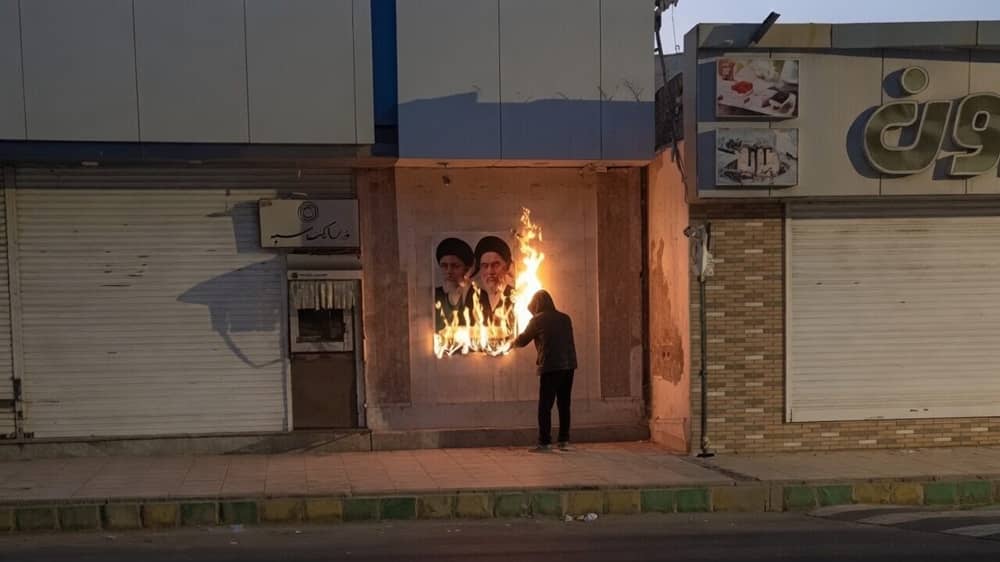
Khorramabad
Resistance Units set fire to Khomeini poster pic.twitter.com/1qtXyge2dV— People's Mojahedin Organization of Iran (PMOI/MEK) (@Mojahedineng) August 9, 2026
August 7, 2026
In a sweeping display of organized defiance coinciding with the anniversary of the 1988 massacre of political prisoners, MEK Resistance Units carried out 60 daring operations, targeting centers of suppression, state institutions, and symbols of the clerical dictatorship across Tehran and 26 other cities, despite intense security measures and surveillance cameras. The coordinated operations spanned multiple urban centers including Kermanshah, Ardabil, Khorramabad, Mashhad, Pishin, Karaj, Isfahan, Shiraz, Urmia, Kerman, Zahedan, Neyshabur, Qaemshahr, Borazjan, Saravan, Aligudarz, Iranshahr, Khash, Bushehr, Susangerd, Astara, Bandar Ganaveh, Chabahar, Zehak, Malard, and Semirom. The targeted apparatuses included the torching of nine IRGC Basij bases in Kermanshah, Tehran, Mashhad, Zahedan, Iranshahr, and Urmia, alongside setting ablaze a judiciary center in Ardabil (Angut). Activists also torched five mullahs’ religious seminaries (Howzeh) acting as suppression and propaganda hubs in Mashhad, Shiraz, and Aligudarz, alongside a district office in Pishin within Sistan and Baluchestan Province and another government propaganda center in Aligudarz. Throughout these operations, banners and posters depicting Ruhollah Khomeini, Ali Khamenei, Mojtaba Khamenei, Qassem Soleimani, and other regime figures were set ablaze, while slogans such as “Terminate the principle of Velayat-e Faqih,” “Long live the National Liberation Army of Iran,” and “Hail to Rajavi” resonated through the streets.
Simultaneously, in the southeastern city of Zahedan, Resistance Units marked the 38th anniversary of the 1988 massacre of political prisoners and the 120th anniversary of Iran’s Constitutional Revolution. Displaying placards in heavily trafficked areas, activists affirmed that the ruling theocracy cannot survive in the face of widespread uprisings and organized resistance. Drawing explicit parallels to constitutional pioneers like Sattar Khan and the historic stronghold of Amirkhiz in Tabriz, the messaging rejected both monarchical and clerical rule, featuring slogans such as “Down with the oppressor, be it the Shah or the Supreme Leader” and condemning state efforts to promote manufactured alternatives centered on the remnants of the deposed monarchy.
🚨 Simay Azadi Exclusive | Message from Political Prisoner Parisa Kamali
In a message from Yazd prison, PMOI supporter and political prisoner Parisa Kamali said:"From 1988 to today, the blood has continued to flow. The clerical regime uses executions and repeated massacres to… pic.twitter.com/IYfRwDpfg6
— SIMAY AZADI TV (@en_simayazadi) August 5, 2026
August 4, 2026
A declaration of defiance emerged from within the security apparatus as political prisoner Parisa Kamali issued an open letter from Yazd Central Prison in Yazd, condemning the regime’s mounting reliance on executions to maintain its fragile grip on power. Kamali noted that while the population remains in deep grief over state killings following the January 2026 uprising, public rage has supplanted fear, calling on international human rights bodies and the United Nations to take concrete action to dismantle the regime’s killing machine.
Concurrently, Resistance Units launched coordinated street operations across Tehran, Shiraz, Isfahan, Tabriz, Kermanshah, and Rasht, displaying placards and painting graffiti reading “Political prisoners must be freed” and “No to state executions”. In Isfahan, public displays highlighted the immediate execution danger facing eight protesters tied to the Alikhani Square dossier, following the public hangings of Abolfazl Sepahi and Amirhossein Safari on July 28, 2026, and earlier hangings of Erfan Esfandiari and Gol-Mohammad Mohammadi on July 19. Activists also paid tribute to fallen MEK members, honoring Mohammad Taghavi in Arak following his execution at Ghezel Hesar prison in Karaj, commemorating Behrouz Ehsani and Mehdi Hassani in Hamedan, and honoring law graduate Mehdi Khanaki in Rasht, who was executed after undergoing months of severe torture in Karaj.
July 7—Zahedan, southeast Iran
PMOI/MEK Resistance Units mark the anniversary of the 1988 massacre of political prisoners by continuing the legacy of 30,000 martyrs who refused to surrender to the regime. pic.twitter.com/sEGUXt1Awt— People's Mojahedin Organization of Iran (PMOI/MEK) (@Mojahedineng) August 8, 2026
August 3, 2026
The nationwide “No to Executions Tuesdays” campaign reached its 132nd consecutive week, encompassing political prisoners across 59 detention centers throughout the country. Dissident networks in Arak, Hamedan, Tabriz, Isfahan, Rasht, Shiraz, Tehran, Kermanshah, and Sari executed coordinated acts of public solidarity to amplify the hunger strikes taking place behind prison bars. Activists distributed anti-execution literature and posted calls for collective civil resistance, directly challenging the judiciary’s legal pretexts—such as charges of “Moharebeh“—used by the state to suppress political dissent and penalize anti-regime protesters.
Conclusion
The relentless expansion of underground resistance operations across Iran exposes a fundamental vulnerability in the clerical regime’s strategy of governance through terror. Far from pacifying a rebellious public, the ruling establishment’s escalating reliance on public hangings, summary trials, and prison crackdowns has catalyzed a deeper political radicalization among the nation’s youth. The Iranian Resistance and its network of MEK Resistance Units have demonstrated a persistent ability to penetrate state security apparatuses across every major urban center, transforming public spaces and high-security prisons into focal points of organized defiance. By attempting to resolve its systemic crises through the gallows, the clerical leadership has backed itself into an inescapable political deadlock; the continuous, synchronized defiance stretching from Zahedan to Tehran demonstrates that the regime’s projection of total control has fractured, proving that state terror can no longer contain a society resolved on democratic change.