

Three-minute read
One hundred and twenty years ago today, on 5 August 1906, a dying king in Tehran signed away the oldest assumption of Iranian politics: that the will of one man was the law of a nation. Mozaffar ed-Din Shah did not sign because he had been persuaded. He signed because merchants had shut the bazaars, because the treasury was empty and the streets were not. By the end of that December, Iran had a written constitution and an elected Majlis. Asia’s first modern parliamentary charter was extracted, not granted.
What happened next is the part that matters for anyone who believes tyranny in Iran is permanent.
The throne, of course, reneged. Mohammad Ali Shah, who inherited it in 1907, understood what every autocrat understands — that a parliament is not a rival institution but an existential verdict. On 23 June 1908, he sent the Russian-officered Cossack Brigade under Colonel Liakhov to shell the Majlis building with artillery, loot it, and hang the constitutionalists who survived. Foreign guns, foreign command, domestic massacre: the formula has proved durable in Iran, and its practitioners have always claimed to be defending order.
The constitution should have died that June. It did not, because of Tabriz.
The Unbroken Struggle: From #Iran's Constitutional Revolution to Democratic Resistancehttps://t.co/bddIYw99kw
— NCRI-FAC (@iran_policy) August 6, 2025
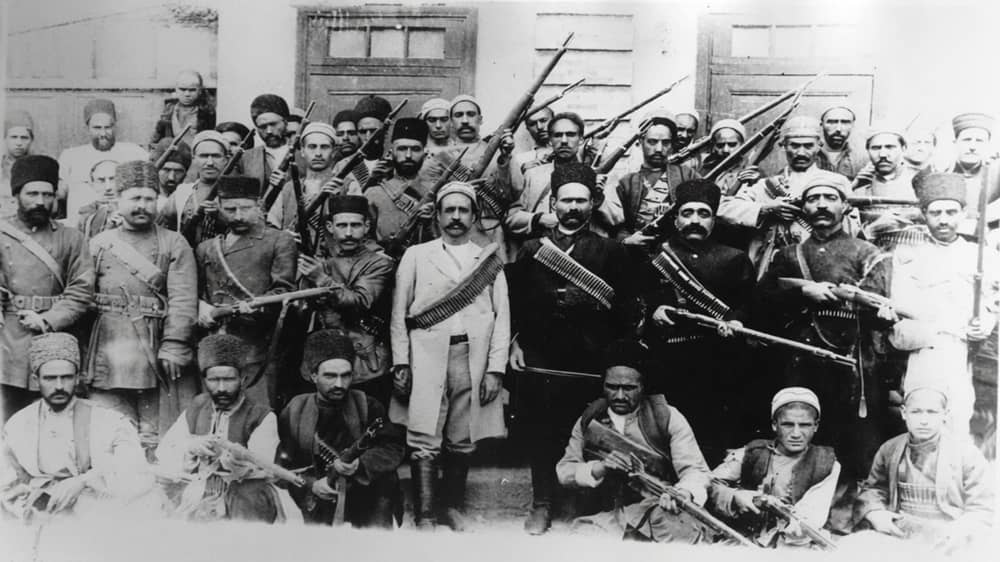
In the Amirkhiz quarter of that city, a horse dealer named Sattar Khan and a stonemason-turned-commander named Bagher Khan did something more consequential than fighting bravely. They organized. They turned neighborhood volunteers into disciplined mojahedin units with sectors, supply lines, couriers, and a chain of command; they defended a city against some forty thousand royalist troops for roughly eleven months, through a blockade so complete that Tabriz ate grass. Sattar Khan famously refused the Russian consul’s offer of protection — the flag over his house would be Iran’s. A young American teacher, Howard Baskerville, took a rifle and died beside them at twenty-four, which tells you what those trenches looked like to outsiders with a conscience.
Tabriz held long enough for constitutionalist forces from Gilan and Isfahan to converge on Tehran in July 1909, depose Mohammad Ali Shah, and restore the parliament. A provincial insurgency, materially outmatched, defeated a monarchy backed by the Tsar’s officers. It did so through structure, patience, and a willingness to be killed for something written on paper.
Then came the betrayal — and it came, as betrayals usually do, from allies. In August 1910 the restored government, urged on by grandees who wanted a constitution without constitutionalists, ordered the volunteers disarmed. On the night of 7 August, government and Bakhtiari forces surrounded Atabak Park. Some thirty fighters were killed. Sattar Khan was shot in the leg and crippled; he died in Tehran on 9 November 1914, a national hero rendered harmless by the state he had saved. Bagher Khan was murdered in 1916. The men were destroyed. The achievement was not. From that August onward, no ruler of Iran could again claim absolute power without lying about it — he had to forge a parliament rather than abolish one.
This year marks the 120th anniversary of the Iranian Constitutional Revolution.
We honor the brave women and men who sacrificed their lives to secure its victory—a pivotal milestone that ushered Iran into a modern era despite immense betrayal and hardship.
Although foreign… pic.twitter.com/4tByMXnelE— Maryam Rajavi (@Maryam_Rajavi) August 5, 2026
Which is precisely the measure of Reza Khan. Iran’s monarchists have spent decades selling him as a modernizer; the historical record shows a British-facilitated coup in February 1921 and an officer who climbed from war minister to prime minister to throne, using the constitution as a staircase and then dynamiting it. On 31 October 1925, a Majlis he had cowed voted to depose the Qajars. Elections were rigged into ritual; the press was silenced; deputies who spoke were exiled, imprisoned, or died conveniently. He did not overcome the Constitutional Revolution — he counterfeited it, because Sattar Khan’s generation had made outright autocracy unspeakable. His son learned only the counterfeiting, kept the ledger, and imported a secret police to guard it.
It was in that October 1925 chamber that a lone voice, Dr. Mohammad Mossadegh, voted no and explained why: a man cannot be both the head of the executive and beyond accountability. Twenty-six years later he nationalized Iran’s oil and was overthrown, in 1953, by the same combination — a Pahlavi shah and foreign intelligence services — that had bombarded the Majlis in 1908 with Russian gunners. Dr. Mossadegh’s most enduring lesson was not oil. It was the lesson that independence is won only by coalition, and that coalitions die of ego long before they die of repression.
Revisiting the Legacy of Mohammad Mossadegh: A Blueprint for Democratic Governance in #Iran https://t.co/RyeT8s4ISt
— NCRI-FAC (@iran_policy) July 30, 2025
That lesson is the operating principle of the organized Iranian Resistance today. The National Council of Resistance of Iran and its constituent organizations have survived four decades of massacre, exile, blacklisting, and the courtship of their oppressor by Western chancelleries for one unglamorous reason: they subordinated individual and organizational vanity to a common structure, with a stated transition plan and a woman as president-elect — a rebuke to both dictatorships Iran has endured.
The clerical regime, cornered by an economy it has looted and a population it can no longer frighten into the streets, is now where Mohammad Ali Shah stood in 1909: shelling institutions, hanging prisoners, hiring foreign patrons. Tabriz answered that question once. Iran’s revolutionaries are organized, and the anniversary is not a memorial. It is an unfinished sentence.