

THIS PAGE WILL BE UPDATED WITH THE LATEST NEWS
UPDATE: 8:00 AM CET
PMOI Resistance Units in Zahedan Honor November 2019 Uprising, Reject Both Shah and Mullahs
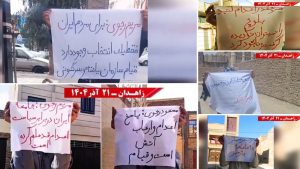
On November 13, 2026, Resistance Units affiliated with the People’s Mojahedin Organization of Iran (PMOI/MEK) marked the seventh anniversary of the November 2019 uprising with anti-regime activities in Zahedan, southeastern Iran, reaffirming their determination to continue the struggle for regime change and reject all forms of dictatorship.
As part of their weekly activities, the Resistance Units displayed placards in public places, commemorating the more than 1,500 protesters killed during the November 2019 uprising and emphasizing that the struggle for freedom remains unfinished.
“The November 2019 uprising will continue until the overthrow of tyranny,” read one placard.
Another declared, “No to mullahs, no to shah, yes to freedom and a democratic republic.”
The messages reflected two central themes of the activities: keeping the spirit of the November uprising alive and rejecting any attempt to replace the ruling religious dictatorship with a restoration of the former monarchy.
Political Prisoner Zahra Safaei Congratulates Mohammad Javad Vafaei Sani on Receiving 2026 Magnitsky Award
On the evening of Thursday, November 12, 2026, the Global Magnitsky Justice Campaign presented its 2026 “Outstanding Human Rights Activist” award during a ceremony in London to Mohammad Javad Vafaei Sani, a political prisoner on death row in Vakilabad Prison in Mashhad, northeastern Iran. Following the announcement, several political prisoners, including Zahra Safaei, speaking from the women’s ward of Evin Prison, congratulated him on receiving the honor. Mohammad Javad Vafaei Sani, a martial arts and boxing champion and coach who holds a national championship silver medal, was arrested on February 8, 2020, in connection with the November 2019 nationwide protests. He has spent the past seven years in prison under torture and pressure awaiting execution, having been sentenced to death three times on charges of membership in the People’s Mojahedin Organization of Iran (PMOI/MEK).
Considered one of the world’s most prestigious human rights honors, the Magnitsky Award recognizes individuals who have stood up against human rights abuses and political repression. During the London ceremony, a message from the 31-year-old death-row prisoner smuggled out of Vakilabad Prison was read aloud to attendees. “I remain steadfast in my pledge, and I will not bow before oppression until the people of Iran are free,” Vafaei Sani emphasized in his message.
Iranian Political Prisoners Send Messages of Solidarity to Death-Row Prisoner Mohammad Javad Vafaei Sani
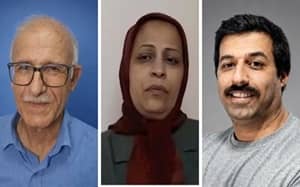
Political prisoners across Iran have sent messages of congratulations to Mohammad Javad Vafaei Sani following his receipt of the 2026 Magnitsky Outstanding Human Rights Activist Award, describing his steadfastness under a death sentence as a testament to the determination of prisoners who refuse to abandon their convictions.
Messages from political prisoners Mehdi Vafaei and Ali Moezi, both held in Qezel Hesar Prison, and Zahra Safaei, imprisoned in the women’s ward of Evin Prison, were conveyed in solidarity with Vafaei Sani. Three other political prisoners—Saeed Gharibi, Ruhollah Eskandarpour, and Reza Heydari—also issued a joint congratulatory message from Adelabad Prison in Shiraz.
Their statements emphasized a common theme: imprisonment, torture, and the threat of execution cannot extinguish the determination of those committed to political freedom.
In an audio message recorded from Qezel Hesar Prison, political prisoner Mehdi Vafaei congratulated Mohammad Javad Vafaei Sani, describing the Magnitsky Award as both a distinction and recognition of the courage of a young man who has refused to surrender despite years of imprisonment.
Iran’s Labor Market on the Brink of Crisis: Widespread Unemployment and the Growing Number of Working Poor
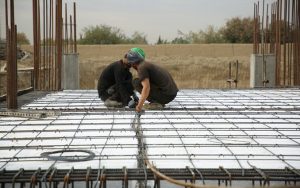
Rising unemployment, business closures, and collapsing wages have plunged Iran’s labor market into crisis, a crisis that is pushing millions of employed people below the poverty line as well. This situation signals the onset of a dangerous phase in which having a job no longer guarantees an escape from poverty, and a university education can no longer provide young people with a secure future.
According to published reports, the unemployment rate among the population aged 15 and older has risen by approximately 24.7%. The employment crisis has become an indication of deep structural dysfunction in the Iranian regime’s economy. An even greater danger is that even those who have jobs are unable to meet their basic living needs because of meager wages.
Businesses facing shortages of working capital, production disruptions, and difficulties accessing bank loans have become vulnerable to even the slightest economic shock.
Power and gas outages, the Central Bank’s contractionary policies, and restrictions on manufacturers’ access to financial resources are placing additional pressure on the production sector. Under these conditions, workforce reductions, cuts in production capacity, and even the closure of businesses have become survival strategies.
From Retirees’ Poverty to Managers’ Astronomical Bonuses in Iran
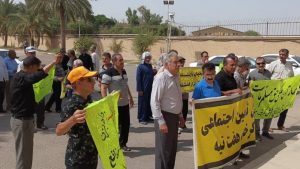
For more than half a century, Iranian workers have contributed a portion of their hard-earned wages to the Social Security Organization, building an intergenerational fund that was supposed to serve as a safety net for more than 55% of the country’s population. To protect the value of these assets against inflation, the Social Security Investment Company (Shasta) was established to shoulder the organization’s financial burden when needed.
Today, however, Shasta and its subsidiaries, spanning industries from oil and gas to cement and pharmaceuticals, are not only failing to support the Social Security Organization but have also become political backyards for distributing spoils among regime factions. The Social Security Organization is now forced to borrow money or turn to the government for financial assistance to pay retirees’ pensions. The roots of this major contradiction lie in four principal factors:
– Paper Profits and Real Losses: A large proportion of Shasta companies operate at a loss in their core business activities. The profits announced at the end of the year are not generated through production but result from “asset revaluation” and inflation. These accounting gains generate not even one rial in actual cash for the Social Security Organization, yet they become the basis for awarding astronomical bonuses to board members.
Iran: The Gap Between the Official Narrative of “Islamic Prison Management” and Prison Reality

Judicial authorities of the Islamic Republic of Iran frequently speak of “Islamic prison management,” respect for prisoners’ dignity, reducing prison populations, and attending to prisoners’ welfare. In contrast, reports emerging from various prisons across the country, including Greater Tehran Penitentiary, Karaj Central Prison, Birjand Prison, and Maragheh Prison, present a markedly different picture. This picture includes severe overcrowding, prisoners sleeping on floors, food shortages, denial of adequate medical treatment, restricted access to hygiene facilities, prolonged solitary confinement, allegations of torture, and degrading treatment.

This report argues that there is a profound gap between the official narrative promoted by the Islamic Republic regarding prison conditions and the reality described by prisoners, family members, and informed sources. This discrepancy not only affects the fundamental rights of detainees but also raises serious concerns regarding the Islamic Republic of Iran’s compliance with its obligations under international human rights law, particularly in relation to the prohibition of torture, the humane treatment of persons deprived of liberty, and the right to access adequate medical care.
In official documents and public statements, the Islamic Republic of Iran has consistently emphasized concepts such as “Islamic prison management,” “preservation of prisoners’ dignity,” “rehabilitation and reform,” and “respect for prisoners’ rights.”
Who Controls Iran’s US Talks? Ghalibaf and Rezaei at Center of Diplomatic Power Struggle
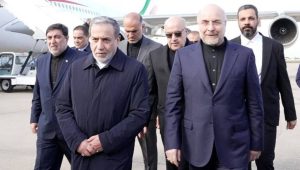
Iran’s leadership is facing renewed questions over who controls negotiations with the United States after Parliament Speaker Mohammad Bagher Ghalibaf reaffirmed his role as chief negotiator while Supreme National Security Council Secretary Mohsen Rezaei assumed a prominent position in diplomatic exchanges with Washington.
The uncertainty intensified after US Vice President JD Vance addressed a letter to Rezaei rather than Ghalibaf, prompting speculation that the parliamentary speaker was being sidelined.
Iranian officials have rejected suggestions that the negotiating team has changed. Yet the episode has exposed competition among conservative factions over diplomatic influence as Tehran considers proposals to end its confrontation with Washington.
The distinction matters because Iran’s negotiators must operate within a security establishment that retains ultimate authority over major foreign policy decisions.
Paris Photo Exhibition Honors Martyrs of Iran’s November 2019 Uprising
Paris, November 13, 2026 — Supporters of the People’s Mojahedin Organization of Iran (PMOI/MEK) and the National Council of Resistance of Iran (NCRI) held a photo exhibition at Place de la République in Paris on Friday to mark the anniversary of Iran’s November 2019 uprising and honor its more than 1,500 martyrs.
The exhibition also displayed photographs of victims of Iran’s nationwide uprisings in 2022 and 2026, as well as political prisoners and protesters executed by the Iranian regime, particularly in recent months.
Photographs of the victims were shown to passersby in the heart of Paris. Their faces, silent but striking, recalled the lives of men and women who sacrificed their lives for freedom and democracy in Iran.

Organizers said the display was a testament to the continuing struggle of the Iranian people against repression and for freedom. They highlighted the Iranian regime’s continued use of the death penalty as a tool of political repression and called for an end to executions in Iran.