
Three-minute read
Women make up most university applicants, yet barely one in seven participates in Iran’s labor market. The contradiction is not merely social discrimination. It is the destruction of human capital on a national scale.
Over the past several decades, Iranian women have become increasingly educated, yet the country’s economy has proved remarkably incapable of employing them.
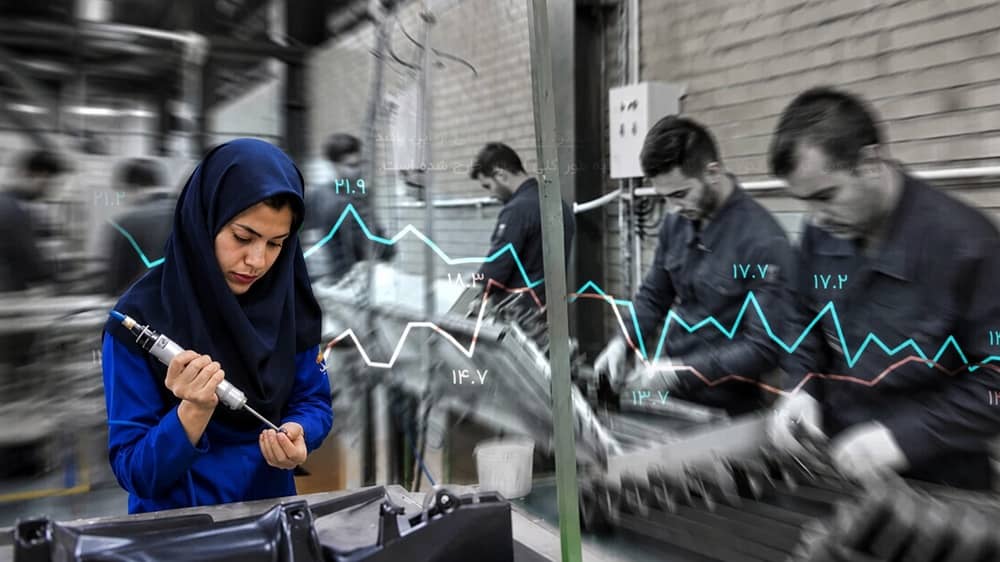
The contradiction is visible in the Iranian regime’s own numbers. Women account for more than 60 percent of university applicants, according to officials, while another state-media report put their share of higher-education entrants at 64 percent. Yet in spring 2026, only 13.7 percent of working-age women participated in the labor market, compared with 67.8 percent of men. Female unemployment stood at 16.7 percent, more than twice the male rate of 7.5 percent.
Those figures reveal something more serious than unemployment. A woman who wants work but has stopped actively searching is not counted as unemployed; she disappears from the labor force altogether. With female participation below 14 percent, Iran’s unemployment rate captures only the small minority of women who remain economically active. The larger story is exclusion.
Youth Employment Crisis: Jobless Rate for Young Women Nears 35%
💥Recent official statistics have sounded the alarm on a worsening youth employment crisis, with the jobless rate for young women climbing to a staggering 35%. This sharp rise underscores a growing challenge in the… pic.twitter.com/1Z8caqw8lS— Women's Committee NCRI (@womenncri) May 30, 2025
The University-to-Employment Pipeline Is Broken
Nowhere is the mismatch clearer than among educated women.
Tasnim reported in October, citing Statistical Center data, that university graduates constitute roughly 40 to 42 percent of all unemployed Iranians. Among unemployed women, however, the ratio rises to approximately seven out of every 10. The unemployment rate among female university graduates exceeds 20 percent, roughly twice the overall graduate rate.
That is an extraordinary waste of investment. Families finance years of schooling; universities devote resources to training doctors, engineers, scientists and other professionals; women invest some of the most productive years of their lives acquiring qualifications. Yet the economy frequently fails to convert that education into productive employment.
The problem cannot simply be blamed on graduates possessing the wrong skills. Iran undeniably suffers from a serious university-to-industry mismatch: one state-linked study found that among graduates surveyed, only 21 percent worked in jobs related to their field, while 26 percent worked in unrelated occupations, 6 percent were unemployed and 47 percent were economically inactive. But if skills mismatch were the whole explanation, it would not explain why the employment penalty falls so disproportionately on women.
Iran: Women Bear the Brunt as 1.2M Workers Lose Jobs to War
Families are beign “crushed” under the weight of poverty and financial ruin. Women and their families are bearing the heaviest burden of a worsening economic crisis.https://t.co/SgNNft1pB5
— Women's Committee NCRI (@womenncri) May 1, 2026
Women Face Two Barriers, Not One
Domestic economic reporting increasingly acknowledges the second barrier: gender itself.
Iranian business reporting has described employers considering a female applicant’s marital status, possible pregnancy, childcare responsibilities and family obligations before her qualifications. Analysts interviewed by domestic media point to inadequate childcare, insecure contracts, weak safeguards for returning from maternity leave and limited advancement opportunities as factors discouraging both employers from hiring women and women from remaining employed.
Even officials acknowledge the scale of the problem. Vice President for Women and Family Affairs Zahra Behrouz-Azar said this year that women’s overall economic participation remains around 14 percent. She contrasted that with university-educated women, whose participation she put at roughly 35 percent, while conceding that women constitute more than 60 percent of university applicants. The government has consequently announced 60 trillion tomans in employment facilities aimed at 11 categories of women.
But credit programs cannot by themselves repair a labor market in which women encounter structural barriers before they are hired, after they have children, and when they seek promotion. Nor can small-business programs substitute for access to the formal professional economy.
Female Breadwinners in Iran Struggling for Survival
Iran’s economic collapse has hit female breadwinners the hardest, forcing millions of women to fight for survival without state support.💰 Rising Numbers, Hidden Figures
While official reports claim 3–4 million women are… pic.twitter.com/2jZWxvROHa— Women's Committee NCRI (@womenncri) March 5, 2025
The Headline Unemployment Rate Hides the Real Loss
If five women want jobs and four eventually stop looking because opportunities are unavailable, official unemployment does not necessarily rise. Labor-force participation falls instead. A declining unemployment rate can therefore coexist with a profoundly unhealthy labor market if discouraged workers simply disappear from the denominator.
That is precisely why the gap between 13.7 percent female participation and 67.8 percent male participation is economically more significant than the unemployment rate alone. Iran is leaving a vast pool of working-age human capital outside formal production. State media itself described the contradiction starkly in August: “64 percent share of women in universities, only 15 percent in employment.”
The consequences extend beyond women’s individual incomes. Fewer earners reduce household resilience. Lower participation narrows the tax and insurance base. Education spending generates a weaker economic return. Skilled women who cannot construct careers have stronger incentives to emigrate, accept work beneath their qualifications or withdraw professionally.
Women Nurses in Iran Face Intimidation, Disciplinary Cases and Wage Cuts After Workplace Protests
Several days after the sit-in, six nurses and healthcare workers who had been chosen by their colleagues as representatives were summoned to the hospital administration building.… pic.twitter.com/wS6sgzSDos
— Women's Committee NCRI (@womenncri) November 7, 2026
A Generation with More to Rebel Against
Iran’s universities have produced generations of educated women. The regime’s economy has shut many of them out. Tasnim acknowledges that roughly 70 percent of unemployed women are university graduates.
That is more than wasted talent. It is a breeding ground for anger. Women who have done everything demanded of them—studied, qualified, competed—and still find the system blocking their path have every reason to question the order that keeps them down.
For the clerical regime, the cost is political as much as economic: it is creating an educated generation with more reasons to confront the status quo than to preserve it.