

Four-minute read
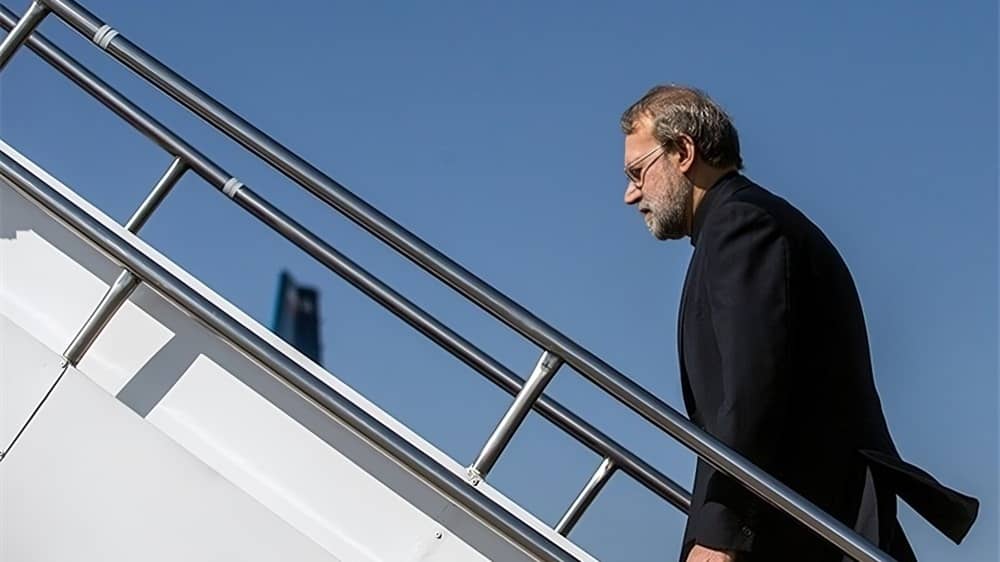
The clerical regime in Tehran is increasingly consumed by infighting over nearly every decision touching its survival — from foreign policy gambits and economic triage to internal power balances among rival factions. The latest flashpoint came with the sudden dispatch of Ali Larijani, Secretary of the regime’s Supreme National Security Council, to Moscow — reportedly carrying a message from Supreme Leader Ali Khamenei to Vladimir Putin. What state media portrayed as a routine diplomatic mission instead triggered an avalanche of recriminations across parliament, the Revolutionary Guard’s ranks, and the regime’s own press, exposing a leadership mired in distrust, contradiction, and fear of political collapse.
State-affiliated website Ruydad24 described Larijani’s visit as a “secret mission” that coincided with a long telephone conversation between Putin and former U.S. President Donald Trump. The timing, Ruydad24 suggested, prompted speculation that Moscow may be seeking a mediating role between Tehran and Washington — a proposition that has inflamed tensions among the regime’s pro- and anti-Russia camps.
Hardline commentators seized on the possibility of rapprochement with the West as a trap. Within hours of Trump’s public remarks offering conditional engagement with Iran — on terms including a cessation of proxy activity and recognition of Israel — conservative outlets branded the proposal “a new deceit” and warned against naive rapprochement. Some regime figures accused domestic rivals of “playing in Trump’s field” by advocating any contact with Washington.
#Iran’s Power Struggle: A Fractured Regime Hiding Behind Bold Rhetorichttps://t.co/SzNeQLYdh4
— NCRI-FAC (@iran_policy) October 16, 2025
Strategic disputes
At the same time, senior security voices publicly signaled alarm at political defections and loss of unity within the system. Abdollah Haji Sadeghi, Khamenei’s representative in the Islamic Revolutionary Guard Corps, warned in a speech at Qom that some who once proclaimed revolutionary zeal are now “repenting” and defecting from core tenets — a development he called “deeply worrying.” His comments were widely read as a direct critique of factional rivals and an effort to rally hardline cohesion.
Meanwhile, veteran security and parliamentary figure Heshmatollah Falakhteh-Pisheh blasted the strategy of deepening ties with Moscow, arguing that overreliance on Russia is a strategic dead end. “If Larijani’s mission aims at divorcing Iran’s fate from the hegemonic games of Russia, then it risks continuing the ruinous course begun in 2021,” Falakhteh-Pisheh said, adding pointedly that Russia’s military calculus is not a substitute for independent Iranian strategy. His comments reflect a growing alarm among some conservative nationalists and technocrats over the costs of the Tehran-Moscow security partnership.
The spat over Larijani’s mission is only the most visible symptom of a wider political crisis. President Masoud Pezeshkian — who has repeatedly cast his appeals in moral and managerial terms — struck a conciliatory tone in public addresses, urging “unity” while repeatedly acknowledging the scale of failures in governance. Speaking in Isfahan, Pezeshkian declared, “We sleep on gold but go hungry — the fault is ours, not America’s,” and warned that internal strife posed a greater danger to the system than external threats.
#Iran’s Power Structure Buckles Under Political, Economic, and Nuclear Pressurehttps://t.co/abvkCn5vAj
— NCRI-FAC (@iran_policy) September 9, 2025
Crying louder than the people
Pezeshkian’s blunt admission underscored two interconnected stress points: an acute economic breakdown and an elite unable to present a unified response. He pointed to stalled infrastructure — “nearly 5 million billion tomans in idle projects” — as evidence of managerial failure and rent-seeking. His message of internal cohesion has been met unevenly; opponents argue that appeals to unity are hollow without accountability and economic reform, while allies view them as necessary damage control. Yet his public lamentations — framed as empathy with the suffering population — serve mainly to project an image of a “compassionate” government, masking the regime’s structural corruption and its absolute unwillingness to change course.
Fuel policy and price reform have become an additional flashpoint. Officials close to the president’s office have begun preparing public opinion for gasoline price adjustments, citing soaring consumption and fiscal strain. Communications deputy Tabatabai and spokesperson Fatemeh Mohajerani have both floated the idea of rationalizing fuel pricing to “curb waste and smuggling.” Yet even within the pro-government camp, there is fear that any sizable hikes — opponents have suggested increases that could reach several hundred percent in some scenarios — would trigger unrest similar to previous price-shock protests.
Parliamentary voices have amplified the discord. Some MPs denounced fuel hikes as “reaching into people’s pockets,” urging anti-smuggling measures and targeted quota systems instead of blanket price shocks. Others blasted ministers and central bank officials for corruption and mismanagement, reflecting deep frustration across Tehran’s political class.
#Iranian Regime MPs Threaten Foreign Minister Araghchi Amid Nuclear Infighting https://t.co/kpDzSrWbsW
— NCRI-FAC (@iran_policy) September 13, 2025
Rigid rivalry over everything
Taken together, the diplomatic maneuvering, public recriminations and economic alarm point to a regime increasingly riven by competing survival strategies: accommodation with external powers, rigid resistance and internal reformist rhetoric. Each strategy has powerful patrons within the system — security organs, conservative media, technocratic ministries — and each threatens to undermine the others.
Observers say the consequence is strategic paralysis. Foreign policy becomes harder to coordinate when factions fear that a rival’s gain will translate into political marginalization; economic stabilization is impossible while elites fight over who will control scarce rents; and social stability is endangered when the state publicly debates whether to raise fuel prices while admitting to massive idle projects and financial waste.
For now, Tehran’s factional war plays out in the open: public speeches, state television denunciations, parliamentary shouting matches and sharply worded commentary in outlets aligned with competing power centers. The visible nature of these fights — rather than closed elite maneuvering — suggests a regime less able to manage internal disputes out of public view, and therefore more vulnerable to erosion of authority.
If these fractures continue to widen, analysts forecast, the clerical establishment may find it increasingly difficult to pursue coherent foreign policy or the disciplined economic adjustments the country needs. Instead of resolving its crises, the regime risks being consumed by the very disputes it manufactures to consolidate control.