

Three-minute read
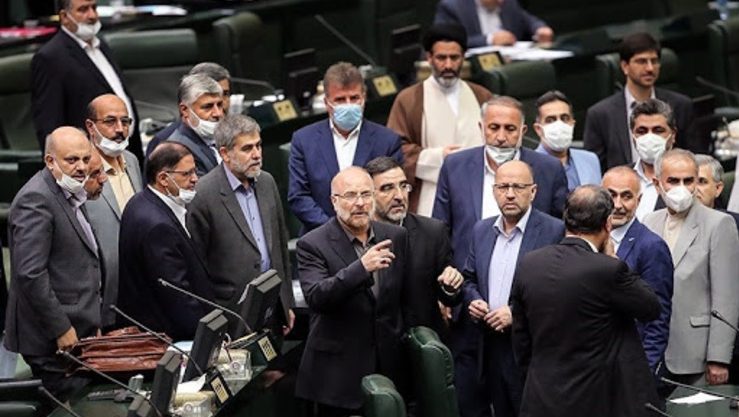
A series of sharply conflicting statements from senior Iranian officials and clerical figures has exposed deepening infighting at the top of the ruling structure, centered on the Strait of Hormuz and potential negotiations with the United States.
Foreign Minister Abbas Araghchi triggered the latest wave of tension by announcing that the Strait of Hormuz would remain fully open to commercial shipping during a ceasefire period. His statement was quickly contradicted by Parliament Speaker Mohammad Bagher Ghalibaf, who insisted that transit remains conditional and under Iran’s control.
Military-linked institutions then intervened, asserting that the strait is firmly controlled and that access depends on the Iranian regime’s terms. The rapid succession of conflicting positions underscores the absence of a unified policy line at a critical moment.
Hardline clerics escalate rhetoric to block any perception of retreat
At Friday prayer platforms on April 17, 2026, senior clerics moved aggressively to counter any signal that could be interpreted as compromise.
Ahmad Khatami, a senior cleric appointed by the Supreme Leader, warned negotiators to maintain total distrust toward the United States, rejecting even symbolic gestures.
In Yazd, Mohammad-Reza Naseri Yazdi, the Supreme Leader’s representative, called for closing the Strait of Hormuz and framed it as a decisive strategic weapon.
At the same time, Abbas Mousavi Motlagh, another state-affiliated cleric, called for the suppression of dissent, declaring that any voice expressing internal disagreement should be silenced by force and criticizing officials for issuing statements outside controlled channels.
These positions go beyond foreign policy—they are aimed at preventing any internal perception of weakness.
The central fact of post-Khamenei Iran is that the regime has entered a crisis of command. The state still carries on with #war and oppression, but the one office that could settle every serious dispute is gone.https://t.co/6JH4qQriPf
— NCRI-FAC (@iran_policy) March 8, 2026
Political and media figures openly challenge negotiators
The confrontation has spread into political and media circles, where attacks on the negotiating track have become increasingly direct.
Hossein Shariatmadari, editor-in-chief of Kayhan Daily, publicly criticized Araghchi’s messaging on Hormuz, questioning why any signal of openness was issued while pressure on adversaries was supposedly effective.
In parliament, MP Amir Hossein Sabeti demanded clarification regarding reports of possible nuclear concessions, warning that if such claims are true, officials must confront the public “firmly and directly.” Calls for impeachment were raised during his remarks.
This level of public confrontation reflects not confidence, but deep distrust within the system itself.
Khamenei's desperate call for elite endorsement after #Iran's bloody crackdown exposes regime fractures: silence from insiders, prolonged internet blackout, and fear of ongoing resistance. Analysis by @HakamianMahmoud https://t.co/0zxnoeYkvY
— NCRI-FAC (@iran_policy) January 23, 2026
Fear of internal erosion drives resistance to compromise
The intensity of the infighting is rooted in a shared concern across factions: any visible concession risks triggering a collapse in morale among the regime’s own base. After months of strategic setbacks and sustained pressure, the system’s core supporters—including its security forces, foreign mercenaries, ideological backers, and institutional apparatus—are already under unprecedented strain.
In this context, even a signal that Hormuz is “open,” any suggestion of nuclear compromise, or even the tone of diplomatic messaging can be interpreted internally as a sign of retreat. As a result, extremist factions are acting preemptively by escalating their rhetoric, imposing impossible conditions on negotiations, and attacking officials perceived as too flexible.
Their objective is not only to confront external adversaries, but also to prevent demoralization from spreading inside the regime itself.
In the aftermath of the #IranProtests and the ensuing crackdown, Iran’s clerical leadership is escalating a familiar two-track response: expanding arrests and judicial pressure at home while urging mass public displays of loyalty to project control.https://t.co/b05fLI15kX
— NCRI-FAC (@iran_policy) February 10, 2026
Nuclear issue becomes focal point of suspicion and control
The nuclear program, or what is left of it, has intensified these tensions.
Officials such as Foreign Ministry spokesperson Esmail Baghaee denied any intention to transfer enriched uranium, framing it as a non-negotiable national asset. Yet political figures openly questioned whether such discussions are happening behind closed doors.
Amid political and clerical conflict, military-linked actors have reinforced their authority over strategic decisions.
Statements emphasized that control of the Strait of Hormuz lies with Iran’s armed forces and that access will remain tightly regulated unless external conditions change.
This assertion places security institutions at the center of decision-making, overshadowing diplomatic messaging and highlighting a fragmented structure where multiple actors compete for control.
Who Is Mojtaba Khamenei: The Iranian Regime’s Last Supreme Leader and Its Hereditary Gamble https://t.co/LwqnQZwdk7 @seanhannity @hughhewitt @marklevinshow
— Ali Safavi (@amsafavi) March 9, 2026
Infighting driven by fear
The statements and developments over the last few days reveal a system under intense pressure. Conflicting positions over a critical strategic chokepoint, public attacks among senior officials, escalating rhetoric aimed at suppressing dissent, and deep suspicion surrounding nuclear policy all point to a growing internal crisis.
At its core, this infighting is driven by fear—specifically, the fear that any sign of submission will further erode the already fragile morale within the regime’s own ranks. What emerges is a system increasingly dependent on coercion and pressure tactics, even as it struggles to preserve internal cohesion under mounting strain.