

Three-minute read
On Saturday, November 29, 2025, state-controlled newspapers in Iran read less like national dailies than transcripts of an imploding power struggle. The Revolutionary Guards’ Javan demanded prosecutions inside Masoud Pezeshkian’s cabinet. Kayhan accused pro-government reformists of betrayal. So-called “reformist” outlets exposed “white” SIM cards and privileged internet access for officials. And former president Hassan Rouhani punctured the official narrative of post-war stability, acknowledging that five months after the 12-day conflict, “a sense of security does not exist in the country.”
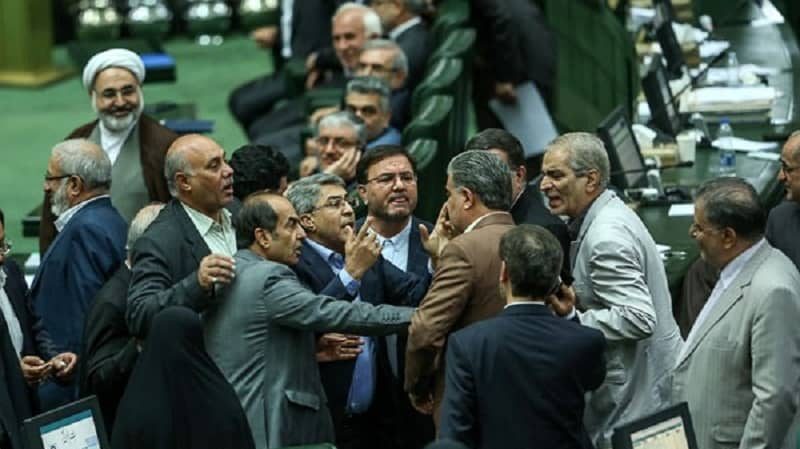
Across the spectrum, the story was the same — a ruling elite fraying under economic collapse, mistrust, and fear of public revolt, each faction racing to shift blame before the next shock hits.
Hunt on ‘traitors’
The week’s fiercest clash followed reports that Pezeshkian had written to Saudi crown prince Mohammed bin Salman to mediate with Washington — a gesture interpreted as presidential initiative beyond factional control. For Khamenei’s camp, that was intolerable.
On Friday, November 28, the IRGC daily Javan ran a front-page attack titled “The Lies of Elyas Hazrati and Friends,” urging prosecutors to charge Pezeshkian’s communications chief for allowing the story to run. Hours later, state TV aired a prerecorded address from Khamenei, dismissing mediation claims as a “pure lie” and declaring that a government like the United States was not “worthy” of Iran’s cooperation.
Kayhan, run by Khamenei’s longtime confidant Hossein Shariatmadari, amplified the assault, accusing the rival faction’s editors of “spreading deliberate disinformation.” The message was clear: foreign outreach, even rhetorical, is the Leader’s exclusive domain.
#Iran News: State Media Slams Senior Cleric for Accusing MPs of #Espionage Amid Regime Infightinghttps://t.co/W8CtQSTlhk
— NCRI-FAC (@iran_policy) January 13, 2025
“White SIMs” and the Two-Tier Internet
Simultaneously, the regime’s information elite faced an embarrassment harder to censor — the exposure of “white internet”, uncensored digital access reserved for top officials.
Data shared on X (Twitter) in late November revealed which Iranian users accessed the platform without VPNs. Tech-savvy activists cross-referenced the numbers with domestic databases, confirming unrestricted lines held by Saeed Jalili, Hamid Rasaee, and numerous other officials and MPs — many of them loud advocates of internet filtering.
Etemad called the revelations “horrific hypocrisy,” demanding the communications ministry publish the names of all officials with white lines. Jomhouri-ye Eslami mocked those who had “denied the privilege on camera,” only to be exposed days later. Former MP Gholam-Ali Jafarzadeh Imenabadi warned that such double standards “have made the nation deeply distrustful.”
Ham-Mihan framed the issue as structural: “It is not censorship alone, but the perception that others live above the rules.” It called the scandal “institutional betrayal” — proof that even access to truth itself is tiered by privilege.
#Iran’s White-SIM Internet: How Tehran Hacks the Feed You Trusthttps://t.co/IUhKVR2wcg
— NCRI-FAC (@iran_policy) November 26, 2025
Economic Decay Beneath the Noise
Beneath the factional theatrics lies a grim economic reality. Even state-linked analysts now concede that inflation and inequality are spiraling out of control.
Donyay-e Eqtesad placed last month’s point-to-point inflation at 49.4%, warning it could surpass 54% by year’s end. It also labeled the new three-tier gasoline pricing system — including the 5,000-toman “station rate” — a “policy trap” that will force poorer households to cut food and medicine.
In Arman-e Melli, social-policy expert Hassan Mousavi-Chelak predicted that “the first day gasoline prices rise, all goods and services will peg their prices to 5,000 tomans,” pushing retirees and wage-earners into deeper hardship. Jahan-e Sanat chronicled plummeting protein consumption, unstable rice prices, and fears that a potential devaluation to 100,000 tomans per dollar could trigger “a severe inflationary wave.”
Meanwhile, government paralysis deepens. MP Mohammad Manan Raisi complained that his impeachment request for the housing minister has sat in the Majlis for six months, in violation of parliamentary rules. Former MP Shahryar Heidari described a legislature “trapped by deal-makers” who trade oversight for personal favors. Even insiders now depict the Majlis as transactional and terrified of accountability.
Price Hikes and Escalating #Inflation Deepen Economic Crisis in #Iranhttps://t.co/La9aQy0LAc
— NCRI-FAC (@iran_policy) November 18, 2024
Corruption Scandal at the Health Ministry
Adding to the sense of decay, a new scandal struck the Pezeshkian administration on Saturday, November 29. State media reported that Jalil Hosseini, deputy minister of health, resigned following publication of a letter from a patient’s mother accusing him of soliciting a five gold-coin bribe to perform surgery.
The letter, shared online by a medical publisher alleged that Hosseini told her, “If you don’t have the coins, you’ll wait three to four years for surgery at Tajrish Hospital.”
A day later, Health Minister Mohammad-Reza Zafarghandi appointed his senior adviser Ali Jafarian as acting deputy. The ministry and Hosseini have yet to issue a public response. The scandal has ignited public anger online, reinforcing perceptions of a system where privilege — and corruption — are as routine as inflation.
#Iran’s Permanent Emergency: How the Regime Governs for the Next Uprisinghttps://t.co/tQsb4PopTG
— NCRI-FAC (@iran_policy) November 19, 2025
A System Focused on Survival, Not Governance
Rouhani, speaking on November 29, framed “national unity” as Iran’s missing ingredient, yet conceded that “a feeling of security does not exist.” Army chief Amir Hatami underlined that Iran “cannot separate national from regional security,” vowing “crushing” pre-emptive defense.
Behind every statement lies the same fear: loss of control. The week’s clashes — over mediation rumors, privileged internet access, economic collapse, and open bribery — expose not debate, but decay.
Each faction now fights to deflect blame rather than fix the system. The clerical regime’s elite appears less engaged in governing Iran — and more preoccupied with surviving it.