

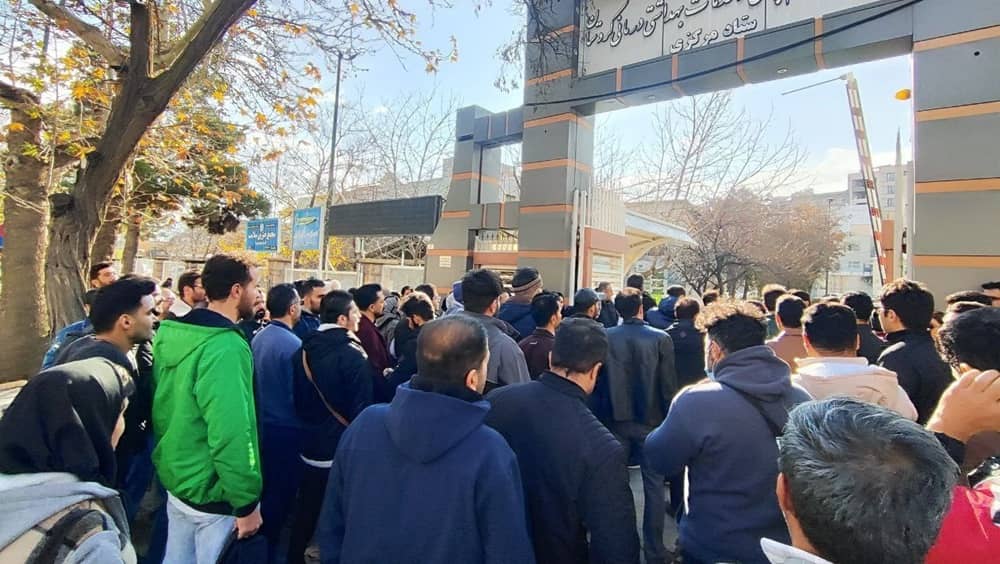
Workers at the Pasargad Alloy Steel complex in Kavar, southern Iran, held a protest on Saturday, December 13, 2025, demanding an end to wage disparities, relief from mounting cost-of-living pressures, and payment of overdue benefits—an action that comes as other groups across Iran have also protested economic policy, broken promises, and what they describe as official indifference.
According to Persian-language reports, a group of workers and employees gathered in the morning outside the facility’s main entrance to press management to address what they called worsening living conditions and persistent discrimination in pay. The reports described the demonstration as a response to management’s failure to meet workers’ legal guild demands, saying this inaction has driven “widespread dissatisfaction” among staff.
“Enough”: workers reject “empty promises”
The protesters’ stated demands focused on three areas:
- Ending wage discrimination — workers called for an end to unequal pay practices among employees.
- Addressing living-cost pressures — they urged immediate steps to improve workers’ household livelihood and purchasing power.
- Paying overdue benefits — they demanded settlement of unpaid bonuses and other outstanding financial entitlements.
During the rally, workers chanted slogans emphasizing that they no longer accept delay tactics. One slogan quoted in the reports was: “Enough — we won’t wait for empty promises.”
Photos and videos of the demonstration were shared on social media, showing a significant number of workers gathered at the plant gate.
December 13—Kavar, southern Iran
Workers at the Pasargad Alloy Steel complex rallied at the factory gate over wage discrimination, unpaid/overdue benefits, and crushing cost-of-living pressures, demanding equal pay, back benefits, and relief for livelihoods. #IranProtests pic.twitter.com/DCT2EjUHJp— People's Mojahedin Organization of Iran (PMOI/MEK) (@Mojahedineng) December 13, 2025
A protest rooted in bread-and-butter grievances
While the protest was framed as a labor dispute at a specific industrial site, its language reflected a wider pattern in Iran: workers linking workplace demands—wages, benefits, equal treatment—to broader hardship at the household level.
The Pasargad Alloy Steel protest was described not as a one-off complaint but as part of a determination to continue demonstrations until demands are met, with workers signaling that prior assurances have produced little concrete change. The rally’s emphasis on “unpaid benefits” and “discrimination in pay” also points to two chronic drivers of labor unrest in Iran: delayed compensation and perceived inequities between different categories of workers or between company subdivisions.
December 13—Kuhnanī, western Iran
Residents of Kuhnanī blocked the Kuhnanī–Kuhdasht road to protest hazardous road conditions after two local teachers were killed in a traffic crash, demanding immediate repairs and accountability from provincial officials to stop deadly… pic.twitter.com/eExAvXAKBu— People's Mojahedin Organization of Iran (PMOI/MEK) (@Mojahedineng) December 13, 2025
Housing applicants and a textile producer confront officials
Separate reporting dated Friday, December 12 described a broader spread of economic grievances in Iran, including repeated protests by applicants for a state-backed housing program and a rare public confrontation involving a textile producer and Iran’s minister of industry, mines and trade.
In Chaharmahal and Bakhtiari province, applicants for “National Housing” reportedly gathered again, complaining of broken promises, prolonged delivery delays, and “astronomical prices.” Protesters said they were tired of “endless” delivery timelines and that “still no one is accountable.”
Reports from inside Iran described a tense moment a day earlier at the Kashan Chamber of Commerce during a session attended by Industry Minister Mohammad Atabak and his deputies. A producer of machine-made carpet—described as being denied permission to speak—stood in front of the minister and shouted complaints about what he saw as the abandonment of the textile sector.
The producer’s quoted remarks included: “I wanted to speak; they said don’t talk… They show everything as rosy. They don’t give currency; they have completely abandoned the textile industry.” He also questioned the purpose of such meetings if business voices are not heard: “When the voice of an economic actor is not going to be heard, what’s the point of these sessions? It’s only for reporting—so they can say we held a meeting.”
December 12—Zahedan, southeast Iran
PMOI Resistance Units resumed anti-regime activities with messages and slogans emphasizing the people’s determination to overthrow the ruling dictatorship and establish a free and democratic Iran. pic.twitter.com/G0F7N7t3Cu— People's Mojahedin Organization of Iran (PMOI/MEK) (@Mojahedineng) December 13, 2025
What these episodes signal
Taken together, the recent protests across Iran point to a widening social pressure cooker: workers, nurses, small manufacturers, and households waiting on state-backed housing are all voicing variations of the same message—daily life has become financially and administratively unbearable, and official promises no longer carry credibility.
What links these disputes is not a single policy grievance but a shared sense of exhaustion across different segments of society: shrinking purchasing power, delayed or missing payments, perceived favoritism and discrimination, and a state apparatus that is seen as unresponsive unless pushed in the street. The result is a steady churn of localized protests that, taken cumulatively, reflects a deeper political risk for the clerical dictatorship—unrest sustained not by one flashpoint, but by overlapping crises that repeatedly force people to mobilize simply to defend basic livelihoods.