

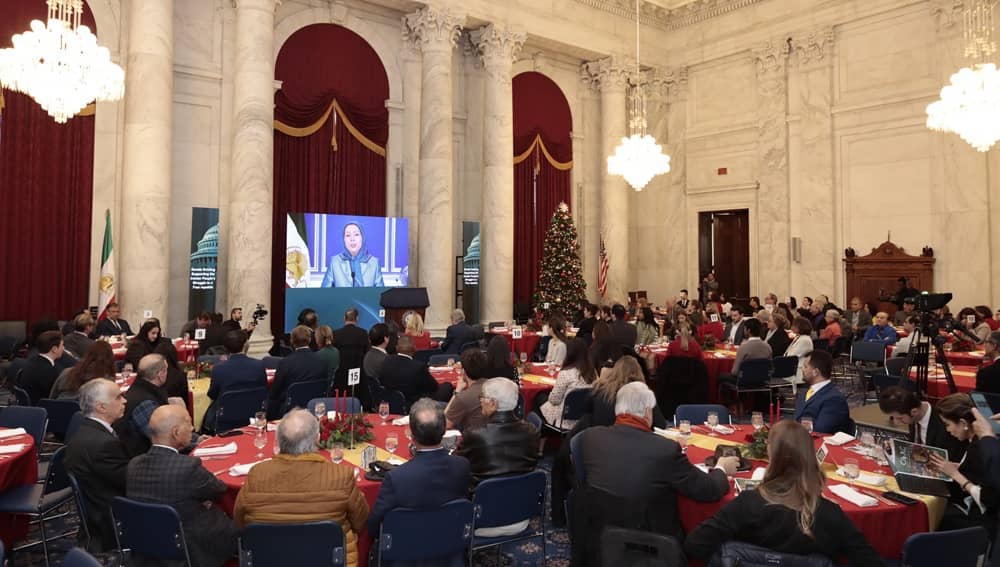
On December 11, 2025, a high‑profile bipartisan forum in the U.S. Senate’s Kennedy Caucus Room brought together senators, former senior officials, and policy experts to back Iran’s democratic alternative to the theocratic regime. The event centered on Mrs. Rajavi’s call for “change in Iran through organized resistance and an organized uprising,” led by Resistance Units inside the country and anchored in her Ten-Point Plan for a secular, non-nuclear republic based on universal suffrage and gender equality.
Speakers repeatedly rejected both the ruling theocracy and any return to monarchy, stressing that sovereignty must rest with the Iranian people. They highlighted the growing strength of the NCRI, the MEK, and Ashraf‑3, the brutal scale of repression—including thousands of executions—and the regime’s failing economy and regional proxies. Across party lines, participants urged greater political, diplomatic, and informational support for Iran’s organized Resistance while insisting that Iranians themselves must determine their future.
In her keynote message, NCRI President‑elect Maryam Rajavi said decades of torture, executions, and discrimination—especially against women—have led to “one solution: change in Iran through organized resistance and an organized uprising.” She stressed that “at the heart of this solution is democracy, both the goal and the only way, to achieve justice, progress, and a government by the people.”
Mrs. Rajavi described the PMOI-led Resistance Units as the “driving force of the uprising,” embedded in cities across Iran, and highlighted Ashraf‑3 in Albania as a vital center of the movement, home to pioneering women, former political prisoners, and widely respected activists.
This regime has fallen to its lowest point in 47 years. Yet it remains the main threat to global peace and security.#NoImpunity4Mullahshttps://t.co/3I0efgpl9L pic.twitter.com/FUtFSDRuGZ
— Maryam Rajavi (@Maryam_Rajavi) December 11, 2025
The NCRI President-elect emphasized that the Resistance’s aim is to transfer power to the people, not to seize it for itself. After the fall of the “religious dictatorship,” she proposed a brief transition ending with nationwide elections within six months for a Constituent Assembly to draft a democratic constitution and appoint a transitional government.
The Resistance, she underlined, “does not ask any foreign government for money or weapons,” but demands international recognition of the Iranian people’s right to overthrow a regime that has “occupied our country for nearly half a century.”
Mrs. Rajavi warned that only two options remain: continued religious fascism, terrorism, and nuclear escalation, or “real change brought by the Iranian people and their Resistance, leading to a democratic, pluralistic republic,” clearly excluding a return to monarchy.
🎥 General James L. Jones, former National Security Advisor and Supreme Allied Commander Europe, addresses the “Supporting the Iranian People’s Struggle For A Free Republic” Briefing in the US Senate's historic Kennedy Caucus Room, Washington, December 11, 2025#NCRIAlternative pic.twitter.com/9aqKckbjvn
— NCRI-U.S. Rep Office (@NCRIUS) December 13, 2025
General James Jones, former National Security Advisor and retired Marine Corps commandant, portrayed the regime as both dangerous and increasingly fragile, and the Resistance as a credible alternative. He said Tehran has long been “the epicenter of regional conflict, terrorism, and instability,” but what many see as its strength actually reflects “the international community’s long-standing failure to hold it accountable.” He argued that Iranian operations from the Red Sea to Iraq, Syria, Lebanon, and Yemen are “not signs of confidence, but desperate attempts to delay what we think will be an inevitable collapse,” and that today “that collapse is accelerating.”
Gen. Jones said the pillars of Tehran’s influence are “crumbling,” pointing to the fall of Assad, the weakening of Hezbollah and the Houthis, and the unraveling of the “axis of resistance.” Domestically, he highlighted the rial’s free fall, widespread poverty affecting nearly 80 percent of the population, and chronic shortages of food, medicine, water, and energy in a country rich in oil and gas. He cited nearly 2,000 hangings this year and thousands of executions under the current president as proof the regime is “terrified of its own people, terrified of organized resistance, and terrified of truth.”
Citing the bipartisan support for the NCRI, the general said, “House Resolution 166, led by a bipartisan majority, also acknowledges the role of the Resistance Units in confronting the IRGC. And it rejects both theocracy and monarchy as unacceptable futures for Iran. So, these congressional resolutions demonstrate that the real alternative to the regime is not chaos, it’s not monarchy, it’s not fragmentation, but a structured, organized democratic coalition capable of leading Iran into a new era and rejoining the family of civilized nations in the world.”
🎦 Dr. Ben Carson, former Secretary of Housing and Urban Development, addresses the “Supporting the Iranian People’s Struggle For A Free Republic” Briefing in the US Senate's historic Kennedy Caucus Room, Washington, December 11, 2025 #NCRIAlternative pic.twitter.com/gTzTaOZvah
— NCRI-U.S. Rep Office (@NCRIUS) December 13, 2025
Dr. Ben Carson, former U.S. Housing and Urban Development Secretary and renowned neurosurgeon, argued that the desire for freedom is universal, reaching back through Iran’s history “even when it was called Persia and the Medo‑Persian Empire.” He recounted the case of the Iranian Bijani twins, joined at the head, who accepted a high probability of death to pursue separation and independent lives.
Dr. Carson praised Iranian women, including teenage girls who refuse to wear the hijab despite the risk of punishment, as modern examples of such courage. He described his own journey from poverty to neurosurgery, crediting a mother who believed “true freedom comes with education” and enforced reading over television, and linked that to the power of ideas in liberation struggles. Drawing on U.S. history—from the Revolutionary War to the War of 1812 and the survival of the American flag over Fort McHenry—he argued that courage, faith, and determination can overcome powerful adversaries.
Dr. Carson said Iranians he has known are “extremely smart people” who “want peace and freedom” like Americans, and traced today’s “brutal, brutal regime” back through the Shah’s earlier authoritarianism. Warning that “if you ignore tyranny, it spreads,” he said tolerating oppression abroad “pav[es] the way for tyranny in our own backyard.” He ended with the story of an 18‑surgeon team successfully separating twins, using it as a metaphor: when people focus on the goal rather than credit, “our goal right now is freedom for the Iranian people.”
🎥 Senator Cory Booker (D-NJ) addresses the “Supporting the Iranian People’s Struggle For A Free Republic” Briefing in the US Senate's historic Kennedy Caucus Room, Washington, December 11, 2025 #NCRIAlternative pic.twitter.com/p1aquamTbz
— NCRI-U.S. Rep Office (@NCRIUS) December 13, 2025
Senator Cory Booker cast the struggle for a free Iran as a universal, moral cause rooted in shared values. Invoking Martin Luther King Jr.’s warning that “injustice anywhere is a threat to justice everywhere,” he said Iranians “know the sweet taste of freedom and liberty and treasure it like Americans do” and are “appalled by the darkness of tyranny like Americans are.” He told the audience that in a time of deep partisan division, this forum “unites people,” bringing together Democrats and Republicans who “share that commitment, that common commitment to love” and to standing with the Iranian people.
Drawing on his own heritage and the story of Frederick Douglass, Senator Booker compared the Iranian struggle to what he called a “sacred effort” similar to the fight against slavery and racism in the United States. Recalling how Douglass described Lincoln’s second inaugural as “a sacred effort,” he applied the same phrase to the work of those fighting for Iran’s freedom.
He spoke of returning each year with the hope of “a free Iran” and insisted that “there is no greater urgency than freedom, and no greater path to it than love,” which he defined as service, sacrifice, and commitment. He pledged that senators “stand shoulder to shoulder in the Senate in our commitment to a free Iran.”
🎥 Senator Jeanne Shaheen (D-NH) addresses the “Supporting the Iranian People’s Struggle For A Free Republic” Briefing in the US Senate's historic Kennedy Caucus Room, Washington, December 11, 2025 #NCRIAlternative pic.twitter.com/gtxEqTrqxH
— NCRI-U.S. Rep Office (@NCRIUS) December 13, 2025
Senator Jeanne Shaheen emphasized the strategic opening created by recent regional changes and the need to protect those fleeing the regime. She noted that “we’ve had big changes in the Middle East in the last year,” including the fall of Assad, direct U.S. and Israeli strikes on Iranian targets, and Iran’s crumbling economy, and said there is now “a real opportunity across the whole region for a different future, a free and democratic future,” one that must include Iran. She praised participants for giving “a voice to Iran’s democratic future” and ensuring the world hears the truth despite ongoing repression.
Senator Shaheen condemned the regime’s continued nuclear threats, support for Russia’s war, mass executions, crackdowns on political prisoners, and “gender-based discrimination and violence,” calling recent U.S. deportation flights returning Iranians to Iran “very concerning.” She warned that deported individuals face “grave danger” and noted reports of summons from the IRGC’s intelligence wing. Since 1979, she said, the United States has been a refuge for Iranian dissidents and minorities, and “we should be protecting Iranian asylum seekers from deportation, including the residents of Camp Ashraf 3.” She called to expand support for Iranian women activists, boost funding to document abuses, and increase sanctions on human rights violators, affirming that a secular, democratic Iran is both what its people deserve and in America’s interest.
🎦 The Honorable Roy Blunt, former U.S. Senator from Missouri, addresses the “Supporting the Iranian People’s Struggle For A Free Republic” Briefing in the US Senate's historic Kennedy Caucus Room, Washington, December 11, 2025#NCRIAlternative pic.twitter.com/zANeQt05kt
— NCRI-U.S. Rep Office (@NCRIUS) December 13, 2025
Senator Roy Blunt used his long involvement with the issue to highlight persistence and a shifting balance of power. He recalled that he has attended “every one of these” gatherings since the first. He said repetition is valuable, and that success would mean attendees leaving saying “all those speakers said the same thing” and remembering the key shared messages. Senator Blunt praised Mrs. Rajavi’s determination to secure “freedom for people who are willing to work for their own freedom, and also freedom for a non-nuclear Iran.”
The American senator argued that “the regime has never been so weak,” citing the severe weakening or removal of key proxies and Assad’s regime. He recalled how the NCRI, with PMOI support, exposed secret nuclear facilities in 2002, and said Iran’s “two trillion dollar effort…to become a nuclear tyrant appears to be a gamble that may never pay off,” especially after recent strikes. At the same time, he warned that “oppression continues, executions continue,” noting that more than 300 people—mostly young—were executed in just one month for standing up to the regime. Revisiting his work on behalf of Camp Liberty and Ashraf residents, he described helping to secure relocation for 3,000 dissidents to Albania and visiting them there, leading to the creation of Ashraf‑3.
🎥 Senator John Cornyn (R-TX) addresses the “Supporting the Iranian People’s Struggle For A Free Republic” Briefing in the US Senate's historic Kennedy Caucus Room, Washington, December 11, 2025 #NCRIAlternative pic.twitter.com/QSlZQDuMEY
— NCRI-U.S. Rep Office (@NCRIUS) December 13, 2025
Senator John Cornyn delivered brief remarks reinforcing his long-standing support for the Resistance and its exile community. He recalled traveling to Albania in 2017 to visit Ashraf 3 and meeting many of those present, saying General Jones had told him they are “the hope for the future of Iran.” He described Iranians under the current “theocratic government” as people who have been denied “hope and opportunity for the future.”
Senator Cornyn characterized the regime in Iran as the driving force behind many regional conflicts, updating his previous metaphor of the regime as “the head of the snake” to “the head of the octopus,” whose arms reach through Hezbollah, the Houthis, and other proxies. He reiterated that Tehran is the “number one state sponsor of terrorism in the world” and said he was pleased to continue supporting the opposition “in any way that I can.” His intervention underscored entrenched Republican backing for the NCRI, PMOI, and the Resistance Units those organizations support inside Iran.
🎦 Ambassador Marc Ginsberg, delivers the opening remarks at the “Supporting the Iranian People’s Struggle For A Free Republic” Briefing in the US Senate's historic Kennedy Caucus Room, Washington, December 11, 2025#NCRIAlternative pic.twitter.com/tRPshu5QiN
— NCRI-U.S. Rep Office (@NCRIUS) December 13, 2025
Ambassador Marc Ginsberg, moderating the forum, framed it as a showcase of a rising democratic alternative. Welcoming participants “on behalf of the National Council of Resistance of Iran,” he said he was honored to highlight the “enormous success that the global Iranian opposition, under the leadership of the NCRI and particularly Mrs. Maryam Rajavi, is achieving.” He noted his own history with Iran policy as a former aide to Senator Ted Kennedy and said the regime’s longstanding hostility to him—including a fatwa—was a mark of his alignment with its victims. Amb. Ginsberg argued that the “organization of the mullahs is crumbling,” that their “vaunted terror Axis of Resistance…is in shambles,” and that Iran’s economy is “on the brink of collapse,” even as the regime escalates brutality against internal opponents, especially the NCRI and PMOI.
In closing, Amb. Ginsberg said that “not since the Iranian revolution have the United States and its allies been accorded such a golden opportunity to help push the mullah cabal over the cliff,” predicting that when the regime falls, “the rejoicing inside Iran will be heard in every capital around the world.” He urged the adoption of an “Iran Freedom Act” to provide the organized opposition tools similar to those given to Eastern European dissidents under the Helsinki Accords, stressing that such support would not put Americans in harm’s way. Speaking personally of losing close relatives to attacks tied to Tehran’s Axis of Resistance, he said, “give them the tools…give them the hope, give them the voices, give them the inspiration,” and echoed Senator Cory Booker’s adaptation of a Jewish refrain by expressing the hope that “next year in Tehran” might become reality if the current opening is not missed.
🎥 Senator Ruben Gallego (D-AZ) addresses the “Supporting the Iranian People’s Struggle For A Free Republic” Briefing in the US Senate's historic Kennedy Caucus Room, Washington, December 11, 2025 #NCRIAlternative pic.twitter.com/3HGH2qivSF
— NCRI-U.S. Rep Office (@NCRIUS) December 13, 2025
Senator Ruben Gallego added a concise endorsement rooted in his national security background. He recalled engaging with Iran issues while serving on the House Armed Services Committee and said that experience revealed “the full scope and threat of the Ayatollah and his regime.” Yet he insisted it is equally important to remember “who the Iranian people are”: human beings who “want to be free,” “to worship in freedom,” and to live without an “overbearing government trying to crush them.”
Senator Gallego said that whenever Americans see “that type of movement” and “that type of resistance anywhere in the world,” they should, “as peace-loving people” who believe in liberty, “continue to encourage that community to survive, to fight, and hopefully eventually to change the direction.” Calling the activists present “kind of like a second family,” he predicted “a great tomorrow coming for Iran” and for relations between both countries, if the world first accepts that “the Iranian people deserve democracy and deserve liberty.” He pledged to keep helping “propel that forward” as a senator and urged supporters to “continue your advocacy because the Iranian people deserve that liberty just like anyone else in this world,” aligning himself with the broader message that backing Resistance Units, the NCRI, and Rajavi’s Ten-Point Plan is both a moral and strategic imperative.
🎦 Former State Department spokesperson Heather Nauert, addresses the “Supporting the Iranian People’s Struggle For A Free Republic” Briefing in the US Senate's historic Kennedy Caucus Room, Washington, December 11, 2025 #NCRIAlternative pic.twitter.com/MhtFqtqNtd
— NCRI-U.S. Rep Office (@NCRIUS) December 13, 2025
Former State Department spokesperson Heather Nauert focused on the frontline role of Iranian women and the power of democratic ideas. Drawing on her experience as a journalist and at the State Department, she said that everywhere she traveled people wanted “to be free from terror and oppression,” a desire “being lived out today in Iran.” She described women leading a movement that began “on the streets” and continues “in homes and universities and even in prisons,” citing reports of hundreds of executions in a single month and the arrest of marathon organizers because some runners refused the hijab. These stories, she argued, show that the fight for freedom is “a lived experience, often carried forward by women.”
Mrs. Nauert strongly endorsed Rajavi’s Ten-Point Plan, saying it reflects principles “Americans across the political spectrum…care about: universal suffrage, free elections, and equal participation for women,” along with a secular state and an Iran at peace with the world. Quoting Mrs. Rajavi’s call to “give power to the people, not the mullahs,” she called these “human” rather than partisan values and praised the bipartisan unity in the room.