

The Iranian regime suffered a significant defeat today, February 22, 2026, as a localized uprising in Abdanan forced the release of Yaghoub Mohammadi, a prominent teacher and former political prisoner. Mohammadi had been abducted by intelligence forces from his home just twenty-four hours earlier, sparking immediate street clashes and widespread unrest that the local security apparatus was unable to contain. In a desperate attempt to maintain face, the local prosecutor had conditioned the teacher’s release on the absence of any public welcoming ceremony, a demand that was met with total defiance by the city’s residents.
The citizens of Abdanan effectively broke the regime’s security blockade, flooding the streets to provide a hero’s welcome for the freed teacher while chanting slogans of “Yaghoub, we love you” and “Honorable, Honorable”. This victory is being viewed as a major blow to the authority of the clerical state, as the regime was forced to back down from its own legal and security dictates in the face of organized popular resistance. Local reports emphasize that the atmosphere in the city remains volatile, with the population emboldened by their success in forcing the government’s retreat.
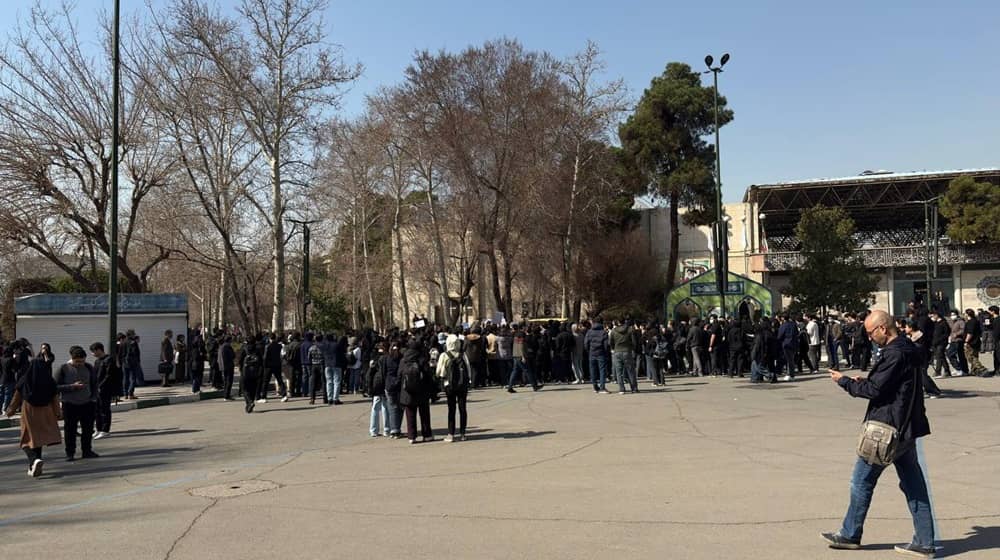
February 22—Tehran, Iran
Students rallied to commemorate martyrs of the uprising. In their slogans, they rejected both the mullahs' and shah regimes:
"Down with the oppressor, be it the shah or the supreme leader"
"Neither monarchy, nor the mullahs' rule, yes to democracy and… pic.twitter.com/tHmiUW1gE8— People's Mojahedin Organization of Iran (PMOI/MEK) (@Mojahedineng) February 22, 2026
Simultaneously, the student movement spearheaded a second consecutive day of nationwide uprisings, transforming university campuses into primary fronts of the revolution. At Khajeh Nasir University in Tehran, students expressed their absolute rejection of the system by trampling images of the Supreme Leader and chanting that Khamenei is a murderer whose dreams are in vain.
Similar scenes of defiance were reported at Sharif University, Elm-o Sanat, Beheshti, Tehran University, and Amirkabir, where protesters called for the immediate release of all political prisoners and the total overthrow of the ruling theocracy.
The Widening Gulf of Economic and Social Defiance
In Mashhad, the protests reached a fever pitch at Ferdowsi and Sajjad universities, where students confronted the regime’s paramilitary Basij forces with slogans predicting that the current year would be the year of the leader’s downfall.
#Breaking Iran Protests Update – Statement by a Group of Tehran University Students Regarding the Fake Videos Published:
“The monarchists seek to legitimize dictatorship and deprive this space — the voice of the people — of real freedom and democracy.”#No2ShahNo2MullahThe… pic.twitter.com/BFAIgC71IT
— SIMAY AZADI TV (@en_simayazadi) February 22, 2026
The demonstrations were characterized by a fierce sense of continuity and martyrdom, with students at Sharif University honoring their fallen comrades through the chant, “Tell my mother she no longer has a son”. This wave of academic resistance is now spreading beyond the capital, creating a nationwide network of defiance that the state’s security forces are struggling to monitor or suppress.
The political upheaval is being further fueled by a catastrophic economic collapse that has pushed various social sectors into open revolt. In Tehran and Shush, large crowds of retirees and victims of the Kourosh Company financial fraud gathered to protest systemic corruption and the regime’s failure to manage the nation’s wealth.
These protesters highlighted the disparity between their meager earnings and the soaring cost of living, chanting that their rights are paid in rials while their expenses are in dollars, a clear indictment of the regime’s failed economic policies.
Salute to the brave #Tehran University students. Today Stood fearlessly against repression, chanting:
“No to monarchy, no to supreme leader; Yes to democracy and equality“
“Down with the oppressor be it shah or the mullahs“
#IranProtests2026 #No2ShahNo2Mullah pic.twitter.com/w6it1oIGat— Mohammad Mohaddessin (@Mohaddessin) February 22, 2026
The depth of this economic misery has been validated by domestic media outlets, which recently admitted that the value of monthly cash subsidies has essentially vanished. According to a report by Fararo, the subsidy which was worth approximately $45 in 2010 has collapsed to a mere $2 today, leaving millions of Iranians in a state of absolute poverty. This financial devastation has transformed economic grievances into a revolutionary demand, as protesters now explicitly link their lack of bread and healthcare to the necessity of ending the clerical dictatorship.
Systemic Failure and the Rejection of Official Narratives
Cracks in the regime’s official narrative have become increasingly visible as prominent academic figures challenge the state’s attempt to blame “foreign enemies” for the unrest. State-affiliated sociologist Morteza Pedrian publicly asserted that the protests are the result of nearly three decades of accumulated social, economic, and political demands that have been consistently ignored since 1997.
February 22—Mashhad, northeast Iran
Students at Ferdowsi University rally to commemorate martyrs of the nationwide uprising and chanting anti-regime slogans: "This is the year Seyyed Ali [Khamenei] will be overthrown!"
"We did not give martyrs to praise the murderous leader!"… pic.twitter.com/ZirR9D3OwE— People's Mojahedin Organization of Iran (PMOI/MEK) (@Mojahedineng) February 22, 2026
He warned that labeling popular demands as security threats only deepens the social divide and ensures that the cycle of protests will continue until the clerical system itself is replaced.
The human cost of the regime’s attempt to cling to power has been further exposed by recent confirmations from within the health sector. A Ministry of Health official confirmed to Sharq newspaper that Al-Ghadir Hospital was forced to receive 150 injured and 36 deceased protesters during the height of the January violence. Despite having a morgue capacity for only five people, the facility was overwhelmed with casualties, including young victims like Aida Aghili, underscoring the extreme and indiscriminate violence deployed by the state’s security forces during the crackdown.
Despite this lethal repression, nightly protests continue to flare up in smaller towns and border regions, such as Mormori in Ilam province. On the night of February 17, rebel youths took to the streets to honor the martyrs of the uprising and declare their intent to fight until the regime is fully overthrown. A significant aspect of these localized uprisings is the clear political message being sent by the youth, who are increasingly rejecting all forms of authoritarianism with the slogan, “Death to the oppressor, be it the Shah or the Leader”.
The regime's security forces attacked the protest rally of students at Ferdowsi University in Mashhad.#IranProtests pic.twitter.com/jhLv22rwBF
— People's Mojahedin Organization of Iran (PMOI/MEK) (@Mojahedineng) February 22, 2026
Flashback to the Zenith of the January Uprising
The current momentum of the national movement draws its strength from the historic confrontations that occurred during the peak of the January uprising. On January 8 and 9, 2026, the Iranian people transitioned from protest to a more offensive stance against the regime’s machine of repression. During these critical forty-eight hours, the strategic balance shifted in several key cities as citizens and organized rebel groups began to reclaim their neighborhoods from the control of security forces.
In Mashhad, the uprising reached a turning point when the strategic Vakilabad Boulevard was seized by the people following intense hit-and-run battles with the regime’s Special Units. Protesters utilized stones and Molotov cocktails to disable the security apparatus, forcing a retreat of heavily armed forces and establishing defensive perimeters with walls of fire. These rebel youths sent a clear message that the regime’s days were numbered, chanting that they would seek justice for every brother killed by the state with the cry, “I will kill whoever killed my brother”.
Simultaneously, in Kermanshah, the Chaleh-Chaleh neighborhood was transformed into a bastion of resistance that effectively paralyzed the advance of the regime’s killing machine. By blocking key transport routes with fire and engaging the security forces directly, the people of Kermanshah demonstrated the effectiveness of organized, collective action. These events from early January provided the blueprint for the current national movement, proving that the regime is vulnerable when faced with a population that has discarded all fear in the pursuit of freedom.