

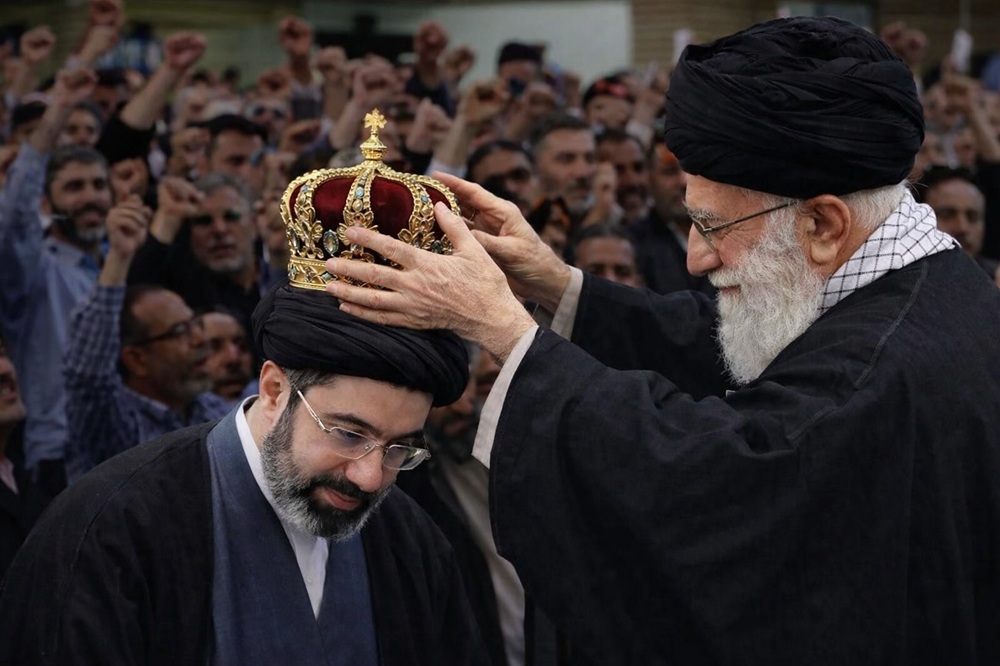
The appointment of Mojtaba Khamenei as the next Supreme Leader has laid bare a truth the Iranian people have long understood: the regime of Velayat-e Faqih has reached a historic dead end. In order to preserve itself, it could only fall back on the name “Khamenei” as a symbol of continuity, turning absolute clerical rule into something increasingly indistinguishable from hereditary monarchy. But this desperate act cannot rescue the religious fascism.
This is not simply a succession. It is a confession of terminal weakness. By elevating the son of Ali Khamenei, the regime has shown that it has exhausted every political, religious, and institutional mechanism for reproducing its authority. What remains is dynastic preservation under a different name: the same repression, the same corruption, the same dependence on fear and force.
Mojtaba Khamenei is no outsider to the crimes of this regime. For more than three decades, and particularly over the past two decades, he has been among the principal architects of repression, the export of terrorism and fundamentalism, and the plundering of the Iranian people’s wealth. He has played a central role in directing the suppression of major uprisings, including those of 2017, 2019, 2022, and the 2025–26 uprising. The IRGC and key security organs have effectively operated under his direct supervision. He bears responsibility not only for the regime’s political violence, but also for the systematic looting of national wealth and the crushing of workers, teachers, nurses, farmers, retirees, women, and the underprivileged across Iran.
Tonight, the absolute clerical rule (Velayat-e Faqih) has effectively turned itself into a hereditary monarchy by placing Mojtaba Khamenei on the throne.
But it cannot save the shipwrecked vessel of religious fascism.
Once again, this regime, just like the monarchical… pic.twitter.com/oXigoVaOJ7— Maryam Rajavi (@Maryam_Rajavi) March 9, 2026
Yet despite his complicity, Mojtaba lacks what his father possessed: the authority to impose discipline across the regime’s rival factions. Ali Khamenei was the system’s linchpin. With him gone, the Iranian regime enters an era of unprecedented internal fragility. Mojtaba may inherit the machinery of repression, but he does not command the same religious stature, political weight, or capacity to manage the regime’s internal contradictions. His leadership will inevitably lift the lid on conflicts that have long been suppressed.
Nor will the people of Iran accept him. The regime may attempt to present his installation as an orderly transfer of power, but in the eyes of the Iranian people it is nothing more than another theft of popular sovereignty. Just as the monarchical dictatorship lost all legitimacy before its fall in 1979, this regime too stands discredited and rejected. The slogan “Death to Khamenei” will remain a central rallying cry—not because of one individual alone, but because the name has become the symbol of a system built on tyranny, massacre, and theft.
In foreign policy as well, Mojtaba Khamenei offers no departure from the past. If the regime survives long enough, he has no path other than continuing the same strategy pursued by his father: regional warmongering, domestic militarization, and the export of terrorism. A regime that cannot solve its internal crisis turns outward through aggression and inward through repression. That cycle will deepen under Mojtaba, not end.
But the real issue before Iran is not who occupies the office of Supreme Leader. The real issue is that the future of Iran will not be decided by palace arrangements, clerical decrees, or hereditary succession. It will be decided in the streets of Iran by the people and their organized Resistance. That is the nightmare from which the ruling clerics cannot escape.
That Resistance is not hypothetical. Despite brutal repression, the Iranian uprising has not been extinguished. It has endured, expanded, and re-emerged with greater force. Resistance Units continue to challenge the symbols and institutions of repression, demonstrating that within Iran there exists an organized force capable of sacrifice, mobilization, and political direction. In conjunction with a nationwide uprising, that force can bring about the overthrow of the regime.
The Iranian Resistance has consistently affirmed that regime change can only be achieved by the people of Iran and their organized Resistance. This is not only a political necessity; it is the sole guarantee that the country’s future will belong to its citizens rather than to a recycled dictatorship in either clerical or monarchical form.
That is why the recent announcement by the National Council of Resistance of Iran of a provisional government to transfer sovereignty to the people is of central importance. Based on Mrs. Maryam Rajavi’s Ten-Point Plan, this framework offers a democratic road map for the period following the overthrow of the theocratic regime. It is not a mechanism for replacing one authoritarian structure with another. On the contrary, it is a guarantee that power will be transferred to the people through free elections and the formation of a Constituent Assembly within a maximum period of six months.
Announcement of a Provisional Government by the National Council of Resistance of Iran
to Transfer Sovereignty to the People of Iran and Establish a Democratic Republic
Based on Mrs. Maryam Rajavi’s Ten-Point Plan pic.twitter.com/5t5bZKYlhX— Maryam Rajavi (@Maryam_Rajavi) February 28, 2026
This vision is rooted in principles essential to Iran’s democratic future: a republic based on freedom and pluralism; separation of religion and state; equality between women and men; and recognition of the rights of Iran’s ethnic and national communities, including Baluch, Kurds, Arabs, and Turkmen. It is a platform designed not only to end tyranny, but to prevent its return in any form.
This is precisely why efforts to present a return to monarchical dictatorship as an alternative to religious fascism are both politically bankrupt and deeply harmful. Nothing serves the current regime more than the false claim that if clerical rule falls, Iran must once again submit to another authoritarian order. The Iranian people have not sacrificed so much only to be trapped between two forms of dictatorship.
For more than a century, the people of Iran have fought to free their country from despotism in all its forms. Their struggle, marked by immense sacrifice and more than 100,000 martyrs, has never been about replacing one tyrant with another. It has always been about popular sovereignty, democracy, and justice.
Equally vital is the principle that Iran’s future cannot be decided from abroad. Only the Iranian people possess the legitimacy to determine their political destiny. The bitter memory of the coup against the nationalist government of Dr. Mohammad Mossadegh remains a lasting warning against foreign-imposed solutions. No durable future for Iran can be built except through the will of its people and their organized resistance.
Today, the international community faces a clear responsibility: to recognize the Iranian people’s right to resist tyranny, to support the democratic alternative, and to end tolerance for a regime whose embassies have long served as instruments of espionage and terrorism. Supporting the democratic aspirations of the Iranian people is not only a moral duty. It is essential to regional peace, international security, and the defeat of extremism.
The appointment of Mojtaba Khamenei does not resolve the regime’s crisis. It deepens it. It confirms that Velayat-e Faqih has consumed even its own ideological claims and now survives only through naked continuity of bloodline, repression, and fear. But Iran’s future belongs neither to clerical tyranny nor to restored autocracy. It belongs to a free people determined to establish a democratic republic.