

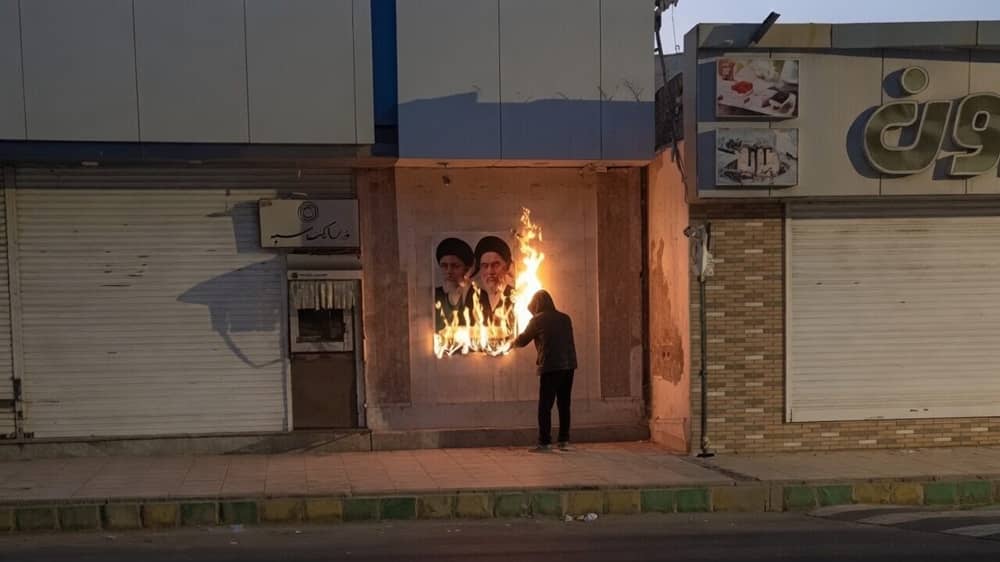
In the week following the volatile late-May unrest, MEK-led Resistance Units across Iran systematically expanded their operational footprint to counter a severe escalation in state-sanctioned executions. Between May 31 and June 7, 2026, underground networks executed coordinated fire attacks, targeted internal security infrastructure, and dismantled state iconography across more than a dozen municipalities. This wave of defiance, occurring amidst a brutal prison purge that saw dozens of prisoners sent to the gallows, underscores a compounding political crisis where the clerical establishment’s reliance on lethal deterrence is failing to contain a highly resilient domestic rebellion.
June 5, 2026
The strategic southeastern capital of Zahedan re-emerged as a primary center of public defiance as specialized resistance cells launched highly coordinated public demonstrations. Moving deliberately through heavily patrolled urban sectors, activists distributed literature and displayed placards that explicitly rejected both the current theocracy and any restoration of the monarchy. The slogans popularized during the day’s actions—notably declaring that dictatorship remains tyranny whether it wears a turban or a crown—directly challenged the institutional legitimacy of both the ruling cleric Mojtaba Khamenei and the exiled remnants of the pre-1979 regime. Local units framed their actions around the transitional democratic platform of the National Council of Resistance of Iran, staging these high-visibility maneuvers to prove that the state’s recent campaign of mass arrests and regional militarization has failed to break the political willpower of the Baluch population.
MEK Resistance Units carried out a coordinated wave of daring operations across Iran, defying the regime's brutal surge in executions and rejecting threats from proponents of the former Shah’s SAVAK secret police.#No2ShahNo2Mullahs pic.twitter.com/leXyEReyT2
— People's Mojahedin Organization of Iran (PMOI/MEK) (@Mojahedineng) June 4, 2026
June 1, 2026
A multi-regional offensive delivered simultaneous blows to the regime’s security architecture and ideological propaganda networks. In the western city of Dehdasht, a fire heavily damaged a state center utilized for regional indoctrination and security coordination, while a synchronized blaze targeted a similar institutional headquarters in Ramhormoz. In Zahedan, operational teams successfully set fire to an Islamic Revolutionary Guard Corps Basij facility dedicated to the surveillance and suppression of local student groups.
Concurrently, a sweeping arson campaign systematically destroyed large-scale state banners and billboards featuring Ruhollah Khomeini, Ali Khamenei, and Mojtaba Khamenei. These operations struck across a vast geographic expanse, neutralizing official displays in Tehran, Karaj, Mashhad, Shiraz, Hamedan, Khorramabad, Iranshahr, Kazerun, Gachsaran, and Dehloran. In Sarbaz, a prominent billboard of the Supreme Leader was reduced to ashes, while a localized strike in Dorud incinerated an information and intelligence directory used by paramilitary forces. This domestic sabotage coincided with a dark escalation in judicial violence, as prison authorities executed six individuals, including a highly controversial public hanging of a 38-year-old dissident in the northern city of Rasht.
Tehran
Resistance Units torch a banner of Ali Khamenei pic.twitter.com/P8yX3j5qIQ— People's Mojahedin Organization of Iran (PMOI/MEK) (@Mojahedineng) June 2, 2026
May 31, 2026
The judiciary accelerated its reliance on capital punishment to clear wards of political dissidents and capital offenders under the cover of regional geopolitical tensions. Masterminded as part of the state’s broader defensive containment strategy, a coordinated wave of hangings claimed the lives of at least 12 prisoners. The executions were carried out across prison facilities in Zanjan, Arak, and Shiraz. Independent monitoring groups confirmed that the victims included minority Baluch and Afghan nationals, signaling an intensification of targeted judicial violence against marginalized demographics to project an aura of absolute domestic control.
Resistance Units in Zahedan reject the dictatorships of Shah and mullahs https://t.co/uI567PkLlL
— People's Mojahedin Organization of Iran (PMOI/MEK) (@Mojahedineng) June 6, 2026
The rapid operational tempo documented during this brief window exposes a regime fundamentally trapped within an unbreakable security deadlock. Tehran’s systematic implementation of its “strategy of the noose”—marked by public hangings and retaliatory prison executions—is no longer achieving its intended psychological effect of mass intimidation. Instead, the visible defiance of activists on the gallows has catalyzed a deeper domestic fury, accelerating the growth of highly organized, native resistance cells capable of striking guarded security installations and state symbols simultaneously across multiple provinces. By maintaining an aggressive operational posture precisely when the clerical establishment is hyper-extended, these underground networks demonstrate that the state’s facade of absolute invincibility has cracked, revealing an internal crisis that structural terror can no longer resolve.