

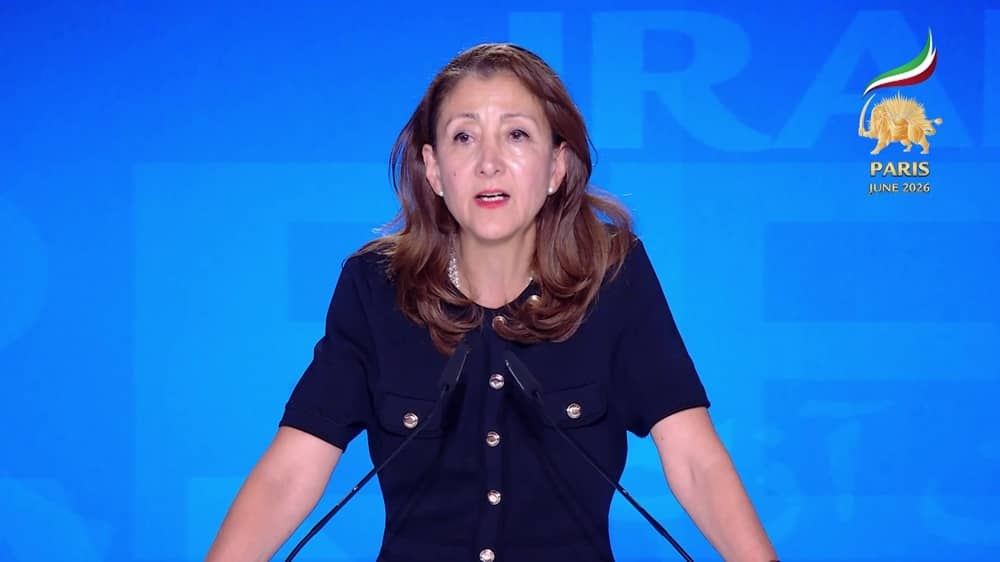
Speaking on the second day of the Free Iran 2026 World Summit in Paris, former Colombian Senator and presidential candidate Ingrid Betancourt delivered an impassioned address centered on the human cost of Tehran’s tyranny. Betancourt opened by detailing the daily psychological terror faced by political prisoners in Iran. She specifically honored Babak Alipour and Pouya Ghobadi—two of six young men executed by the regime on March 31, 2026—quoting their final, defiant messages rejecting both the mullahs and the monarchy in pursuit of a democratic republic.
Betancourt expressed deep “pain, shame, and disgust” over the French authorities’ recent decision to prohibit a peaceful rally in Paris protesting the mass executions. Criticizing the ban as a painful contradiction of France’s historic human rights principles, she warned that Western complacency allows the Iranian regime to export domestic repression to free lands. She reminded the audience of the foiled 2018 bomb plot against the opposition near Paris, emphasizing that appeasement and cowardice carry a heavy price.
Ultimately, Betancourt asserted that the decisive battlefield lies in shaping global public opinion and recognizing that a true path to freedom cannot be imposed by outside puppets or a return to past dictatorships. She declared that the international community’s long-sought solution is already present within the organized Iranian Resistance. Highlighting her democratic legitimacy, Betancourt reaffirmed Maryam Rajavi as the democratically elected leader chosen by the united opposition to guide Iran toward a free and just future.
Excerpts of Ingrid Betancourt‘s speech follow:

Ma chère Maryam, mes chers amis pour un Iran libre.
Distinguished guests, ladies and gentlemen, and our heroes and heroines back there in Ashraf 3.
Tomorrow, somewhere in Iran, another young prisoner may hear footsteps approaching his cell.
He will know what those footsteps mean. He will know that the regime wants him to choose between fear and surrender.
And he will know, as so many before him have known, that his life may end before the sun rises.
This is the reality of Iran today. It’s not diplomacy, it’s not geopolitics, it’s not headlines. It’s a woman or a man waiting for the sound of a key turning in a prison door.
Some of us, especially those back in Ashraf 3, know what the feeling is.
On March 31st, some days ago, 2026, six young men were led to the gallows: Babak Alipour, Pouya Ghobadi, and four other courageous comrades.
The regime believed that by executing them, it could extinguish their ideas. Instead, it amplified their voices.
From their prison cells, they left us not messages of despair, but messages of strength.
Babak Alipour wrote: “I pledge to fight and resist until the end for the overthrow of this anti-humane regime and the establishment of a democratic Republic.”
And Pouya Ghobadi declared: “I reject the mullahs, and I reject the shahs.”
Their words reveal a profound truth: the struggle for Iran is not a struggle between the past and the present. It’s not a choice between one dictatorship or another.
It is the struggle of a new generation determined to build a democratic Republic.
.@IBetancourtCol : The path to freedom goes through the organized resistance of the people, not through a puppet imposed from outside. The regime strongly fears the youth, courageous women, and the MEK resistance units that continue to organize despite unimaginable repression.… pic.twitter.com/RusMmwG97D
— Women's Committee NCRI (@womenncri) June 22, 2026
That is why the regime kills. Not because it is strong, but because it is afraid of young people who refuse to surrender. Afraid of women who refuse to submit.
Afraid of workers, students, prisoners, and Resistance Units who continue to organize despite unimaginable repression.
Killings, they know, will not save this regime. And the gallows are not instruments of governance.
But they are the final refuge of a dying system waging war against its own people.
And because the regime understands where the real threat lies, it seeks to suppress that threat not only inside Iran, but beyond its borders.
Yesterday, French authorities prohibited a peaceful rally in Paris, organized to protest the mass executions taking place in Iran.
What a painful contradiction in the country, my country—my second country, but my country too—of the Declaration of Human Rights and of Citizens’ Rights.
I am in pain, as we all French here are, and ashamed and in disgust, because I’m afraid that everything is done so that my [fellow] French countrymen and women are not informed of what happened yesterday.
When those who speak against executions are silenced, we must ask ourselves, not only as French citizens but as world leaders: Are these rights still universal principles, or have they become mere words on paper?
Former Colombian Senator @IBetancourtCol: “The @Mojahedineng is not just an option. It is the only option. It is the foundation of change and the face of hope for #Iran. The free world must embrace this mission now.” pic.twitter.com/v63p23X5Ob
— NCRI-FAC (@iran_policy) August 6, 2025
The Iranian regime has exported, we know, terrorism for decades. But now, it is exporting repression. And repression in our countries, in free lands of the world.
Silencing a peaceful rally in Paris means silencing worldwide outrage against executions in Iran, at a moment when brave young Iranians are paying with their lives the price to confront the same tyranny that democratic nations seek to contain. And our voices of solidarity have tried to be silenced.
What message does that send? That we are willing to confront tyranny when our own security is threatened, but not when freedom itself is under attack? That our interests matter more than our principles?
A free world cannot defend itself by abandoning its values. We cannot allow this to happen.
This regime has already demonstrated that its violence does not stop at Iran’s borders. Remember 2018?
Operatives linked to the Iranian regime were convicted for plotting to bomb a large opposition gathering near Paris attended by many of us here today, and thousands of other people and international dignitaries.
Its objective was clear: to silence the opposition beyond Iran’s borders through fear and terror.
Because if our free societies fail to defend their principles wherever in the world they are threatened, those same threats will eventually reach our own soil.
History teaches us that cowardice has a price. Complacency has a price. Appeasement has a price. And too often, that price is paid in human lives.
Let me be clear. We recognize and welcome the efforts of those who have confronted this tyranny and weakened its machinery of repression.
Former Colombian Senator @IBetancourtCol condemns “hostage diplomacy,” saying governments quietly pay ransoms while targeting #Iran’s Resistance: “Instead of supporting the Resistance… they pay for hostages’ release and pursue the Resistance. I strongly oppose this path.” pic.twitter.com/xHio5AD56w
— NCRI-FAC (@iran_policy) May 7, 2025
And yes, silence does a favor to tyranny, because it strengthens it.
And the decisive battle is not between foreign states and Tehran, but between the possibility we have here in France to speak for the Iranians that cannot speak in their country.
This is the battlefield today. It’s a battlefield of public opinion, where we need to make people understand what’s happening in Iran. Not only bombs and missiles, but lives, people that matter.
And history has taught some other lessons to us; for example, that the path to freedom is not a puppet imposed from outside. It’s not a return to the past.
The path to freedom in Iran is the organized Iranian Resistance of the people themselves.
That means that we have the solution. The solution the international community has been seeking for decades is here; it’s [among] us.
Because here, amongst us, we have the only solution possible for Iran’s crisis: the force, the organization, the commitment, the democratic values and principles that we share and we defend. But most of all, the legitimacy. It’s about legitimacy.
Maryam Rajavi has been elected by the opposition, by all the movements and organizations opposing this regime in Iran.
It has been a democratic way of solving [internal] problems, to unite the opposition and to elect Maryam Rajavi as its leader.
.@IBetancourtCol: The #MEKResistanceUnits are stronger than ever, mobilizing thousands across Iran—young people, women, men, and entire families—to end tyranny. They've also fought against gender inequality and misogynistic policies, achieving notable success. #FreeIran2024 pic.twitter.com/lkvqvc5gPj
— NCRI-FAC (@iran_policy) July 7, 2024
We have the solution, we have the leader, and we have the legitimacy.
And it’s with Maryam Rajavi, with the Resistance Units, with the prisoners of conscience, with the youth, with the women, with the men, with the students, that Iran will change, because that is the true force for change.
And that is why the regime fears you. And that is why it fears even a peaceful gathering held thousands of kilometers away from Iran.
Yes, the democratic alternative already exists. We have said it so many times here.
Maryam Rajavi’s Ten-Point Plan offers a vision for a secular and democratic Republic based on free elections, gender equality, separation of religion and state, the abolition of the death penalty, the abolition of misogynistic laws, the respect for human rights, and a non-nuclear Iran.
This is, with you, a transition from obscurantism to light.
And we have to say—and I want to address our heroes and heroines of Ashraf 3, also the prisoners who continue to resist in the prisons of Iran, and to the young people in Iran who refuse to surrender in the streets of Iran—that you are, all of you are, pure strength.
You are the driving force for a free, democratic change.
And your victory is very near.
And it will be the victory of freedom itself, not only in Iran, but for the whole world.
So here we are, all together here, and we say, and we claim for the world to hear what you always say: that we’re ready for freedom, we’re ready for justice, we’re ready for democracy. We’re ready for Iran.
[Ma hazerim], as you say: Hazer, Hazer, Hazer.
We have the solution, we have the leader, and we have the legitimacy.
And it’s with Maryam Rajavi, with the Resistance Units, with the prisoners of conscience, with the youth, with the women, with the men, with the students, that Iran will change, because that is the true force for change.
And that is why the regime fears you. And that is why it fears even a peaceful gathering held thousands of kilometers away from Iran.
Yes, the democratic alternative already exists. We have said it so many times here.
Maryam Rajavi’s Ten-Point Plan offers a vision for a secular and democratic Republic based on free elections, gender equality, separation of religion and state, the abolition of the death penalty, the abolition of misogynistic laws, the respect for human rights, and a non-nuclear Iran.
This is, with you, a transition from obscurantism to light.
And we have to say—and I want to address our heroes and heroines of Ashraf 3, also the prisoners who continue to resist in the prisons of Iran, and to the young people in Iran who refuse to surrender in the streets of Iran—that you are, all of you are, pure strength.
You are the driving force for a free, democratic change.
And your victory is very near.
And it will be the victory of freedom itself, not only in Iran, but for the whole world.
So here we are, all together here, and we say, and we claim for the world to hear what you always say: that we’re ready for freedom, we’re ready for justice, we’re ready for democracy. We’re ready for Iran.
[Ma hazerim], as you say: Hazer, Hazer, Hazer.