

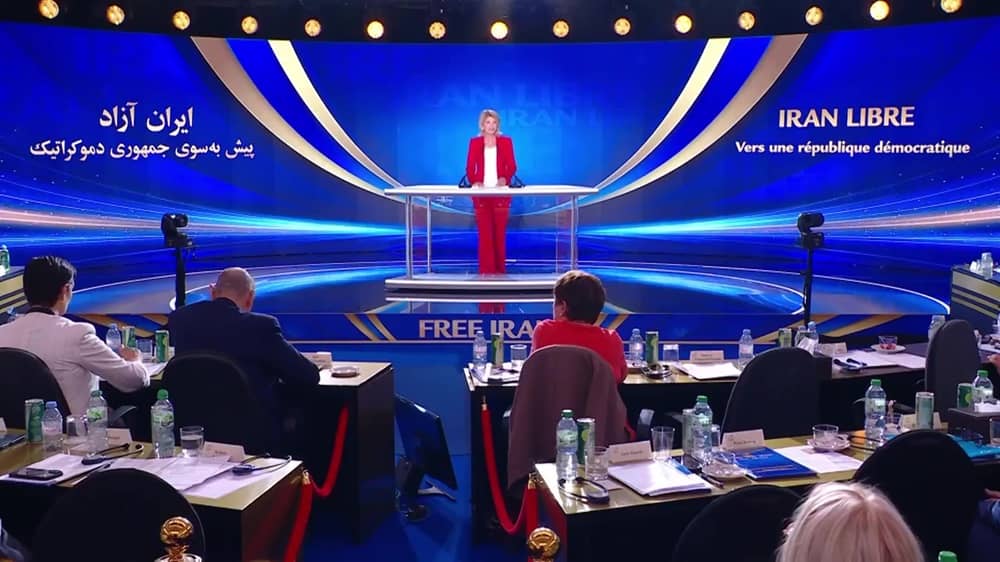
Speaking on the second day of the Free Iran 2026 World Summit in Paris, former U.S. Ambassador to Denmark Carla Sands declared that the ruling Iranian regime is on its “back heels” after nearly five decades of failure. Amb. Sands emphasized that a critical window of opportunity now exists for the international community to move past the false dichotomy of war or appeasement. Instead, she urged Western powers to embrace Maryam Rajavi’s “third way”: democratic change driven from within by the Iranian people and their organized domestic resistance.
Amb. Sands fiercely criticized Reza Pahlavi, the son of the deposed Shah, dismissing his claim to leadership as a media illusion. She noted that Pahlavi has no organized base or sacrificing constituency inside Iran, resides permanently in Los Angeles, and has recently called on the U.S. to “finish the job” rather than building a genuine domestic movement. Furthermore, the American former ambassador condemned recent intimidation tactics by his supporters in Europe, who have displayed symbols of SAVAK—the Shah’s notorious secret police—and threatened those who reject a return to one-party dictatorship. She noted the Iranian people have made their position clear by chanting against both the Shah and the current Supreme Leader.
In contrast, Amb. Sands lauded the National Council of Resistance of Iran (NCRI) as a structured, resilient, and cohesive alternative. She praised Mrs. Rajavi’s Ten-Point Plan as a practical blueprint for transition, highlighting its commitments to free elections, gender equality, freedom of expression, a free-market economy, and a non-nuclear republic.
The full script of Carla Sands’ speech follows:

The regime is on its back heels after 47 years. They’re weak but lashing out, talking tough. This is a real window of opportunity right now.
Mrs. Rajavi, thank you so much for being the stalwart leader of this incredible organization for so many years and leading the good fight.
Ladies and gentlemen, distinguished guests, today Iran stands at a decisive crossroads, one whose consequences extend beyond its borders.
For about five decades, the ruling regime has been this source of instability, first against its own people through systematic repression and the denial of fundamental freedoms, and then across the region and beyond, undermining peace and security.
What we witness now is the culmination of this long-standing failure to address the root of the problem.
The recent wave of executions of political prisoners—many [of whom are] members of the MEK, or for participating in the January uprisings—has exposed both the regime’s weakness and brutality, but also the courage of the people.
These acts of repression are meant to silence dissent, but instead, they reveal a society, above all its younger generation, that refuses to be intimidated. God bless the people of Iran.
Their defiance is a powerful reminder that the central struggle in Iran is not between external forces; it’s between the repressive regime and the people determined to reclaim their future.
Their brilliant future is laid out in the Ten-Point Plan.
✅This is true!
I was there! France caved!😡
We MUST stand WITH the people of Iran AGAINST the Mullah Regime.@jsolomonReports @iran_policy
Paris bans rally as Iranian dissidents accuse France of bowing to Tehran https://t.co/CeOlESFeq0 via @JustTheNews
— Carla Sands (@CarlaHSands) June 23, 2026
For too long, the international community has trapped itself in a false choice: war or appeasement. But Mrs. Rajavi has said for many years there’s a third way: change from within, driven by the Iranian people and their organized Iranian Resistance.
Failure to recognize this option and the NCRI as the leading force for democratic change has been the missing element in Western policy.
This alternative is structured, cohesive, resilient, and democratic, and the network of organized Resistance Units on the ground has shaken the regime.
Now we have the executions of eight members of the MEK just recently, and 12 more on death row. This is precisely because of the regime’s fear of this Resistance.
We must also guard against the illusion promoted by the son of the deposed Shah through propaganda and coordinated online campaigns.
In recent months, his supporters have displayed images of SAVAK, the Shah’s notorious secret police responsible for the torture and executions in the 1970s, and they’ve harassed and threatened those rejecting a return to dictatorship on the streets of Europe. I’ve seen the photos.
They hold no power and they never will, but they’re already resorting to intimidation against those who oppose a return to the one-party rule of his father’s regime.
I’m proud to stand with @NCRIUS as they fight for democracy in Iran.
pic.twitter.com/lmCBAfh8MC— Carla Sands (@CarlaHSands) May 17, 2026
Even more troubling, Reza Pahlavi has recently called on the US and its leadership to “finish the job”, meaning he wants the US to overthrow the regime for him, and such displays play into the regime’s hands.
He has no organized base inside Iran, no constituency willing to sacrifice for him. By his own admission, his life is elsewhere; he lives in LA.
He has nothing to return to Iran for, and the Iranian people have made their will unmistakably clear, chanting: “No to the Shah, no to the Supreme Leader, no to oppression.”
This brings me to the path forward.
The National Council of Resistance of Iran under the leadership of Mrs. Maryam Rajavi offers a viable democratic alternative.
Mrs. Rajavi has dedicated her life to uplifting the movement for change with her brilliant Ten-Point Plan, and it provides a clear roadmap to a bright future: free elections, freedom of religion, equality between men and women, a free market economy—I love that one, with 100% inflation in Iran and people being impoverished by this repressive regime—freedom of the press, of expression, of assembly, protection of the environment, and a non-nuclear republic that’s peaceful and friendly with its neighbors.
This isn’t an abstract vision; it’s a practical blueprint for transition.
I’m proud to stand alongside Ambassador @SamuelBrownback with the patriotic resistance of Iran and mourn the loss of young Iranians like champion wrestler Saleh Mohammadi. @iran_policy @NCRIUS pic.twitter.com/TWkxeKsgtj
— Carla Sands (@CarlaHSands) April 16, 2026
She began implementing that blueprint years ago within the movement’s ranks, and the most vivid example is women’s leadership in the movement.
The international community and the United States would be wise to support this movement. It represents the only viable solution to the crisis in Iran.
The choice is between continuing the policies of the past or embracing the strategy that’s supported by the will of the Iranian people, whose central element is Iran’s organized Iranian Resistance.
The sooner we change course, the sooner we can help end this tyranny. We will open the door to peace, stability, and freedom.
Now is the time for freedom in Iran. Thank you.