

Three-minute read
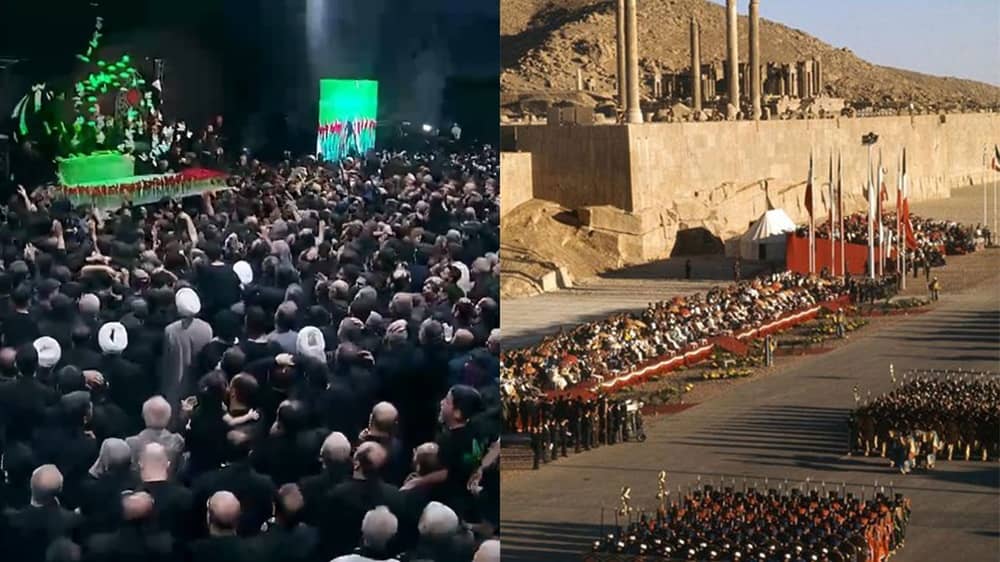
In October 1971, Mohammad Reza Shah Pahlavi staged one of the most extravagant political pageants of the twentieth century. At Persepolis, amid the ruins of Darius the Great’s ceremonial capital, sixty-nine heads of state dined on roast peacock and drank Château Lafite while the Shah wove his Pahlavi dynasty—installed by a CIA-backed coup barely eighteen years earlier—into twenty-five centuries of Persian imperial glory. The bill ran to an estimated two hundred million dollars. Across Iran, families in the tin-roofed shantytowns that his own botched land reforms had created watched the festivities on state television, if they had a television at all.
The celebration was meant to project invincibility. It projected contempt. Every golden plate at Persepolis was an itemized invoice of what the regime had denied its own people: functional housing, political freedom, a judiciary untethered from SAVAK’s torture chambers. Rather than binding the nation to the crown, the 2,500-year spectacle widened the fracture between a autocrat and a discontented population. Within eight years, the Shah was gone—toppled not by a foreign army but by the accumulated fury of a people who had been asked to applaud a stage set built over their misery.
Half a century later, the clerical dictatorship is staging its own version of Persepolis. The multi-day state mourning for Ali Khamenei—the orchestrated grief, the managed crowds, the wall-to-wall hagiography—is not merely a funeral. It is a legitimation exercise, an attempt to drape a fracturing regime in the mantle of sacred continuity. And it is failing for precisely the reasons the Shah’s pageant failed: because spectacle cannot feed the hungry, free the imprisoned, or silence the dead.
"The funeral of the century is a burial of something larger than one man. It is the burial of the pretense that the Iranian regime commands the faith of its people or the obedience of its own institutions," Farid Mahoutchi writes on #Khamenei's burial theatrics.…
— NCRI-FAC (@iran_policy) July 2, 2026
The Parallels the Regime Cannot See
By several measures, the socioeconomic ledger of the clerical regime in 2026 is worse than the Shah’s was in 1971, but the situation today is also profoundly different and far more severe. Inflation has eroded the rial into irrelevance. Youth unemployment is systemic. The environmental collapse of Lake Urmia, the water crises in Khuzestan and Isfahan, and the hollowing out of the middle class have produced a geography of despair that dwarfs the Shah’s shantytowns. Where the Shah’s White Revolution was a top-down reform that created new dispossessions, the clerical establishment has managed the rarer feat of presiding over decades of stagnation dressed up as divine governance.
And where SAVAK was a scalpel—brutal but targeted—the clerical regime’s repressive apparatus has become a bludgeon. The November 2019 massacre, in which security forces killed an estimated 1,500 protesters in a matter of days, and the bloody crackdown on the January 2026 uprising were not acts of a confident state. They were the reflexes of a regime that has replaced politics with violence because it has nothing left to offer.
"The Iranian political establishment is experiencing unprecedented institutional friction following the transition of authority to Mojtaba Khamenei," writes @MansoreGolestan.https://t.co/6UZCU4cjdx
— NCRI-FAC (@iran_policy) June 30, 2026
Isolation the Shah Never Faced
Here is the critical difference the clerical establishment refuses to confront: the Shah, for all his domestic failings, was embedded in a web of international support. Washington supplied his arms, his intelligence training, his nuclear ambitions. Neighboring Arab states saw him as a stabilizing force. The Pahlavi regime fell despite its alliances.
The clerical dictatorship has no such cushion. Its regional proxies have collapsed or been degraded—Hezbollah is a shadow of its former self, Assad’s Syria is gone, and the Houthis are a liability rather than an asset. Diplomatically, Tehran is more isolated than at any point since 1979. The regime that once exported revolution now exports only threat, and the world has stopped buying.
The Fire That Each Crackdown Feeds
Since December 2017, Iran has experienced a rolling sequence of nationwide uprisings—2017–18, 2019, 2022, 2026—each broader, younger, and more explicitly aimed at the regime’s totality. These are not reform movements. Their slogan is not “Where is my vote?” It is “Death to the dictator.” Every round of repression kills protesters and manufactures new enemies. The mothers of the slain do not forget. The classmates of the imprisoned do not reconcile.
"The regime is weaker than at any point in its history — its founder dead, his successor repudiated, its proxies degraded, its #economy in ruins, its streets seething with a generation that has nothing to lose. For four decades, Western capitals bet on every alternative to the…
— NCRI-FAC (@iran_policy) June 30, 2026
Simultaneously, the regime’s own base is hemorrhaging. Voter turnout has plummeted to historic lows. Seminaries report dwindling enrollment. Former insiders—commanders, clerics, even former presidents—have distanced themselves publicly or gone silent. The clerical regime is not merely losing the street; it is losing the mosque.
But the most decisive difference between today and the Shah’s era is the existence of an organized resistance. Across Iran’s cities, the MEK Resistance Units have become a daily, active presence, carrying out acts of defiance that keep the flame of resistance alive and prevent the regime’s machinery of repression from turning fear into despair. Their role is not merely symbolic. Through their daily practices, they channel social anger toward uprising, give direction to scattered grievances, and help sustain the continuity of revolt from one wave to the next. This organized force is precisely what the regime fears most: not simply public discontent, but a disciplined network capable of transforming that discontent into a sustained struggle for change.
The Shah learned too late that a throne built on spectacle collapses when the audience stops clapping. The men who replaced him, now staging their own pageant over Khamenei’s coffin, have learned nothing at all. The Iranian people, however, have learned everything.