

Three-minute read
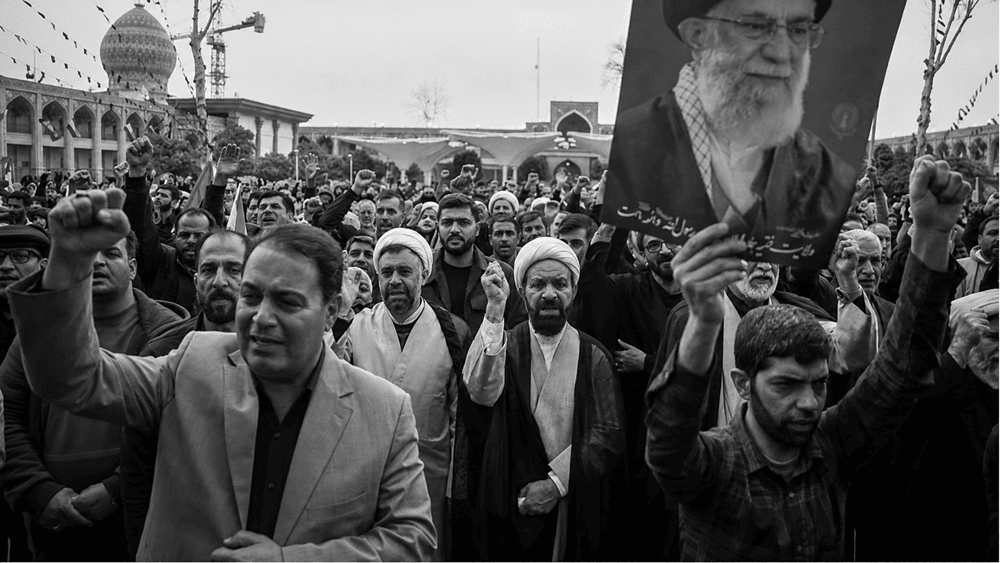
Iran’s state media has taken to calling it tashyi’-e qarn — “the funeral of the century.” Four months after Ali Khamenei was killed in the American-Israeli strike of February 28, the Iranian regime is staging a five-day, four-city procession for his remains that is, by any measure, the most elaborately choreographed political theater the regime has produced in its forty-six-year history.
The numbers broadcast intent. Officials are already claiming between twelve and twenty million mourners. The IRGC’s Mohammad Rasulollah Corps has built what its commander, Hassan Hassanzadeh, described as a funeral vehicle modeled on “the shrine of Imam Reza,” the coffin elevated so it is “visible from all angles” — a set piece engineered for the camera, not for grief. The official slogan is “One Must Rise”; the chosen symbol, a clenched fist. On July 1, 2026, Al-Alam, the regime’s Arabic-language network, called the event “a destiny-shaping moment in the history of the Islamic Republic” and venerated Khamenei as “a symbol of independence and sovereignty.” The grammar is not elegiac. It is martial.
That is because the funeral is not, in any meaningful sense, a funeral. It is a desperate power demonstration addressed to three audiences at once: the Iranian public, which has risen in successive uprisings against the theocracy; the Resistance, which the regime needs to believe the cost of confrontation remains prohibitive; and the global community, which Tehran hopes will mistake manufactured spectacle for organic legitimacy. The goal was never to honor the dead. It is to project survival.
"Iranian state media and insiders reveal a regime that possesses no real internal strength, economic resilience, social capital, or diplomatic cards left to play. It is openly counting on political turmoil inside the #UnitedStates and the global headache of disrupted shipping and…
— NCRI-FAC (@iran_policy) May 4, 2026
The decision to fly Khamenei’s remains to Najaf and Karbala is the most revealing act of the production. The regime’s cultural attaché in Iraq told Fars News Agency on July 2, 2026, that the body would undergo “circumambulation at the shrines of Imam Ali, Imam Hussein, and Hazrat Abbas.” Tabnak reported that the Iraqi government had formed a “supreme funeral committee” at the “extensive request of the Iraqi people, elites, tribes, clerics, and personalities.”
The reality is less flattering. Khamenei visited Iraq exactly twice — at seven and eighteen — and never returned. His claim to transnational religious authority was always contested in the seminaries of Qom, where senior scholars regarded him as neither a qualified mujtahid nor a legitimate ayatollah before the regime elevated him overnight to Supreme Leader in 1989 — a theological shortcut whose architect, Rafsanjani, Khamenei later sidelined. Parading his corpse through Najaf is not tribute to a revered marja’. It is a desperate assertion of influence delivered to an Iraqi prime minister who has pledged to confront the very Iran-aligned militias that make such processions possible.
Then there is the question the regime cannot answer: Will Mojtaba Khamenei, the new Supreme Leader, even attend his father’s burial? Ali-Akbar Pourjamshidian, secretary of the funeral committee, told reporters on June 30 that the matter “is not within the authority or information of the organizing committee.” Ahmad Alamolhoda, Friday prayer leader of Mashhad, admitted publicly that “we have no information about the contents of Ali Khamenei’s will.” Khamenei’s brother-in-law went on television to beg the public to “pray for the second daughter,” describing her as “a stranger fallen in the desert” — language suggesting injuries the state will not name. The strike that killed the Supreme Leader also killed his daughter, son-in-law, grandchild, and Mojtaba’s wife. The dynasty cannot even show its face.
Power Dynamics in Iran and #MojtabaKhamenei’s Inner Circlehttps://t.co/eTfcnFH14Z
— NCRI-FAC (@iran_policy) June 3, 2026
Mojtaba inherits a system buckling under the very crises his father failed to escape: proxies shattered, nuclear leverage under negotiation he did not want, commanders suspected of disloyalty over the recent agreement with Washington. His written message on the accord — “I had a different opinion in principle” — was an astonishing confession of impotence. The IRGC’s own representative rushed to deny any rift between the commanders and the new leader, which only confirmed one. Mojtaba carries nothing but his surname, and his sole mission is not to govern but to avoid being overthrown.
The funeral of the century is a burial of something larger than one man. It is the burial of the pretense that the Iranian regime commands the faith of its people or the obedience of its own institutions. The clenched fist on the banners is not raised in solidarity. It is clenched in fear.